
Was the first Olympic torch relay Nazi propaganda?
yes

Paris. Milan. Tokyo. Lake Placid.
What do all these cities have in common?
Is it their cultural prestige? Their culinary excellence? Their striking views of the Adirondacks?
Negative on all three counts. No, it’s something far greater, far more lucrative for NBC, and with far more interlocked multi-colored rings. It’s the Olympics, baby.
I love the Olympics, okay? Every two years, the world’s great cities (and also Lake Placid) compete for the privilege of bankrupting themselves to host the world’s most athletic sleepover, and I eat up every second of it.
I love the obscure sports, I love seeing Bob Costas with pinkeye, I love seeing the next generation of Dancing with the Stars contestants find their footing on a global stage.
But more than anything, I love the pageantry1 and glamor of it all.
And the best part of the show is the elaborate, high-budget ceremonies the host cities choreograph to begin and end it all, with the centerpiece being the all-powerful, omniscient Olympic flame towering high above in its cauldron.
I think it’s very cute that they let the flame watch the entire Olympics from its little chair in the sky. It must be very tired after the long journey it took to get there all the way from Greece!
The very end of this torch-based journey gets lots of attention, as it typically features prominent, hand-picked figures toting the torch through the host city’s streets and into the stadium.
But the earlier parts – the vast majority of the torch relay’s route – are seldom seen or heard about by anyone besides the most devoted Olympicheads.
Thankfully, though, you are all fortunate to have one degree of separation from someone who has read the Wikipedia pages for every single Olympic torch relay that has ever occurred, and that someone (me) is going to get you up to speed on this incredible, wacky phenomenon just one month before the torch relay for Milano Cortina 2026 concludes. Let’s get into it.
The fire contains the ghosts of Olympics past, I think
I’ll start by saying that symbolism is a hugely important component of the Olympic torch relay, which is perhaps unsurprising for a process that involves lugging a torch around an entire country, mostly on foot, instead of simply asking any man, woman, or child who happens to be in the vicinity if you can borrow their lighter for a second.
Seriously, look at any city that’s ever hosted the Olympics and tell me with a straight face that these places aren’t filled with people who started smoking when they were ten years old. You simply cannot. Paris? Beijing? Squaw Valley? Anyway
The International Olympic Committee (IOC) is obsessed with symbolism to an extent that I cannot adequately cover in this piece alone, but the most important thing for you to know is that the sanctity of the flame takes precedent above all else.
Do you want to guess how the Olympic torch gets ignited in the first place? If you said “harness the energy of the Sun using parabolic mirrors” then you are spot on, congratulations.
Months before the Games kick off, the Greeks hold a ceremony at the Temple of Hera, featuring a group of women dressed as Vestal Virgins saying some stuff in Greek and then lighting the first torch. Here’s a clip of the ceremony for Tokyo 2020.
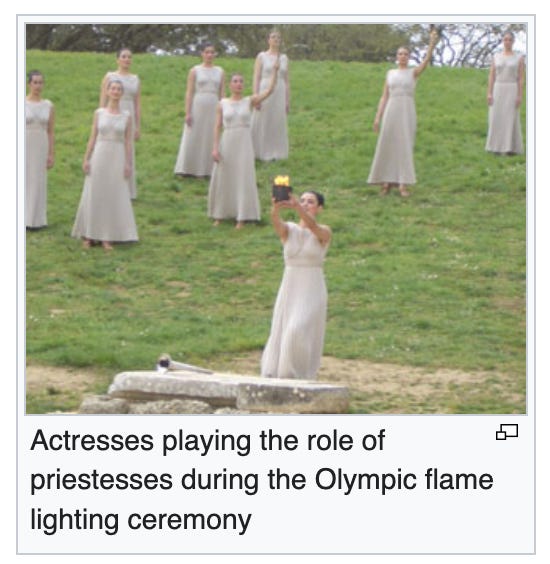
What happens if it’s cloudy? Don’t worry, they’ve got a pre-lit flame ignited a few days beforehand by (you guessed it) parabolic mirrors that can be used as a backup, as seen in 2024 for the Paris Games.
Either way, the flame of the torch, and thus the eventual flame of the cauldron, will always be able to trace its source back to the concentrated power of the Sun’s rays at a ceremony in Olympia. Symbolism!
But for all this emphasis on symbolism today, the first Olympic flame was actually introduced for very practical and non-symbolic reasons.
Simply, people needed to know where the Olympics were happening, so organizers in Amsterdam (1928) placed a cauldron atop a tower at Olympic Stadium, and a new tradition was born.
Four years later, the people in charge of Los Angeles 1932 said “sure that sounds fun” and they also did a cauldron, and four years after that, the people in charge of Berlin 1936 (Hitler, etc.) said “we’ll do the cauldron, but we’re also gonna add a fun new element to emphasize the Aryan connection between Germany and Greece” and the IOC said “alright, go nuts,” and the Olympic torch relay was created.
Hitler thought the torch relay was a great way to highlight what he saw as the Third Reich’s strong link to ancient Greek ideals.
It also allowed Germany to flex its organizational and political muscle. Tracing a route through Central Europe was no small feat, and by taking on these challenges of logistics and political instability, Germany sought to increase its influence among the countries through which the torch was carried.
“Sporting chivalrous contest helps knit the bonds of peace between nations,” Hitler proclaimed just before the torch relay began, and over the next decade, his Nazi regime would come to dominate every single country along the route.
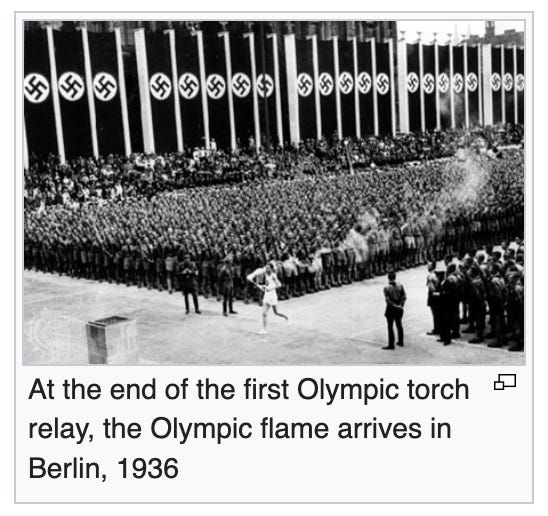
The torch relay’s Nazi beginnings are, from what I can tell, largely forgotten today, and no vestiges of the evil ideology remain in any part of the ceremony.
And I certainly don’t mean to suggest that there’s anything problematic about being a modern-day torch relay stan – this would be very bad news for me!!!
I just think it’s interesting to peek behind the curtain and dig into the history of things like the torch relay that we usually don’t think twice about. Sometimes, though, you find Nazis behind the curtain. It happens a lot more often than you’d expect when you’re waist-deep in Wikipedia.
Anyway, should we learn about all the subsequent torch relays that had nothing to do with fascism or antisemitism? Yeah, let’s do that.
All the non-Nazi torch relays
The 1940 and 1944 Olympics were cancelled due to the aforementioned Nazis, but organizers for London 1948 were ready to go with their torches.
Following a 12-day journey from Greece to the UK, the torch arrived at Empire Stadium only 30 seconds behind schedule. And according to Wikipedia’s editors, this half-minute hold-up “may have only been in the final few hundred yards of the relay … as the pressure of the crowds on the torch carrier and their escorts reduced the pace to walking speed.”
Similarly remarkable precision was achieved four years later at the Helsinki Summer Games. In the relay’s final stages, the torchbearer followed close behind a police car whose occupants kept in radio contact with the organizers at Helsinki Olympic Stadium.
Through this correspondence, the torchbearer was instructed to speed up or slow down as needed, which led to the torch arriving at the stadium with perfect timing.
1952 also saw the first torch relay for the Winter Olympics, which were held in Oslo that year. (Summer and Winter Games were held in the same year until 1992.)
Remember how Olympic organizers are obsessed with symbolism? That part is relevant again here.
Rather than being lit by parabolic mirrors in Olympia, the flame for the 1952 winter relay was lit in a hearth in Morgedal, Norway, the birthplace of competitive skiing.
And because the source of the flame was not Olympia, the IOC said it could not be considered a true Olympic torch relay. Instead, it was pitched as an entirely distinct event that celebrated the use of torches while skiing in the dark (sure, ok, whatever you say)
The relay was conducted entirely on skis, except for the very last part where the final torchbearer had to take off his skis to go up a flight of stairs and light the cauldron. But apart from that, all skis, baby. Milan could never.
Melbourne 1956 saw perhaps the funniest prank in all of Olympic torch relay history, and maybe one of the funniest pranks of all time.
A group of Australian university students wanted to protest the spectacle of the torch relay for, among other reasons, the fact that it was invented by Nazis.
To do so, they built a fake torch out of a wooden chair leg covered in silver paint, topped with an empty plum pudding can containing kerosene-soaked underwear.

As Wikipedia puts it, “The result was a roughly torch-shaped object.”
With 30,000 onllookers cheering him on and a fake military escort in tow, veterinary student Barry Larkin paraded the flaming underwear torch through the streets of Sydney, eventually handing it to Mayor Pat Hills and quickly disappearing into the crowd.
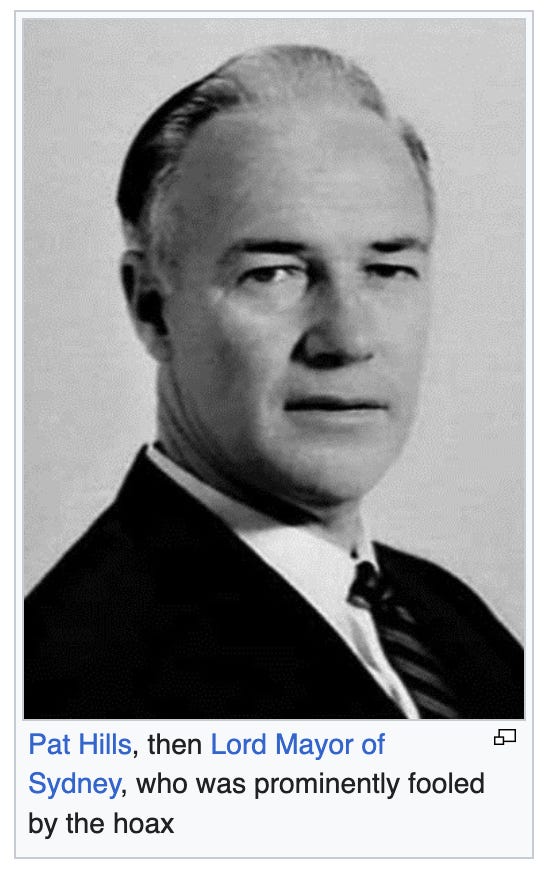
Mayor Hills did not realize it was a prank, despite the fact that the still-wet paint now coated his hand as he began his prepared remarks to a crowd.
Soon, someone whispered in the mayor’s ear that the torch was a fake. The mayor relayed this information to the crowd, who understandably became upset. Eventually, the real torch arrived, but by then half the crowd had already gone home. Barry Larkin’s identity as the prankster remained a mystery to all but a small circle of people for decades afterwards.
Mexico City 1968 was the first time the Olympic cauldron was lit by a woman (awesome) but also saw several torchbearers injured by small explosions as lit torches came into contact with unlit ones (less awesome).
The relay torch for Montreal 1976 had one thing in common with my tummy which is that it was fuelled partially by olive oil. Organizers made this decision to emphasize the Greek origins of the Olympics, and I make this decision simply because I love olive oil.
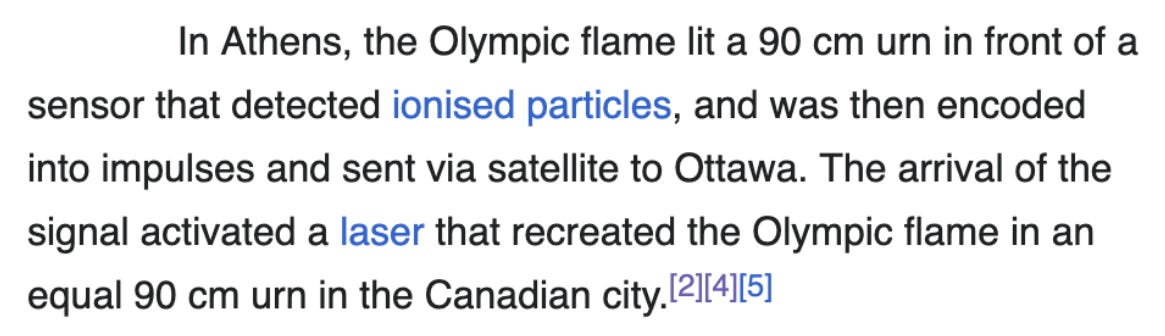
Another unique feature of the Montreal 1976 relay was that it used satellites and lasers to transport the flame across the Atlantic.
The explanation of how this was achieved is too sciencey for me to attempt to paraphrase, so I’ll just let Wikipedia take this one:
The Games go corporate
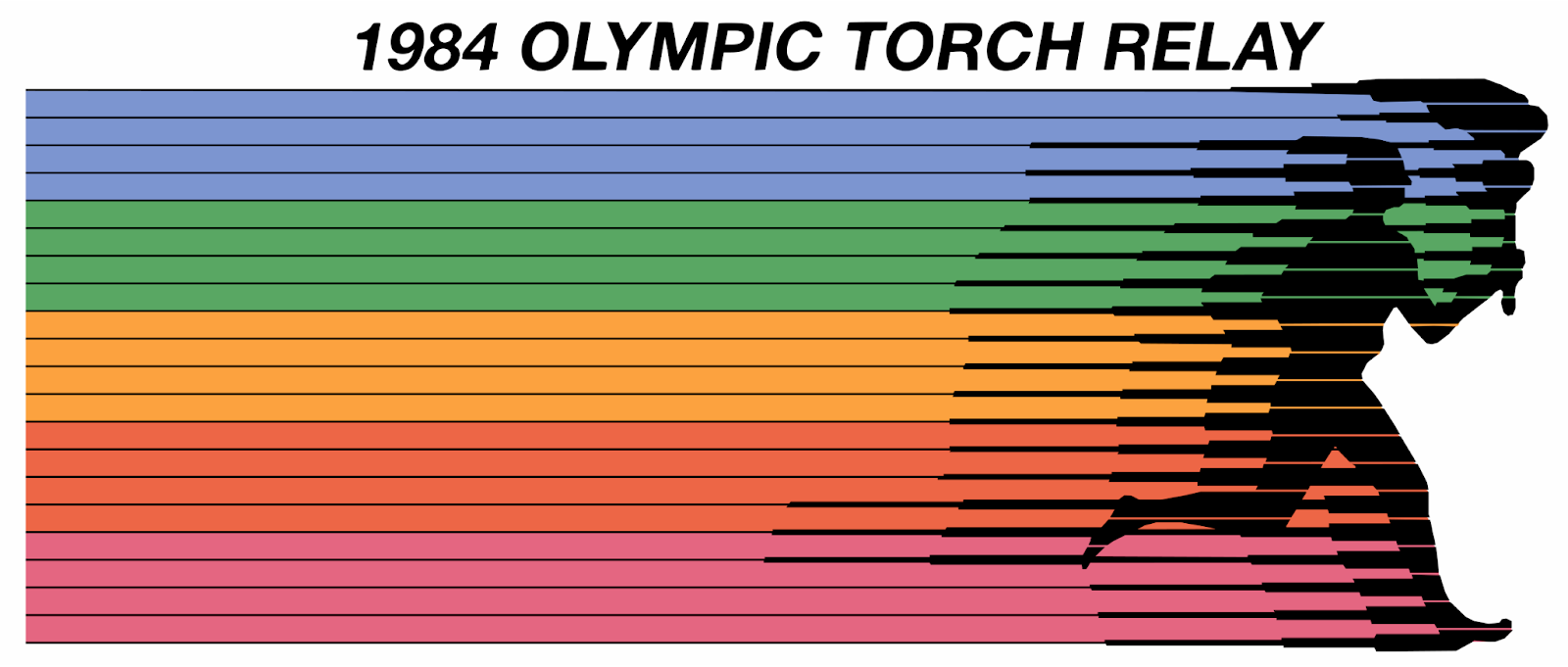
Los Angeles 1984 was a groundbreaking Olympics, and the torch relay was no exception. First of all, the torch relay got its own logo and it was incredibly dope:
And in true American fashion, this torch relay was an absolute desecration of the traditional torch relay as the world had come to know it. USA! USA!
The AT&T Olympic Torch Relay, as it was known, was the first torch relay whose funding came primarily from corporate sponsorships. The general manager of the LA organizing committee said, “we have not commercialized the torch run,” despite that being exactly what they did. Oh well.
Fifty kilometers of the relay were sponsored by the Caesars Tahoe Palace casino, which announced it would raffle torchbearing privileges off to lucky gamblers. In addition to the torch, winners would receive a two-night stay at the casino and a $1,984 cash prize.
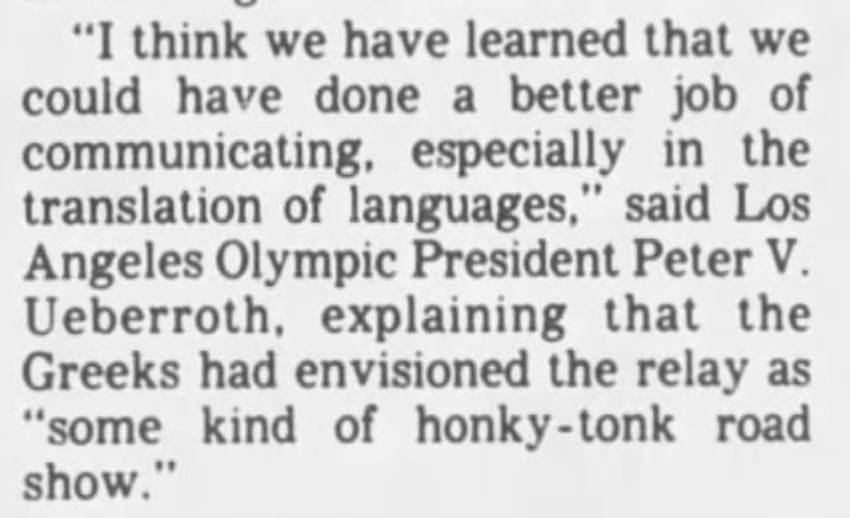
The Greeks got so mad about this that they said, “we will simply not light the flame.” The Greeks said, “how are you gonna do a torch relay without our special Sun flame?” The Greeks said, “parabolic mirrors? never heard of her.”
Just one week before the torch was set to be lit in Olympia, the Greeks cancelled the ceremony. In response, the president of the IOC said “we don’t even need your Vestal Virgins” and sent two students to Olympia to light their own flame.
They brought this flame all the way back to IOC headquarters in Switzerland, and with that, the Greeks lost all their leverage. The official ceremony went on as planned.
LA84 was also the first time that the privilege of being a torchbearer was extended to members of the public, rather than being restricted to people hand-selected by organizers.
Anyone could become a torchbearer for the low, low price of $3,000! (adjusted for inflation: nearly $10,000, or €8,500, or £7,500). All money raised (totaling nearly $11 million) was donated to various charities.
Also, guess what? The U.S. is very big, so this was the longest Olympic torch relay in history. It also set the precedent that torch relays should be grand tours of the entire host country rather than simply the most direct route to the stadium holding the opening ceremony.
The relay began in New York on May 8th and snaked its way across the country for nearly three months. The torch maintained a steady pace of about seven miles per hour, transported entirely on foot, as it was run for up to 20 hours per day.
Reaching Los Angeles on July 28th, the torch was handed to its final bearer, Rafer Johnson. Mr. Johnson was a gold medalist in 1960 and became the first Black athlete to light the Olympic cauldron.
But guess what? That is far from the most interesting accolade this man has. He was also – and you will never in a million years guess where this sentence is about to go next – one of the guys who tackled Sirhan Sirhan immediately after he assassinated Robert F. Kennedy in 1968. (!!!!!!!)
Anyway, I found this incredible documentary footage from the 1984 relay and there are some hilarious snippets included in here. Please enjoy at your leisure. Moving on!
Atlanta 1996 marked the 100th anniversary of the modern Olympics, and guess what? The Greeks were mad they didn’t get to host it.
Greeks? Mad? At America’s Olympics? Feel like I’ve heard this one before
There was also lingering annoyance over the fact that LA84’s torch relay was turned into one giant commercial, so the Atlanta organizing committee promised upfront to “refrain from selling the honor of carrying the Olympic flame, to control and minimize commercialization of the flame or relay imagery, to prohibit any sponsor identification from appearing on the torch or torchbearer uniform, and to protect and acknowledge only one Olympic flame.”
However, corporate sponsors were still heavily involved in supporting the relay, including, for obvious Atlanta reasons, Coca-Cola, which distributed torchbearer nomination forms to customers who bought 12-packs of their soda.
Apart from the intense commercialization, though, lots of cool and funny things happened during this relay.
Things got off to a great start with this headline that I’m choosing to present upfront without context:
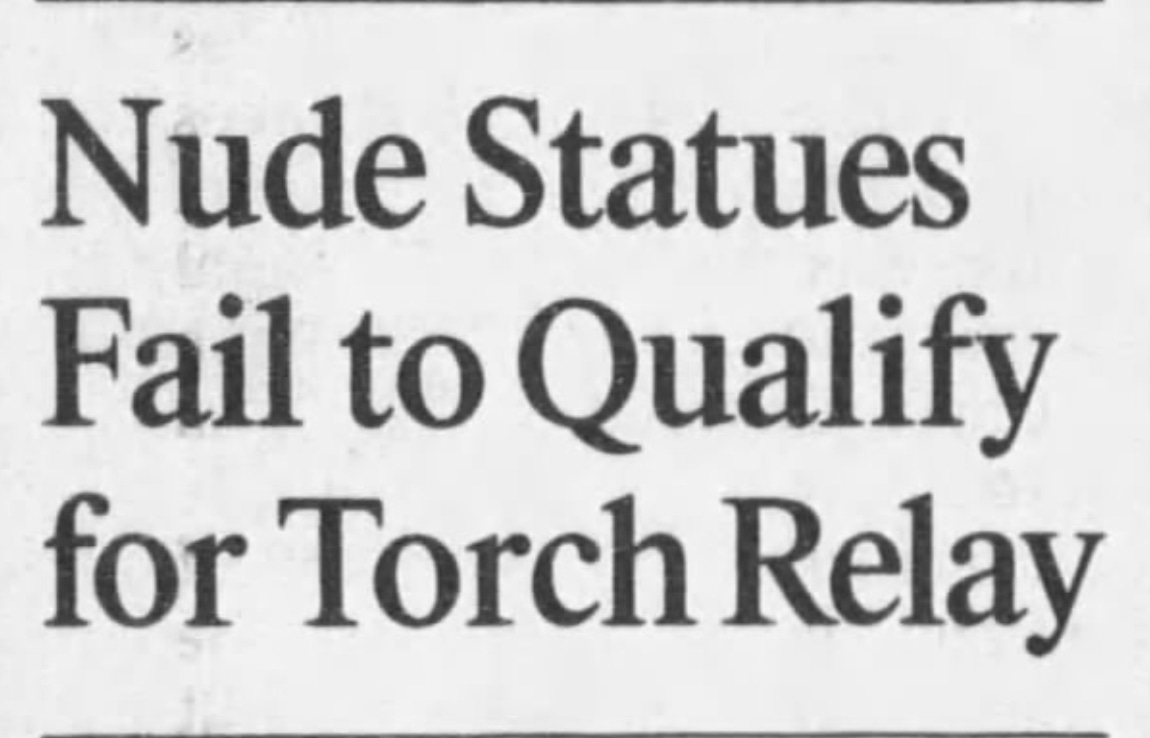
What? Okay, let’s explain. An opening ceremony for the torch relay was held at Los Angeles Memorial Coliseum, the entrance of which is flanked by two giant (you guessed it) nude statues. See below:
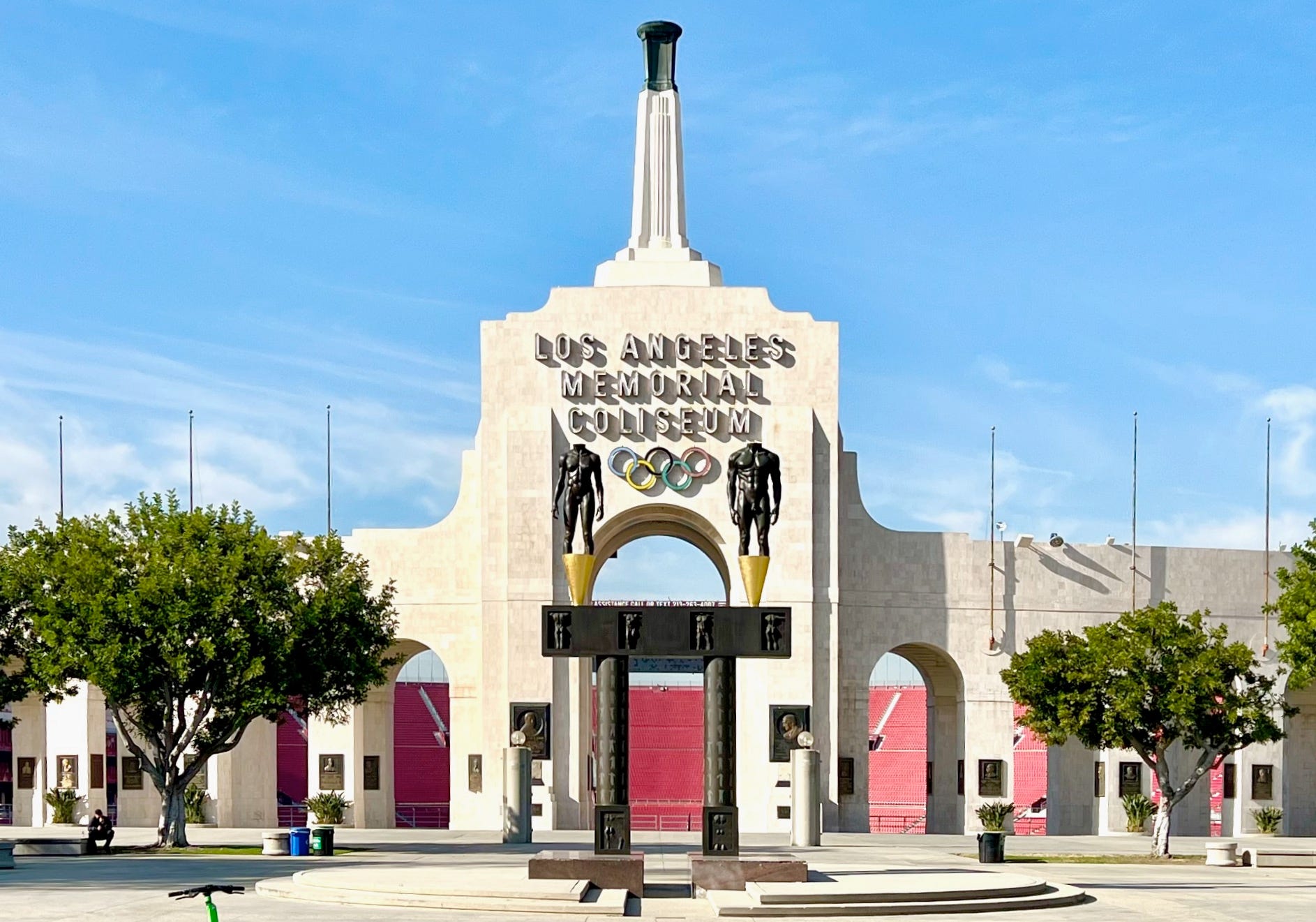
The organizers thought that showing these giant nude pieces of metal on national television would be “an indecent way to start their torch relay” and attempted to have them covered up.
However, LA Coliseum officials were not having it, and insisted “that the anatomically correct statues were important links to the stadium’s Olympic history.”
The Los Angeles Times reported, “Unable to find fig leaves large enough, officials were still trying Wednesday to determine the material they will use.” The statues ultimately remained uncovered and America’s innocence was spoiled.
Thus began the 1996 torch relay. Okay, what else happened?
For the first time ever, the torch went to space, riding aboard the Space Shuttle Columbia.
The torch was also carried for 56 continuous hours on horseback by riders from the National Pony Express Association.
Another horse-torch connection occurred, but this time to more disastrous effect. A horse carrying the torch in Nebraska got spooked by the flame, threw its rider off, and then “bolted toward a group of [150] schoolchildren.” (the kids were unhurt)
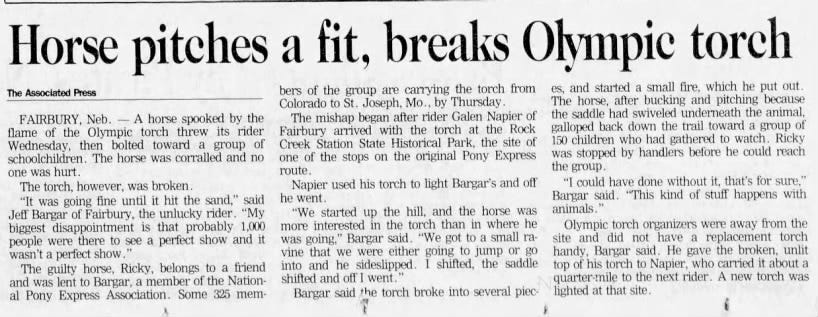
The rider was also unhurt physically but probably damaged emotionally. He had this to say: “I could have done without it, that’s for sure.”
Another torchbearer, a cyclist, was carrying the torch across the Tacoma Narrows Bridge (not Galloping Gertie, the one that replaced it) when his back tire hit a grate and burst, causing him to fall and extinguishing the flame.
People thought this was so funny that he was invited to appear on Leno. The 1990s were a much simpler time.
Thankfully, this guy was also uninjured but like our horseback rider, did not escape embarrassment. He reflected on the incident, saying, “Unfortunately, there were cameras all over the place.”
When the torch went down to Georgia, it met controversy in Cobb County, where the County Commission had three years prior passed a resolution condemning “the gay lifestyle” for being in opposition to its “community standards” and “family values.”
Protestors successfully rallied for volleyball events scheduled to take place in Cobb County to be moved elsewhere, and the torch relay also avoided the county entirely.
This angered Cobb County’s congressional representative, Speaker of the House Newt Gingrich, who said, “the homosexual demonstrators blackmailed the Olympic committee” (lol)
“statuesque, baby-faced flame attendant”
In 2000, the torch went underwater for the first time ever, as a scuba diver carried it across a popular portion of the Great Barrier Reef.
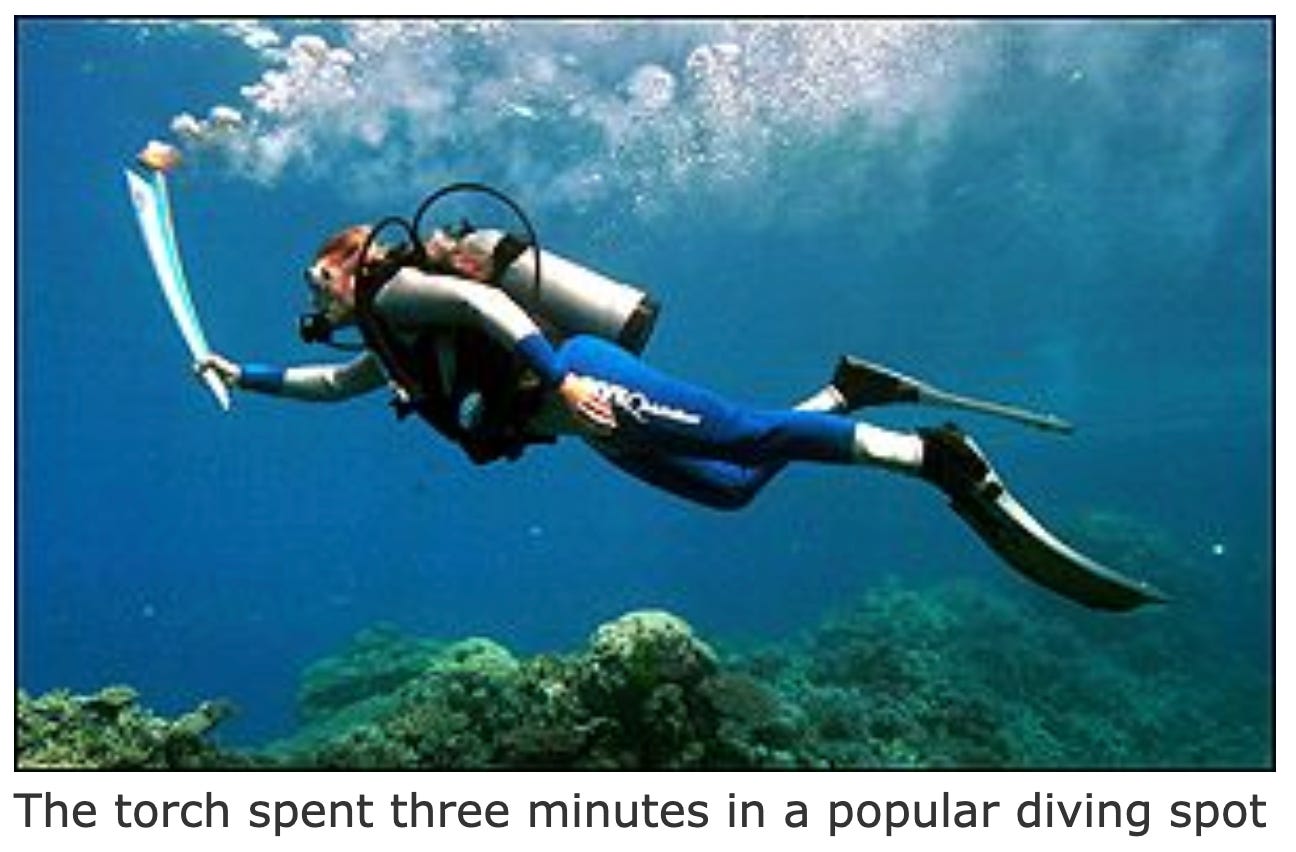
I’ll be the first to admit this defies everything I thought I knew about how fire works. So how was this possible?
Per the BBC: “The flare burns so fiercely at more than 2,000 degrees Celsius that this creates enough pressure to keep the water from entering the tube.”
In 2004, the Greeks finally got to stop being angry because the Olympics returned to Athens. But before the torch got to Athens, it went literally everywhere else.
To celebrate the occasion of another Greek Olympics, the relay traveled to every habitable continent, including, for the first time ever, Africa and South America. It also visited every city that had ever hosted the Olympics and all future cities selected to host the Summer Olympics at that point, up to the 2028 Games in Los Angeles.
This global relay went so well that the IOC said “we should do this every time” and they almost immediately changed their minds after the disaster that was about to be the Beijing 2008 relay.
This relay holds the record for the longest distance covered by an Olympic torch relay, and it’s likely this record will stand forever because the relay also ended up being an unmitigated disaster.
Let’s just say it’s a lot easier to parade symbolic ambassadors of your country all around the globe when your country is the relatively uncontroversial Greece, rather than China.
The torch route was visited at several different points by people protesting China’s human rights record. Also present were activists in favor of Tibetan independence, animal rights, nudism, and legal online gambling, and I’ve just gotta say – that’s gotta be the most iconic quartet of protest movements you could ever hope to assemble. Give me a naked vegan online casino hosted on servers located in a free Tibetan state. I am ready.
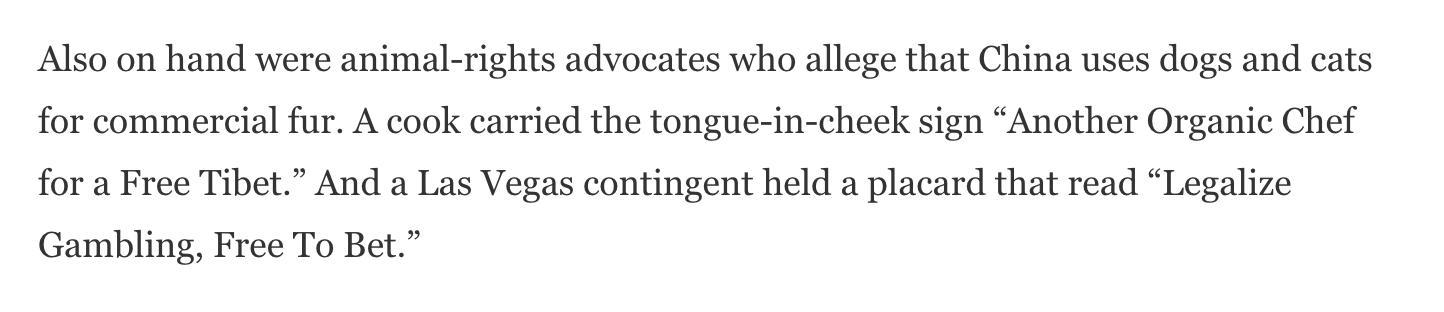
Pro-China counterprotests also started showing up as the relay progressed, so any cities along the relay route had a huge security headache to deal with.
London officials attempted to handle this by surrounding the torch with “[a] protective ring of 10 Chinese flame attendants and fluorescent-jacketed police officers.” Police also confiscated Tibetan flags and ordered protestors to remove pro-Tibet apparel, despite promising earlier that they “would not intervene to prevent embarrassment to Beijing.”
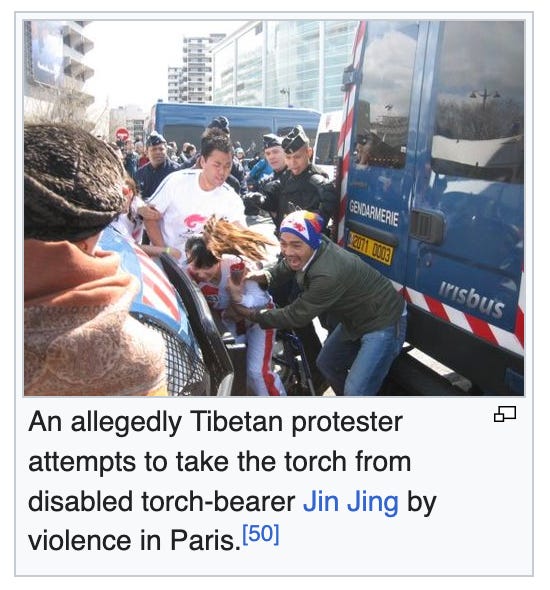
But even with the high security presence, one demonstrator still broke through the protective ring and “almost wrestled [the torch] from the hands of TV presenter Konnie Huq,” who reported being “a bit bashed about“ but largely uninjured.
Next, the relay made its way to Paris, and as you can see, it did not go much better here:
San Francisco was the next stop, and huge numbers of protestors were waiting for the torch here. One large protest was led by Richard Gere and Archbishop Desmond Tutu, i.e. the power couple of my dreams.
Things got off to a very confusing start as the first torchbearer of the San Francisco leg immediately disappeared into a waterfront warehouse and remained there for half an hour.
Eventually, “a convoy of vehicles emerged from the warehouse,” but nobody knew which one carried the torch, leaving onlookers puzzled. The torchbearer was later spotted getting off a bus in a completely different part of the city,
Organizers decided on a last-minute route change in order to avoid the protests, which mostly worked but also had the side-effect of annoying all the people who had waited for hours along the planned relay route to catch a glimpse of the torch.
The San Jose Mercury News described the torch relay as “a game of ‘Where’s Waldo,’ played against the landscape of a lovely city.”
After San Francisco, the relay continued and later ended up in Seoul, where thousands of riot police were deployed along the route. Violent exchanges broke out between pro- and anti-China demonstrators, and a North Korean defector attempted to set himself on fire to protest China’s treatment of North Korean refugees.
The torch also passed through Pyongyang, where no protests were reported.
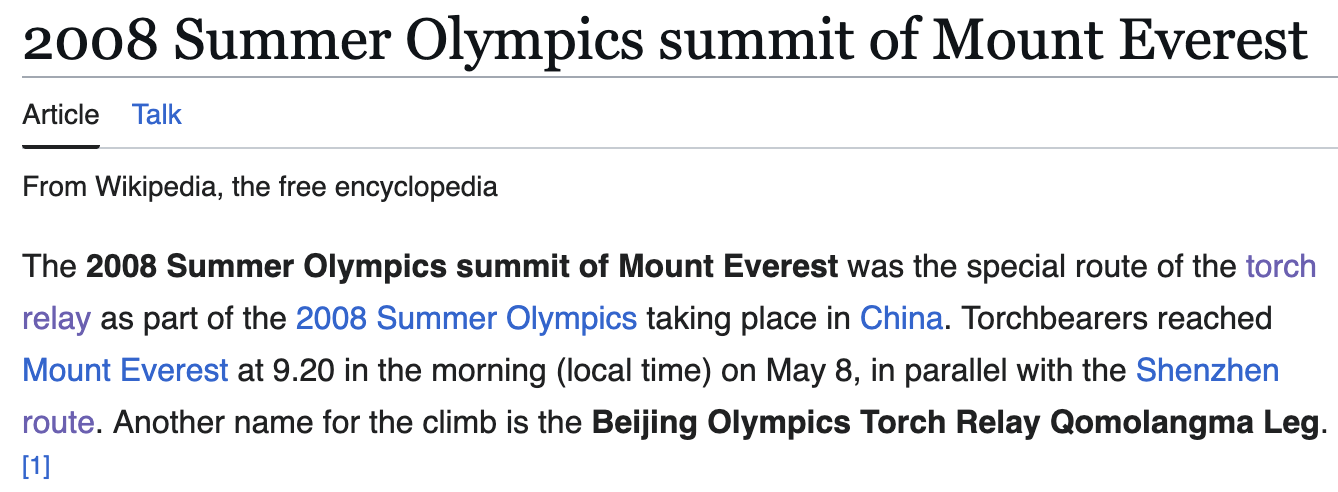
By far the coolest place (no pun intended) that the torch visited was the summit of Mount Everest. Climbers carried a torch specially designed to endure the cold, windy, oxygen-depleted environment at Everest’s peak.
This is also a great opportunity for me to express my admiration for hyperspecific Wikipedia articles like this one:
The Chinese government spent 10 months improving a 67-mile road leading to Mount Everest base camp so that torchbearers could more easily travel up to the peak. According to critics, this project damaged the permafrost in the area, but the Chinese government denied this.
Over on the Nepalese side of the mountain, the government imposed a complete communication ban on journalists and gave soldiers permission to use deadly force against any pro-Tibet demonstrators who may have made the trek (seemingly none did, unsurprisingly).
The last thing I’ll say about the Beijing 2008 relay is that for some reason, people online got really horny for one of the “tracksuit-clad security guards” guarding the torch.
Described by one journalist as a “statuesque, baby-faced flame attendant,” he “quickly became the subject of titillating discussions on forums and chat rooms where China’s female ‘netizens’, gushed about his ‘sexy mouth’, muscularity and pretty boy good looks.”

Anyway, all the crazy stuff that happened during this torch relay caused the IOC to require future torch relays to take place solely within the host country2, which makes a lot of sense.
The torch is burning as we speak
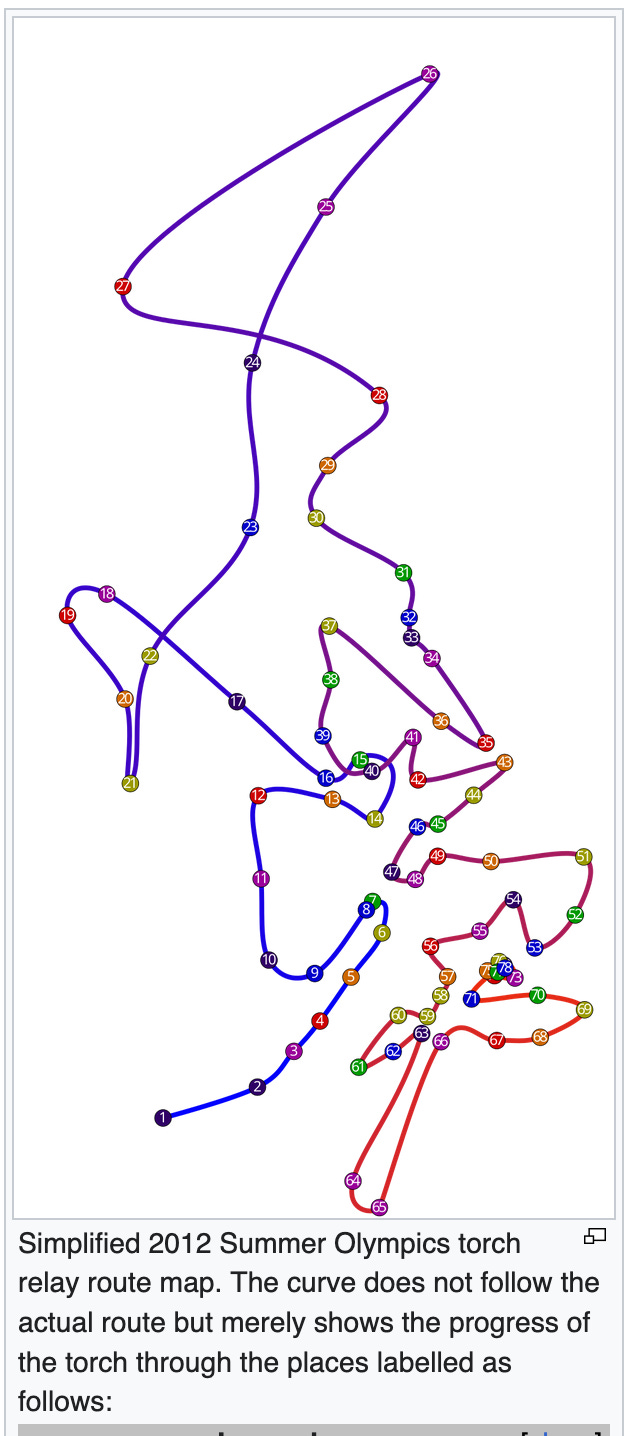
Fast facts about the London 2012 torch relay:
Organizers designed the route in a way that the torch would come within 10 miles of 95% of the UK’s population
Did you know? The Olympic torch traveled via zipline in Newcastle. It’s gone unreported whether the torchbearer was only there for the zipline
There was an episode of EastEnders that featured a seven-minute live segment of character Billy Mitchell (played by Perry Fenwick) carrying the real Olympic torch as part of the relay through London
Sochi 2014:
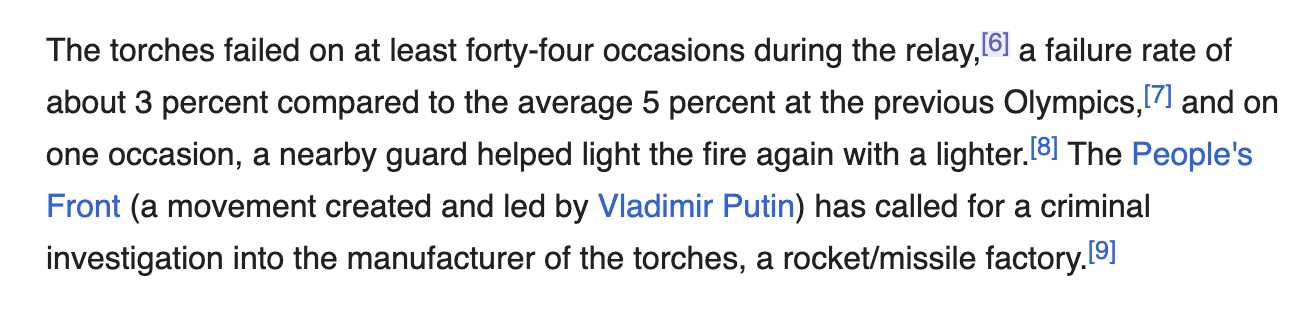


The Sochi torch also made its way to the North Pole via Santa’s sleigh a nuclear-powered submarine, traveled to space and back aboard a Soyuz rocket, and reached the depths of Lake Baikal, the deepest lake in the world (super fun video if you watch it at 2x speed)
The Tokyo 2020 torch relay began on March 12, 2020, which seems bad for some reason I can’t quite place. The relay was suspended less than two weeks after it began and was later restarted in March 2021.
I love the cherry blossom-inspired design of the Tokyo 2020 torches. The torches were constructed of recycled aluminum from unused shelters deployed after the catastrophic 2011 earthquake and tsunami.
And that brings us to today! The relay for Milano Cortina 2026 is ongoing at the time of writing!!!!!!!!!!!!!!!!!!!!!!!!!!!!!!!!!!!!!! Ahhhhhhh. Get yourself into an Olympic mindset NOW. The Games are almost upon us.
(You might be wondering why I skipped over a bunch of Olympics in here, including the most recent one. Simply, some of their Wikipedia pages were extremely boring (or even nonexistent) and had nothing interesting for me to share here. Usually, I would have spent more time doing research outside of Wikipedia to see what I could scrounge up, but with the holidays, I didn’t have quite as much time to work on this piece as I usually do. Let’s just agree to assume that the Torino 2006 relay was boring anyway!)
Anyway, thanks for reading! Your attention is your most valuable resource and I’m grateful as always that you choose to share it with me. Until next time!
If you enjoyed this piece, consider tossing me a few bucks (I will spend it on snacks)
Sports is all about winning jewelry and you cannot convince me otherwise. Super Bowl rings? WWE championship belts? Olympic gold medals? (They are just fancy, heavy necklaces)
and Greece, for a little bit
Laughed so hard I started coughing, then couldn't breathe, nearly died. 10/10 would read again.
How dare that article on the hot flame guard not include images?