

Stupid Rat Facts
also hamsters, also gerbils, also guinea pigs


“Why don’t I write that stupid thing about rats already?” is what I said to myself as I finally pulled the trigger on turning this post you’re reading from a bad idea for a post into an actual in-the-flesh bad post on Substack dot com. Hello and thank you to the 30 of you who will ever read this. We’re gonna learn about rats today.
Every time I go on Wikipedia I learn all sorts of stupid shit I didn’t wanna know about animals and nature. It’s, like, a recurring thing. It’s well-documented. If I had a nickel for every time this happened to me I would genuinely have like 50 cents. Two bubble gums from the bubble gum machine. Because of nature.
I am a freelance trivia writer so trawling through Wikipedia for fun facts is a daily practice for me and it happens very frequently that I’ll get into an unproductive rabbit hole about too-obscure things concerning animal biology or earth science or something or another.
I always get to the point where I have too many dozens of tabs open and I need to utilize the “break glass in case of emergency” option of simply saving all the links in my Notes app for later. Here is a small sampling of that:

You might be wondering why I am so averse to falling down ecological rabbit holes. There are fun facts to be found, no?
Yes, there are fun facts aplenty, but what I’ve found about this area of knowledge that I’ve never discovered (at least to the same extent) with other topics is that there are numerous facts that are indeed very fun but are ultimately way too hard to explain or arcane to easily work into a trivia question.
I’ve come across stuff that is really interesting and I would love to share, but the trouble is that the only way in which it’s actually interesting is if I have a full five minutes to explain the context of the fact first, which is not something you have the benefit of when you’re writing in such a confined format as the bar trivia question.
So, given my experience with how fraught these rabbit holes can be, I generally try to avoid them in favor of other topics that lend themselves better to good trivia.
But the magnetic draw of these links can simply be too strong for somebody like me who traffics in fun facts for a living respectable side income. Because of this, I recently amassed a modest collection of information about small mammals kept as pets. I hope you enjoy.
Guinea pigs
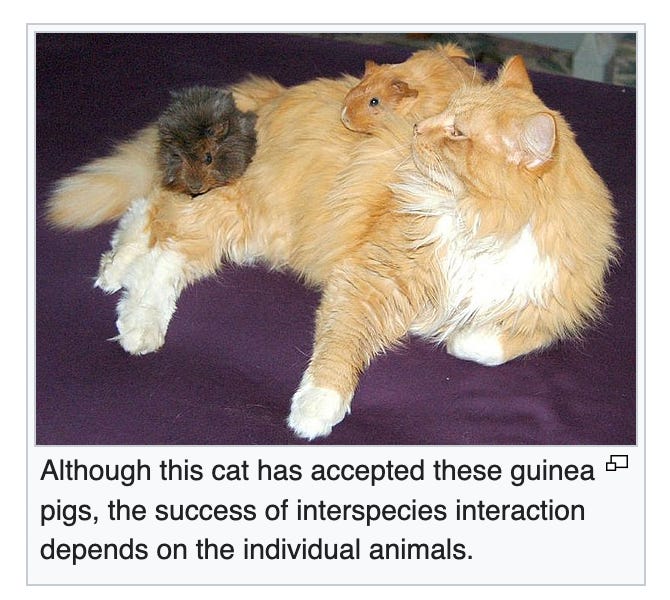
Okay, first of all, you probably already know this, but the naming of the guinea pig is “hard to explain,” as Wikipedia puts it.
It’s not from Guinea. It’s not a pig. We’re not totally sure why they’re called that. But I’m not gonna get into it further. We have more important information to cover. Click here for more on the name stuff.
There are some crazy guinea pig videos on YouTube, by the way. Sorry, this is another digression, but there’s a 13-minute video of guinea pigs eating watermelon and you don’t even have to pay to watch it. This is free entertainment, folks. Welcome to the 21st century.
Speaking of centuries, in the 16th century, guinea pigs were a very fashionable pet. The upper classes in Europe liked them because they were “exotic,” brought over all the way from South America. Even Queen Elizabeth I owned guinea pigs.


But guinea pigs reproduce very quickly, so before long, the lower classes got their hands on guinea pigs as well, and they stopped being a status symbol.
How quickly do they reproduce, you ask? Genuinely, too quickly. Like, it’s too fast. You might be thinking, “A lot of animals reproduce quickly, it can’t be that bad, I’m sure it’s fine.” No. No it’s not. They have babies so fast. A female guinea pig can become pregnant again as soon as six hours after giving birth. You could start watching “The Irishman” two times in a row the moment a guinea pig gives birth and you’d only be a quarter of the way through your second viewing when the guinea pig would become capable of getting pregnant again. That’s so fast.
For comparison’s sake, humans can technically become pregnant again 3-4 weeks after giving birth, but it’s generally recommended to wait closer to 18-24 months. To put that in a more digestible unit of time, that’s between 3,754 and 5,005 back-to-back viewings of “The Irishman.” I hope this information is helpful as you plan your family’s future.
Fancy rats
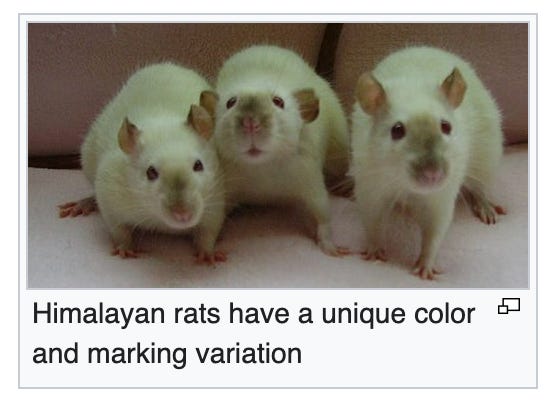
Not like regular rats, but those ones can be pets too, I suppose. These ones are fancy. They have cool colors.
They also have cool teeth. Did you know? Their teeth never stop growing. I was surprised when I first learned this but it turns out this whole “teeth never stop growing” thing is actually quite common among rodents and other small mammals. This is why they’re always gnawing on stuff. It’s not just for fun. It’s to shave down their teeth to an appropriate length.
For reference, human teeth DO stop growing at some point. I have yet to determine what that point is.
Back to rat teeth — sometimes owners of pet rats get “rat bite fever” which is pretty much exactly what you would imagine it to be. It’s fever from rat bites. Okay.
This is the part where we fall prey to the rabbit hole. Are you ready? It doesn’t matter, it’s happening anyway.
Wikipedia tells me: “As an early breeder of fancy rats, 19th-century rat catcher Jack Black recounted that he nearly died several times after bites.”
No, not the chicken jockey Jack Black. This Jack Black:

According to Wikipedia, he was “a rat-catcher and mole destroyer.” Fuck. Fuck. Mole-destroyer. God. Fuck.
Why didn’t they tell me this was a job I could have when I was in school? Why didn’t they tell me I could destroy moles?
I once met a woman who told me that when she was a child, she was crawling in a tube, or maybe a tunnel, or maybe some other kind of confined underground passage. I don’t really remember. But she was crawling somewhere, and suddenly, she came face to face with an opossum, and the opossum hissed at her. And I think of this story frequently and it always frightens me. The opossum was hissing at her and she had nowhere to go. Remember, she was in a tube (maybe). She couldn’t simply turn around and crawl away. She had to, like, crawl backwards, or do some sort of claustrophobic U-turn within the tube. I don’t actually remember what happened next, but I don’t think the opossum attacked her. I think she would have mentioned that part. Seems like that would have been relevant.
Anyway, I say all of this to highlight the fact that somebody could have been destroying that opossum if our industrialized modern-day economy still valued jobs like “mole destroyer.” It doesn’t. And look what happened.
Jack Black (mole destroyer) was a really lucky guy because he came along right when England had a bunch of moles rats that needed destroying, on account of they kept eating the plants and giving everyone the plague and whatnot.
Jack Black was so good at destroying rats that he was a minor celebrity and the official rat-catcher of Her Majesty Queen Victoria. People loved this guy. He had a whole homemade outfit for killing rats that featured a “huge leather sash inset with cast-iron rats.”


Jack got into the rat-killing biz as a child, when he would fearlessly grab feral rats at the park for the entertainment of adults. They (the rats) crawled up and down his arms, and instead of saying “hey maybe this kid shouldn’t be doing that with the rats?” they (the adults) just said “this kid is awesome,” and the rest is history. Times were simpler back then.
You might be wondering, “Did the rats bite him though?” I’ll let Mr. Black answer that for you:
“I’ve been bitten nearly everywhere, even where I can’t name to you.”
You might also be wondering, “Did he ever eat the rats though?” You probably weren’t wondering that, sorry. But anyway, yeah he ate the rats. Jack again:
“If they are shewer-rats [sic], just chase them for two or three days before you kill them, and they are as good as barnrats, I give you my word, sir.”
Good to know, thanks Jack.
Jack did all his rat-eating “unbeknownst to his wife” and asserted they were “moist as rabbits, and quite as nice.” Okay, I’ll keep that in mind.
Hamsters
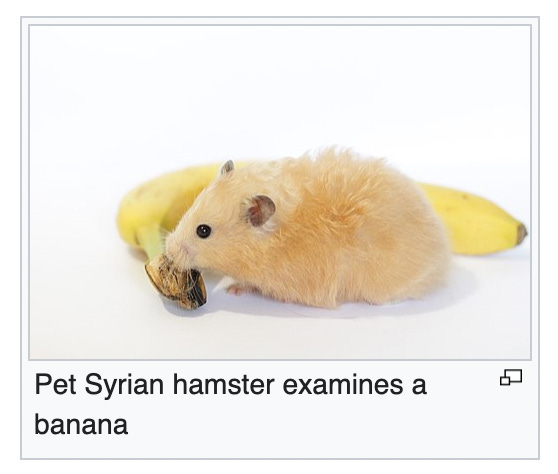
Hamsters — or, if you are me and also five years old, “hampsters” — first became popular pets in the 1930s, the same decade the Hindenburg exploded. Also the same decade helicopters were invented. Unrelated events.
Virtually all modern hamsters trace their lineage back to a single litter of hamsters taken to Palestine for scientific research in 1930. I don’t have any jokes to make about this, I just think that’s a neat fact.
I would have assumed that hamsters would be nice to other hamsters but as it turns out, no. They aren’t.
Hamsters that are caged together are aggressive towards each other, especially when they get older, and it usually ends in death. So just the one hamster then, okay.
Gerbils
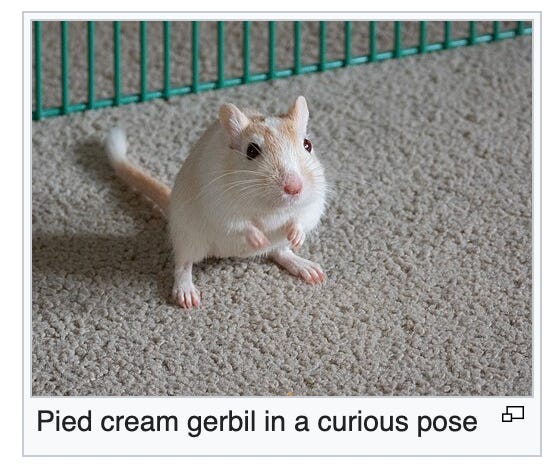
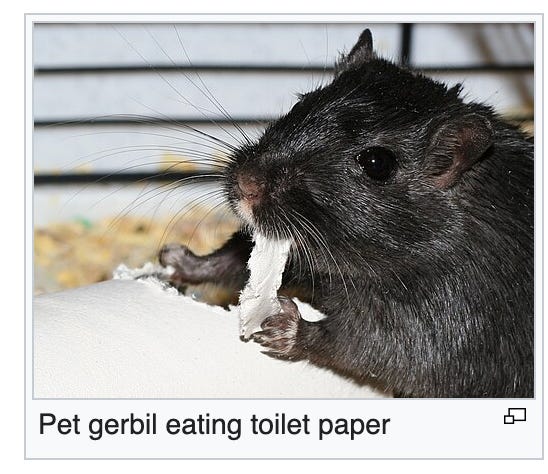
How do people in the UK pronounce “gerbil”? Is it weird? I ask because I’ve had the displeasure of hearing Paul Hollywood say “taco” and that was enough for me to never again trust that British people know how to pronounce things correctly. Sorry guys, guilty until proven innocent. Trust is hard to gain and easy to lose. Next time pronounce “taco” correctly.
Gerbils talk to other gerbils by thumping their back legs and whistling sharply. Wikipedia says “thumping can be both a communication of excitement of excitement and anxiety,” which, weirdly, is also true for me.
Gerbils are also unusually susceptible to epilepsy — 10-20% of them suffer from seizures in response to stressors like being handled or having their cage cleaned.
This prevalence has a genetic basis, so gerbils breeders have created both seizure-resistant and seizure-prone varieties of gerbils. And I’m just gonna repeat that last part again — breeders have created types of gerbils that are genetically predisposed to have a higher likelihood of having epilepsy.
When I first read this, I was like, sorry? What the hell? Why are they making gerbils that are more likely to have seizures? Do people want this in a pet?
But then I did a little more digging and figured out what probably should have been obvious to me right away, which is that they breed seizure-prone gerbils for research purposes, so scientists can learn more about how epilepsy works. Which is a much more reasonable explanation than “some people just want their gerbils to be having seizures all the time.”
Chinchilla
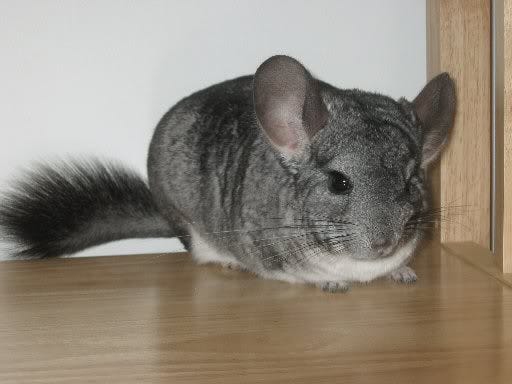

The best thing I can tell you about the chinchilla is the it has the densest fur of all land mammals.
Chinchillas have about 20,000 hairs per square centimeter, and they may have up to 50 hairs growing out of each individual follicle.
Now, you might be wondering — how many hairs do I (you) have per square centimeter? Great question, I also have no concept of how thick my hair is.
Well, according to this website for a French cosmetics company, human hair density varies by ethnicity:
“Caucasian hair has the highest density, with 226 hairs per square centimeter, making it the most abundant hair type. Asian and African hair have lower densities, with 175 hairs/cm2 and 161 hairs/cm2, respectively.”
Also, sorry, I got distracted reading the hair website, so here are some more hair facts:
Hair facts
“Each hair has a lifespan of around 4 years before it falls out and is replaced by a new one.”
The only part of your hair that is actually alive is inside the root and thus not visible. All of your visible hair is biologically dead. Sorry you had to find out this way. I actually already knew this but for some reason when I first learned this fact it really bugged me, so I’m sorry to pass this burden onto you.
“Asian hair has the highest hardness and elasticity. It is resistant to stretching and can withstand a traction force of 60 to 65 grams.”
How do we think they measured this? Did they just conduct a study where they told the volunteers, “ok so we’re just gonna pull on your hair gradually harder and harder until it rips out of your scalp. you cool with that?” Do NOT sign me up
…………………………………………………………………………………………………………………………………..………………..unless it pays $500 or more
“Hair can absorb more than 30% of its own weight in water. This percentage can reach 45% for damaged hair.”

Okay, so as I’m writing this I actually had to scroll back up to remember what I had been talking about. Like, not even “which mammal was I talking about?” but fully “what is this post supposed to be about? why am i talking about hair?” Sorry about that.
So, chinchillas then. They don’t actually have the densest fur of all animals — that honor belongs to sea otters. Chinchillas with their 20,000 hairs per square centimeter are rather unimpressive compared to sea otters with their 600,000 to 1,000,000 hairs per square inch. (I am too lazy to do the conversion here but just understand that 600,000 is a lot bigger than 20,000 regardless of how inches compare to centimeters, ok)
Chinchillas Do Not Sweat. They lack the ability to sweat. They couldn’t do it even if they wanted to. Instead, they like to take dust baths. Turns out a lot of animals do this dust bath thing. Have they ever heard of regular baths? Like the rub-a-dub-dub kind? Do they know about Bert and Ernie?
Did you know if you tried to bathe a chinchilla in water, its hair might grow mold? That sounds bad. Probably don’t do that.
Last thing I wanna tell you about chinchillas is that they can live up to 20 years in human care. You’re telling me there are chinchillas out there that remember when Pluto was still a planet? We got pre-YouTube chinchillas? Someone should record their stories before they are gone.
Ferret

Two things you need to know about ferrets — one, they have a high metabolic rate which means they eat 8-10 small meals per day. Me too brother, me too.
And two, following up on that “war dance” thing from above… um, okay, where do I start. So it’s not just ferrets that do this — it’s colloquially known as the “weasel war dance” and it’s been observed in domestic ferrets as well as weasels in the wild.
When wild animals do this, it’s usually to confuse their prey and to mesmerize them until they can go in for the kill. Please watch this video it’s so silly.
When domestic ferrets do the war dance, it is decidedly not to confuse or kill anything. Here’s Wikipedia:
In domestic ferrets the war dance usually follows play or the successful capture of a toy or a stolen object. The war dance is commonly held to mean that the ferret is thoroughly enjoying itself.
The behavior consists of a frenzied series of erratic leaps, often accompanied by an arched back and a frizzed-out tail. Ferrets are notoriously clumsy as they dance and will often collide with or fall over objects and furniture.
The war dance usually includes a clucking vocalization, known among domestic ferret owners as "dooking."
I kind of want a ferret now? Do you think my cat would get along with a ferret? Probably not
Stumbled upon this and was ENTHRALLED the entire time!
thank you so much for the 13-minute video of guinea pigs eating watermelon that I don’t even have to pay to watch. I love free entertainment, folk. in this specific sort of niche circumstance, I do feel quite welcome in the 21st century.
it makes me so happy to read a post that feels like i could have written it, lol. we're so alike. although i probably would have said "rat hole" at least once, with perhaps some "hold the 'bbi'" sprinkled in lol
> not the chicken jockey jack black
NOOOOOO THE LEGACY CRUMBLING
> According to Wikipedia, he was “a rat-catcher and mole destroyer.” Fuck. Fuck. Mole-destroyer. God. Fuck.
> […] somebody could have been destroying that opossum if our industrialized modern-day economy still valued jobs like 'mole destroyer.' It doesn’t. And look what happened.
> Jack Black (mole destroyer) was […]
dawg i love you so much