
Does it hurt to go to space?
quick, someone call Katy Perry

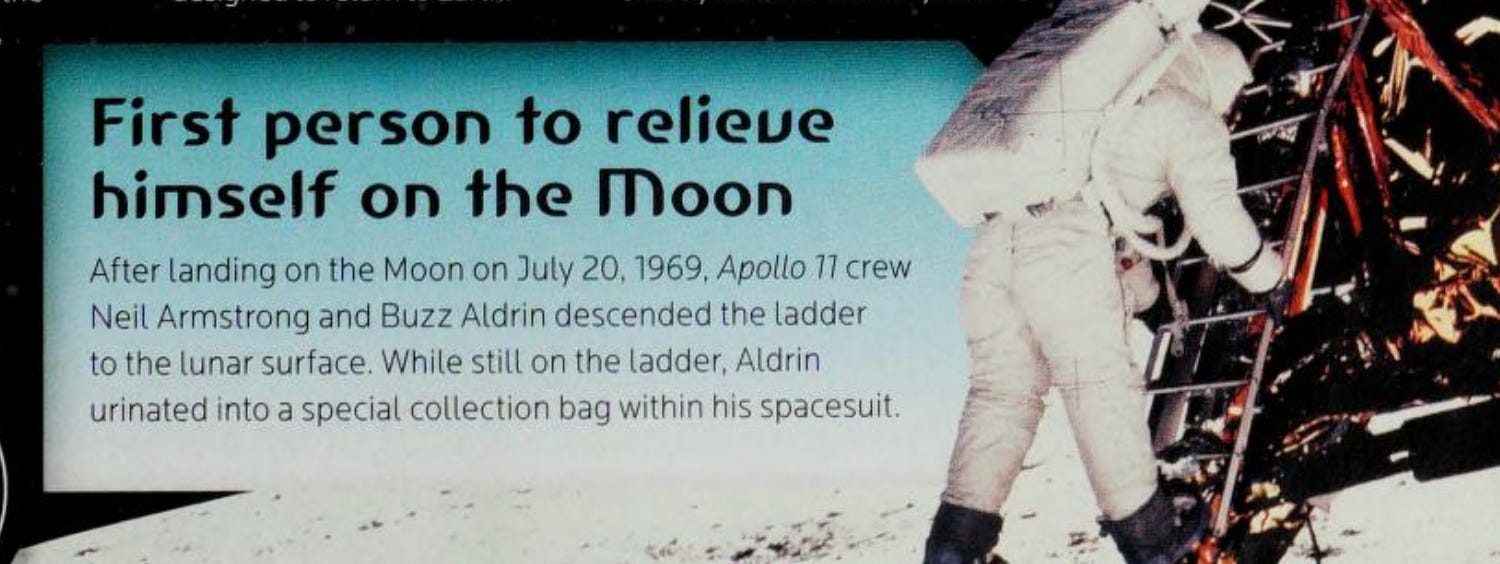
Buzz Aldrin may have only been the second person to walk on the Moon, but he holds the much more impressive accolade of first person to pee on the Moon. And folks, he is NOT shy about it.
According to Popular Science, this inaugural lunar piss is “a frequent point of discussion in interviews about [Aldrin’s] role in the historic mission.”
Buzz is rightly proud of the urinary havoc he wreaked upon the lunar surface. But, as Popular Science continues, “what many people don’t know is that the urination did not go according to plan.”
“What’s unfortunate is that when he landed the lunar module, he landed so softly that the legs, which were designed to compress, didn’t,” Muir-Harmony explains. As a result, what was supposed to be a small step from the module to the surface was more of a giant leap. In the jolt of that surprising step down, Aldrin’s urine collection device broke. “So instead of going where it was supposed to, the liquid ended up collecting in one of his boots,” she says. “When he walked around the lunar surface he was kind of sloshing around.”
I’m not surprised this is the first time I’ve learned of this crucial detail. It makes sense that the chroniclers of human history would want to leave one of our proudest moments unmarred by the mental image of a dude with piss sloshing around in his boots.
But reader, dear reader, if you’ve been reading this blog for any amount of time, you surely know that my first priority is not safeguarding the dignity of the human race. As such, we celebrate Buzz and his piss boots.
Okay, wanna hear about another dude who did something embarrassing with his bodily fluids in space? (Rhetorical question, you know what you signed up for by subscribing to Rabbit Cavern)
Meet Senator Jake Garn, Republican from Utah. I’m not gonna bore you with Senator Garn’s bio because literally the only thing you need to know about this dude is that he wanted to go to space so bad.

According to Time, “Garn once joked that if he did not get to fly on the space shuttle, he would not appropriate ‘another cent’ to the agency.”
This obsession was ongoing for years and years. In 1983, Garn reminded NASA, “I still have a great desire to go,” giving the reasoning, “...it is a necessity that Congressmen check things out that they vote for [...] It might be necessary to have a Senator kick the tire.’‘
Eventually, NASA relented. Welcoming Garn aboard the Space Shuttle in 1985, one NASA official insisted, ‘’It’s not a case of giving in. He’s just shown an exceptional amount of interest, more than any other member of Congress. It became very obvious he definitely wanted to go.’‘
In the runup to Garn’s historic mission, where he would become the first sitting member of Congress to fly in space, NASA teased that Garn would “serve mainly as the shuttle’s human guinea pig … to increase understanding of space motion sickness.”
An excited Garn said, “I am hopeful that I can fill in a few of the pieces of the puzzle in the medical department,” and oh boy, dear reader, did he ever.
Years after Garn’s flight, in an oral history interview, a NASA official reminisced that Garn “has made a mark in the Astronaut Corps because he represents the maximum level of space sickness that anyone can ever attain.”
Translation: he vommed. He vommed so bad. Vomming is basically all he did in space.
As a result of Garn’s disastrous experience aboard the Shuttle, NASA began informally using the “Garn scale” to measure the severity of space sickness for astronauts. The NASA official continues: “...the mark of being totally sick and totally incompetent is one Garn. Most guys will get maybe to a tenth Garn, if that high.”

I find a lot of irony in the fact that this dude who only got to go to space because he pestered NASA for years and wielded his political influence for selfish personal gain did not get to enjoy one second of the experience. Hope it was worth it, Jake.
But guess what? Lots of people vom when they get up there (“up there” being space).
According to NASA, space sickness is “experienced by 50 percent or more of astronauts during the first few days of exposure to the microgravity environment of space.”
Veteran astronaut Steve Smith estimated, “I threw up, I would say, 100 times in four flights.”
Space sickness is similar to motion sickness in that it occurs when there is a disconnect between the motion of your body and your perception of the motion of your body, but these two conditions are technically exact opposites of each other.
Motion sickness on Earth occurs when your inner ear senses your body in motion but your eyes perceive a stationary environment. Conversely, space sickness occurs when your inner ear senses a stationary environment but your eyes perceive your body in motion relative to its environment.
So, both conditions are essentially just “your body and your eyes don’t agree on what is happening right now” but the inputs are direct opposites of each other.
Interestingly, the astronauts aboard the first two American space programs, Mercury and Gemini, did not experience space sickness because the design of their capsules restricted their ability to see outside. As such, they didn’t receive enough visual stimuli to sufficiently confuse their vestibular systems into vomming their guts out.
Okay, that’s enough science for one post – back to the unserious rambling that I excel at.
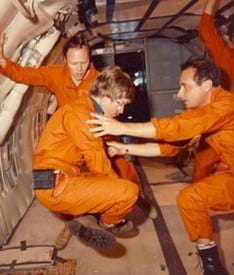
It’s not just astronauts that experience space sickness – the lucky ducks aboard those zero-G airplane flights get all yucked up too.
As many as two-thirds of all passengers aboard these “vomit comet” flights experience some degree of sickness.
One such passenger disgustingly related his experience, sharing that veteran vomiteers advise a breakfast of pancakes and bananas before your flight because “pancakes and bananas taste the same going in and coming out.” (I am so sorry for putting that sentence into your head, but you feel more cultured now, don’t you?)

But would you believe that an upset tummy is the least of your concerns should you find yourself blasting beyond the protective embrace of our Earth’s atmosphere? You should! Turns out our bodies aren’t really built to withstand the environment of space. Who knew?
As the BBC puts it, “[b]illions of years of evolution have adapted us to life in a stable 1G environment,” but all bets are off once you exit that environment. Everything about space is fundamentally hostile to the conditions of our existence. Humans are not designed to flourish in space, as you will soon learn.
A non-comprehensive listing of all the ways space can totally wreck your shit
Okay, let’s start with the eyeballs. Try this one on for size: when you go to space, your eyesight gets worse and it never really gets better.
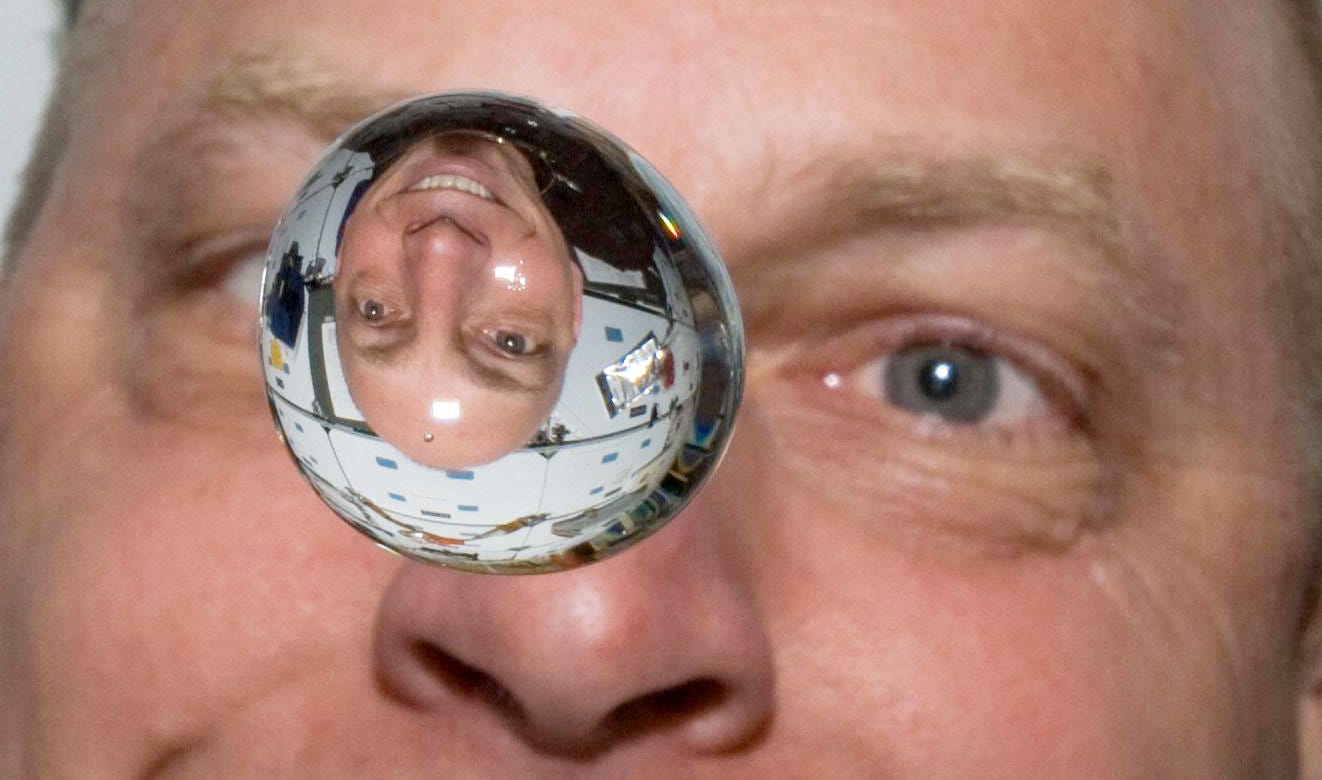


Back when The Washington Post was still a functional newspaper, they reported that 80% of astronauts on long-duration missions are affected by a condition called visual impairment intracranial pressure syndrome (VIIP).
Here’s how it’s thought to work:
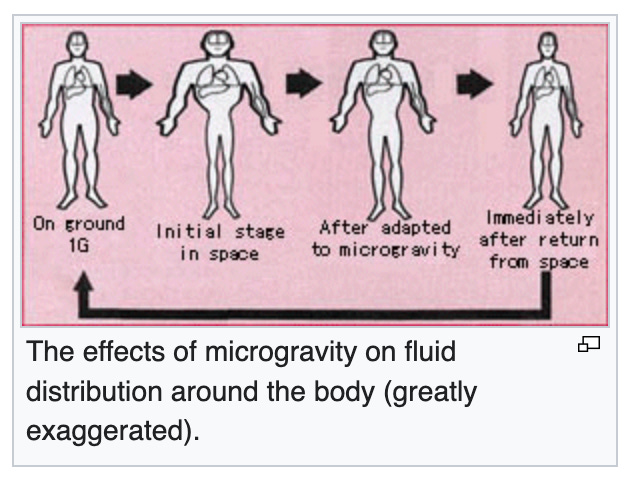
On Earth, gravity pulls bodily fluids down toward the feet. That doesn’t happen in space, and it is thought that extra fluid in the skull increases pressure on the brain and the back of the eye.
(This is bad for the eye)
It’s not 100% proven that VIIP explains the impaired eyesight many astronauts experience because the only way to verify it would be by performing a spinal tap in space or drilling a hole into an astronaut’s skull.
Unsurprisingly, nobody is really champing at the bit to perform either of these procedures. As a senior flight surgeon at NASA explained, “Having to anchor somebody and do a spinal tap in space is not something we would relish.”
Surveys of hundreds of astronauts have found continuing issues with eyesight following long-duration missions to space, and while your vision may bounce back to a certain extent, astronauts who sign up for these missions do so knowing that they will likely experience some degree of heightened visual impairment for the rest of their lives.
Bone density and muscle mass also suffer in the harsh environment of space. Because astronauts put almost no weight on many of their muscles and bones while experiencing weightlessness, bones become brittle and muscles atrophy quickly.
According to NASA, “[m]uscle mass can vanish at a rate as high as 5% a week,” and bones “atrophy at a rate of about 1% a month, and models suggest that the total loss could reach 40 to 60 per cent.”
As the BBC bluntly puts it, “For future Mars walkers, this is a potentially devastating effect. Imagine if one small step for mankind were to result in a broken leg.”
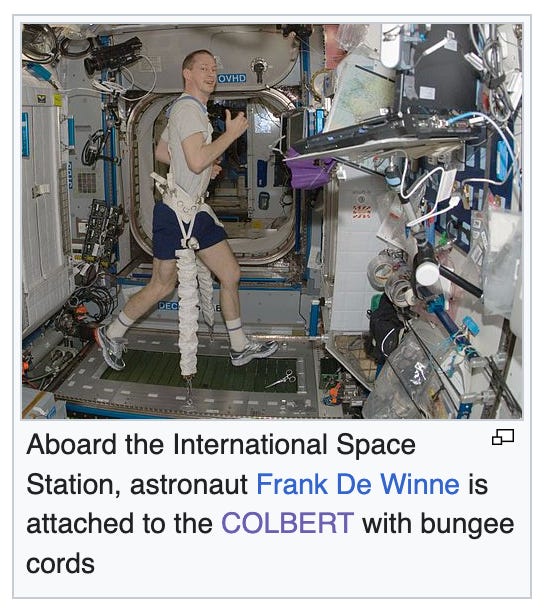
To counteract these effects, astronauts must engage in regular exercise, but this, too, is more challenging in space due to the lack of gravity as a form of resistance. Astronauts use specially-designed machines (sometimes named for Stephen Colbert) to get a workout comparable to what they would get back on Earth.

Upon returning to Earth, muscle mass is gradually rebuilt at a rate of about one day of recovery for every day spent in space.
Bones are a slightly more complicated matter, though: “For a three to six month space flight, says Schneider, it might require two to three years to regain lost bone -- if it’s going to come back, and some studies have suggested that it doesn’t.”
Okay, here’s one of my favorite space facts: On Earth, gravity causes blood to pool in your feet, so blood pressure is naturally higher down there than it is in your head. Without the effect of gravity, though, your blood pressure in space is equalized throughout the whole body, and as a result, blood pressure ends up being higher in your head while in space than your body is used to on Earth.
Your brain interprets this change in blood pressure as a signal that your body contains too much blood, so it responds by producing less blood until cranial blood pressure drops to a normal level. This has the incredible effect of reducing your overall blood volume by as much as 22 percent while in space.
Of course, this also means that with less blood in your body, your heart doesn’t have to work as hard to pump it, so your heart muscle begins to atrophy. Isn’t space grand?
(Blood volume is typically back to normal within a few days of returning to Earth.)

STD stands for Space Transmitted Disease
So far, we’ve talked about a lot of things that your body loses while in space – kind of a bummer, right? Why don’t we talk about something that your body gains?
Without that pesky gravity compressing your spine, the skeleton is allowed to expand in space, and within one month, you can gain up to one inch (2.5 cm) of height. Neat!
The gain isn’t all good, though. In addition to height, your body may also gain – you guessed it! – herpes.
A 2019 NASA report found that dormant herpes viruses hiding within astronaut bodies reactivated “in more than half of crew aboard Space Shuttle and International Space Station missions.”
Here’s how it works:
“During spaceflight there is a rise in secretion of stress hormones like cortisol and adrenaline, which are known to suppress the immune system. In keeping with this, we find that astronaut’s immune cells - particularly those that normally suppress and eliminate viruses - become less effective during spaceflight and sometimes for up to 60 days after.”
Most astronaut herpes cases were thankfully asymptomatic, but the finding still represents a concerning risk for future long-duration space missions. We don’t want herpes on Mars, people!
Let’s wrap up by talking about sleep. Sadly for these brittle-boned, weak-muscled, blood-deficient, half-blind, artificially tall, vomit-covered, herpes-addled astronauts, they can’t even sleep it off when they’re feeling like garbage.
NASA reports that up to half of all crew members aboard some space missions may be taking sleeping pills, and yet they still average about two hours less sleep per night than they normally get on Earth.
In fact, “nearly half of all medication used in orbit is intended to help astronauts sleep.” (I assume the other half is herpes medication)
This sleep debt greatly affects astronaut performance. According to a Harvard Medical School professor, “Research performed on Earth suggests that some of them, after a week or two on this restricted sleep schedule, are performing at the level of someone who’s been awake for 24-plus hours.”
Sleep in space is also carefully monitored so it does not jeopardize astronaut health. Ventilator fans must always be nearby, as “warm air does not rise in space so astronauts in badly-ventilated sections end up surrounded by a bubble of their own exhaled carbon dioxide.”
As the European Space Agency reports, “The result is oxygen starvation: at best, they will wake up with a splitting headache, gasping for air.” (The ESA did not say what happens “at worst” but I assume it is death)
It’s not all scary and life-threatening, though – there are some silly stories of sleep in space. From NASA:
“The first night in space when I was drifting off to sleep,” recalled one Apollo astronaut, “I suddenly realized that I had lost track of ... my arms and legs. For all my mind could tell, my limbs were not there. However, with a conscious command for an arm or leg to move, it instantly reappeared -- only to disappear again when I relaxed.”
Another astronaut from the Gemini program reported waking in the dark during a mission and seeing a disembodied glow-in-the-dark watch floating in front of him. Where had it come from? He realized moments later that the watch was around his own wrist.
And that’s all I have on space! A good chunk of the notes I had for this post were leftovers from my post, “Do astronauts have alarm clocks?” so go check that out if you enjoyed this one.
Thanks, as always, for reading! Until next time :)
If you enjoyed this piece, consider tossing me a few bucks (I will spend it on snacks)
"Piss in Boots"
piss boot goofin