
Do astronauts have alarm clocks?
sorta kinda yes but not really

Programming note: I recently learned that Substack auto-emailed a bunch of you trying to shake you down for 20% off a paid subscription, and this annoys me because (1) I had no idea they were doing this, and (2) if I did, it would have been a 15% discount because uhhhh I’m not running a fucking charity here (joke)
No, but seriously – I think subscribing to a newsletter is an act of trust whereby you give me your email address and in return I promise to never send you anything annoying, and that trust was somewhat damaged when Substack put on a mask of my face and asked you for money, so I apologize for that. Okay, we now return to our regularly scheduled weekly bullshit.
I was always pretty good at waking up on time for school as a child, and that’s because I had the greatest alarm clock in the world: my mom.
The “mom telling me to get out of bed” method worked really well for many years until one day, I passed the arbitrary milestone of 18 laps around the Sun on this cold, dusty Earth, and society decided it was time for me to start paying thousands of dollars to sleep in a shoebox and re-learn algebra from an overworked, underpaid graduate student (college) (shoutout to Andy for never giving up on the futile effort to teach me what a “polynomial” is)
This also meant I had to figure out how to wake up on my own. For this, I had an iPhone with the default marimba alarm clock tone, which proved to be very effective.
Unfortunately for me, the marimba was also the default ringtone used in movies and TV shows, so whenever someone’s phone rang in Suits, I got really anxious all of a sudden.
Thankfully, I was able to easily solve this problem by changing my alarm tone to something else, and these days I can both (1) reliably wake up when my alarm goes off, and (2) watch Suits LA without fear.
Very rarely, though, I will sleep through my alarm. Years ago, I inexplicably managed to sleep until noon on a workday, but luckily for me, not a single person at my job noticed, which gives you an idea of how important I am to the overall functioning of society.
But you know who is important to the overall functioning of society and does need to wake up on time? Astronauts.
There’s so much to do in space and so little time to do it. NASA needs their Little Space Guys (technical term, also gender neutral) to be up and at ‘em as soon as their allotted sleep period is up so they can get to work doing important science experiments and also drinking soda.
So, it’s crucial that astronauts wake up on time – but how do they do this without their marimba iPhone alarms?
Friends, meet the wake-up call. No, I don’t mean like that scene in The Office where Jim realized he had high blood pressure. This is – or, actually, was (more on that later) – a fun little tradition where NASA woke up the astronauts every morning with specially selected songs, often chosen by family members or friends back on Earth.
Sometimes these songs held special meaning, like an astronaut’s wedding song sent up by their spouse. Sometimes they were silly little jokes – “Fly Me to the Moon” by Frank Sinatra was a popular choice. Sometimes they made no sense at all, like – and I swear to god I’m not making this up – “Recorded turkey gobbles followed by ‘Cheeseburger in Paradise’ by Jimmy Buffett” (Nov. 28, 1991).
Here’s one of my favorite wake-up calls, specially delivered by Robin Williams:
Today, we’re going to take a journey into space to figure out what kind of music those space freaks have been listening to this whole time. Ready? Please keep your arms and hands (not concerned about legs) inside the vehicle at all times.
RISE AND SHINE, DENIZENS OF SPACE
Okay, guess which one of these songs has NOT been played to wake up astronauts in space:
Just kidding! They’ve all been played in space. Astronauts, am I right?
Other favorites from the cosmic playlist include “Y.M.C.A.” by Village People, “Gettin' Jiggy Wit It” by Will Smith, and “Zamboni” by Gear Daddies.
Did you know they’ve played “All Star” by Smash Mouth three separate times? And not one single Black Eyed Peas song???
Sometimes songs came with a personal touch or even a special recording. There was this weird example from 1991:

Other times it’s very cute, like recorded messages from astronauts’ children. An official NASA report specifically notes these children “shouting” such encouragement as, “Get up, Dad, get out of bed and get to work” and “Hi, daddy, this is your darling daughter telling you to wake up.”
And don’t get me wrong, this is very sweet and I’m sure the astronaut parents appreciated it, but, like… can you imagine being an astronaut, and you go all the way up to space, right? You train for years after working your entire life to gain the qualifications necessary to even enter the applicant pool in the first place. And you’ve finally done it – you’re all the way up in space, and you’re fast asleep in the Space Shuttle as it hurtles around the Earth at nearly 18,000 miles per hour (30,000 km/h). You’re floating there, peacefully suspended high above our planet’s surface, probably having the coolest dream that the human brain is capable of producing, and all of a sudden you’re jolted awake by your shithead kid shouting at you to get out of bed?
Oh my god, I’d fucking crash the thing.
Anyway, my favorite astronaut alarm clock was that time on August 10th, 1991, when NASA sent up “Sounds from Shannon Lucid’s backyard (frogs, crickets, etc.)” (Shannon was one of the astronauts on board)
A close second was that time in late 1981, on the second-ever Space Shuttle flight, when the crew awoke on two consecutive mornings to specially recorded “Pigs in Space” comedy routines from the Muppets:
In January 1990, they did this, for some reason:

There was also that time the astronauts got themselves all hyped up the day before Halloween 1992 with “Bang the Drum All Day” by Todd Rundgren and then on Halloween itself, they jammed out to “Monster Mash” by Bobby “Boris” Pickett.
Also, terrifyingly: “In honor of Halloween, Mission Control included a pattern for a cutout mask in flight plans radioed to the shuttle. The mask was of Moe of the Three Stooges.”
Can you imagine being trapped in the close confines of the Space Shuttle when one of your fellow astronauts puts on a mask of Moe from the Three Stooges? Once again I would opt to crash the spacecraft rather than confront this terrifying reality.

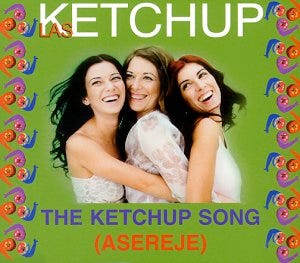
Anyway, I didn’t initially recognize the title of this next song because I was still acquiring fine motor skills when 9/11 happened and thus not familiar with popular music of the day, but the not-nearly-as-silly-as-its-title-suggests “The Ketchup Song” was used to wake up the astronauts in December 2002:
Did you know? The band is called “Las Ketchup” because they’re the daughters of a flamenco guitarist called “El Tomate.” Cute :)
If a mission was extended by a few days due to bad weather at the landing site, Mission Control would play “I Got You Babe” by Sonny & Cher as an homage to Bill Murray’s alarm clock in “Groundhog Day.”
When Jim Lovell was aboard Gemini 7 in December 1965, he was awoken by “I Saw Mommy Kissing Santa Claus,” sent as “A request from his daughter, Barbara, age 12, who hopes the song will bring her daddy home for Christmas, a little early.”
Astronauts aboard Columbia in 1996 heard “Bad to the Bone” and “Every Breath You Take” in honor of musculoskeletal and lung function experiments they were conducting, respectively.
Seven years later, Columbia astronauts were treated to “Kung Fu Fighting” by Carl Douglas, commemorating a stuffed hamster toy that was their “mascot” during training and which played that song.
This Columbia mission also heard “Burning Down the House” in reference to combustion experiments they’d be conducting, and nine days later the shuttle catastrophically disintegrated while re-entering Earth’s atmosphere, killing all seven astronauts on board.
Trends came and went over the years, but some songs remained staples no matter who was at the top of the charts. College and military fight songs featured prominently, as did theme music from sci-fi works like Star Trek, Star Wars, and 2001: A Space Odyssey.
Many astronauts woke up on the last day of their mission to “Houston” by Dean Martin (“...going back to Houston…”) as well as “Homeward Bound” by Simon & Garfunkel. If the mission took place during the holidays, “I’ll Be Home for Christmas” was a popular choice.
The whole catalog of music used to rouse astronauts from their celestial slumber is vast and spans a wide range of genres, but some types of music were more represented than others. There were plenty of Frank Sinatra tunes, for example, but I only counted two Metallica tracks and one Jay Z song.
This is obviously reflective of the astronauts’ and their families’ music tastes, but there’s also a disincentive to playing music that gets the blood pumping too much. From writer Steve Knopper: “It’s considered poor form, and possibly dangerous, to freak out a sleeping astronaut with Rob Zombie or Eminem.”
Wake-up calls created an opportunity to add more meaning and lightheartedness to humanity’s endeavors into space.
Nine days into their mission, the Apollo 17 astronauts heard Roberta Flack’s “The First Time Ever I Saw Your Face,” referring to the lunar surface below.
The morning before a scheduled spacewalk to repair an antenna on Skylab 4, crew members heard “A Walk in the Black Forest” by Horst Jankowski, referring to the blackness of space they would soon enter.
Occasionally, the astronauts got teased (my interpretation of facts, likely not truthful).
As Space Shuttle Discovery orbited the Earth in August 1997, Mission Control sent them songs like “To the Moon and Back” and “You Will Go to the Moon” despite the spacecraft going nowhere near the Moon. Rude of them!
Just before returning to Earth, astronauts heard “So Far Away” by Dire Straits just to clarify the true parameters of their mission.
Sadly, since the Space Shuttle program ended in 2011, the tradition of wake-up calls has been put on hold. This isn’t because NASA is staffed by a bunch of squares now, but rather, because the longer duration of missions on the ISS means schedules aren’t as rigid as they used to be. When missions are measured in months rather than days, it’s less important that astronauts wake up at a super-specific time.
But worry not! The wake-up call may still make a comeback yet with NASA’s Artemis program.
According to Popular Mechanics, “Astronauts flying to the moon and beyond will likely face regimented flight itineraries similar to NASA's early Gemini and Apollo programs—along with the wake-up calls that go with them.”
Personally, I hope they wake the astronauts with some Sabrina Carpenter music, just because it would lead to so many terrible Substack essays.
But for a more poetic choice, NASA might take inspiration from Apollo 17. Just before heading home on that final Apollo mission, astronauts awoke to “We’ve Only Just Begun” by the Carpenters, “played in the belief that the end of Apollo is not the end of humanity's lunar adventure.”
Now, half a century on from the last time humans set foot on the Moon, we are on the precipice of returning, with a crewed lunar landing scheduled for mid-2027 (although very much subject to further delay).
And I’m so excited about it! I’m excited we’re going to be doing ambitious space stuff again. I’m excited to see more high-resolution video from the surface of the Moon. I’m excited about the possibility of astronauts taking space selfies or playing frisbee golf this time around. I’m excited for all the memes. I’m excited to look up at our beautiful glowing orb in the night sky with the knowledge that someone is walking around on it. I’m excited to stare up at the Moon knowing that even if I can’t see them, someone is staring back at me. (I like this as a metaphor for the afterlife.) I’m excited that a new generation of young minds will find heroes in those astronauts who will take a few more small steps on the dusty, pockmarked surface of our only natural satellite.
Astronaut Shannon Lucid again:
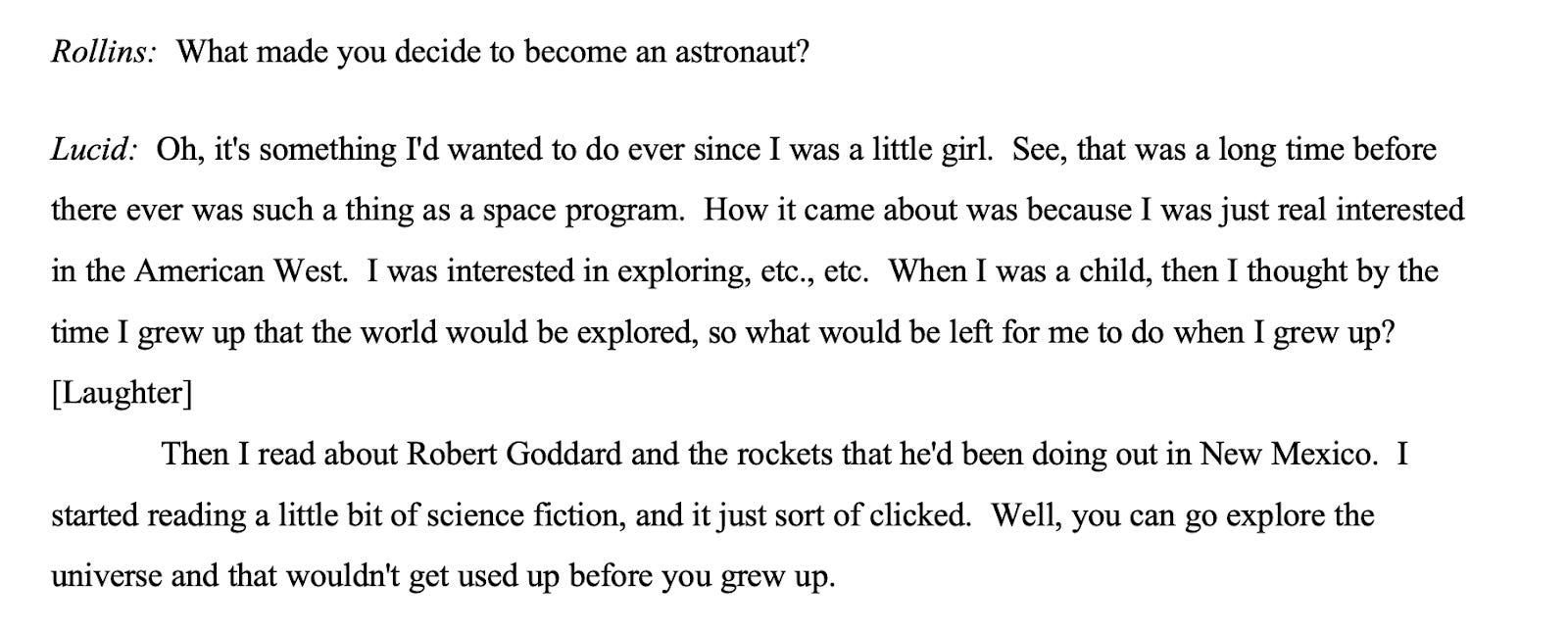
In 1955, when Shannon was in the eighth grade, she was assigned to write about what she wanted to do when she grew up, and when she said that she wanted to be a “rocket scientist and go explore the universe,” her teacher thought she was making fun of the assignment. Undeterred, Shannon would go on to fly five missions in space and become the first female recipient of the Congressional Space Medal of Honor.
I find a lot of inspiration in the idea that we have, in fact, only just begun and that the course being charted for humanity’s collective future is newly shaped every day by our individual actions. Shannon Lucid wanted to be part of something bigger than herself, so she set her sights on it and she went out and did it, and today, the world is better off because of it.
Like many people, I’ve long internalized this idea that I’m simply existing alongside the world rather than within it, not really moving the needle on anything consequential. But seeing people push the boundary of what’s possible while literally rocketing towards new frontiers makes me feel empowered in a way that’s hard to describe.
It obliterates the idea that everything worth doing thing has been done already, that there’s no more room for innovation, and that we’ve simply arrived too late to have a meaningful impact on course of history. It evokes this feeling of, If they can do it, why can’t I?
That’s all for this week! As always, thanks for reading.
Go look at the Moon tonight! I’ll be looking at the same one.

If you’d like to read the full report on wake-up calls used all the way from Gemini to the end of the Space Shuttle program, you can download that here:

If you enjoyed this piece, consider tossing me a few bucks (I will spend it on snacks)
Your substack has become my favorite email of the week, hands down. What a joyful read. Thank you so much!
Thank you for reminding me about the Ketchup Song, that hand jive was waiting deep in the recesses of my subconscious.