
Do animals make art?
technically humans are animals so the answer is yes no matter what

Animals make lots of sounds, so much so that there’s an entire Wikipedia page full of ‘em.

Some personal favorites:
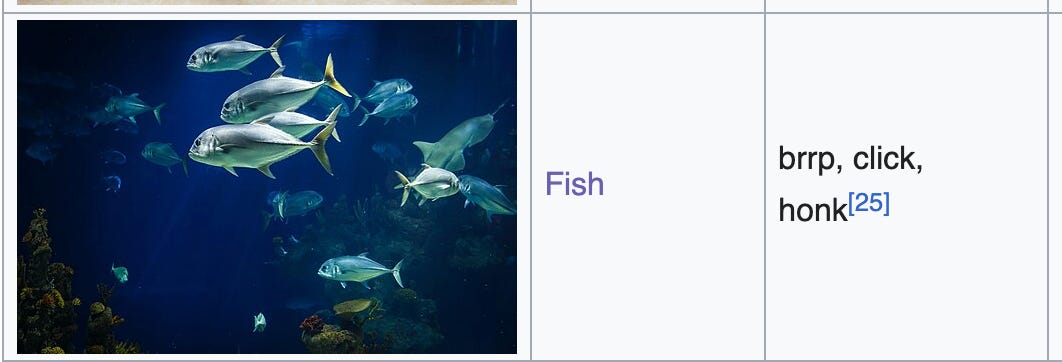
Anyone ever hear a fish honk?1
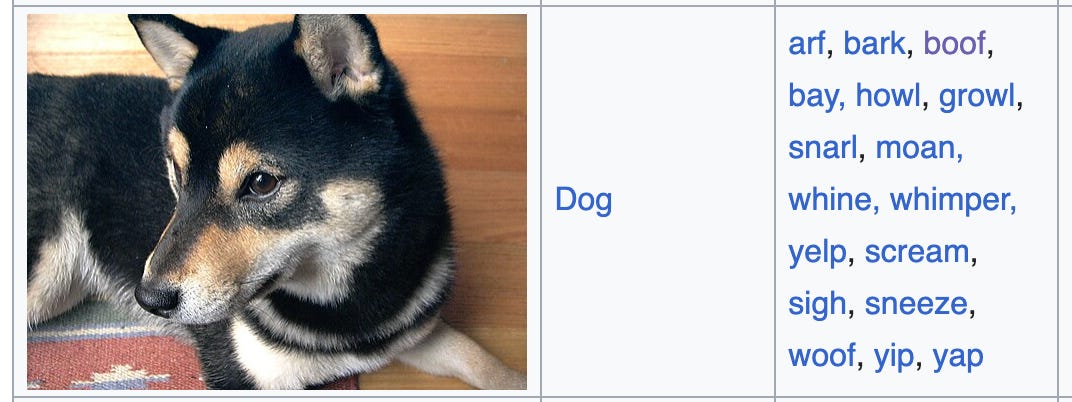
Truly the most sonically versatile species in the entire animal kingdom
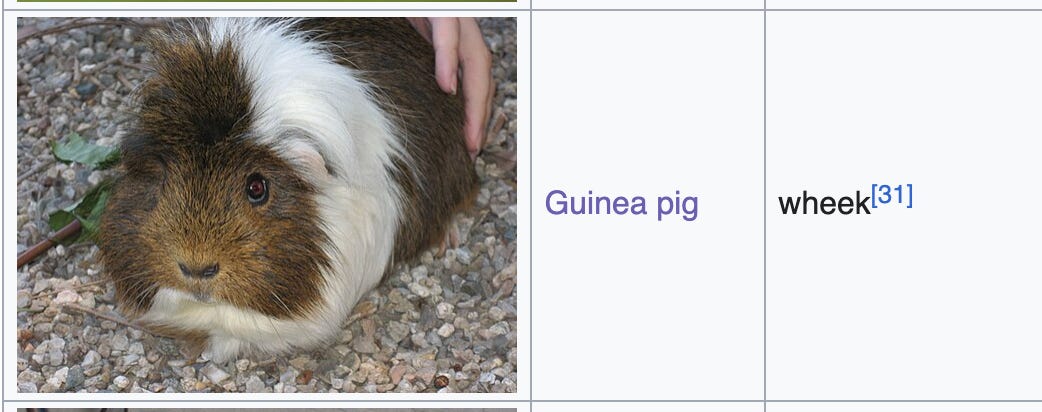
Wheek!
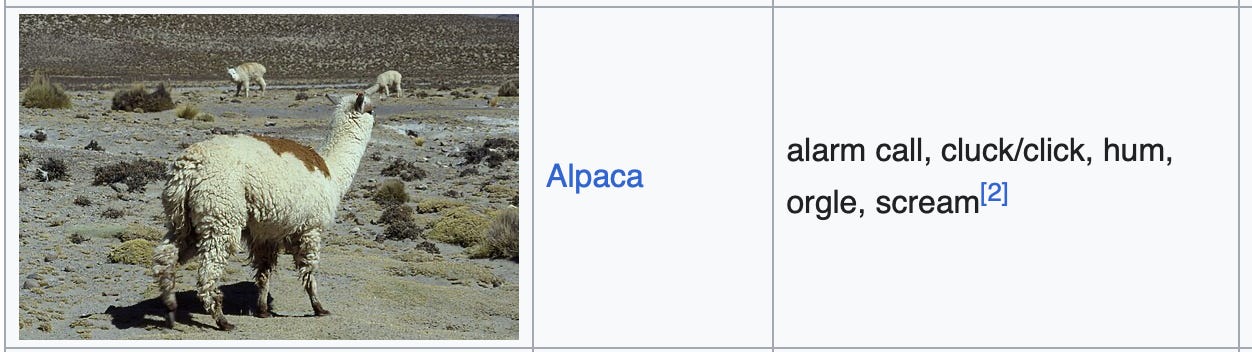
In case you were wondering what an “orgle” sounds like: “His song seems to attract the most ladies out of anybody in our herd. We’re not sure why, but they love his song the best.” (NSFW unless you work on an alpaca farm)
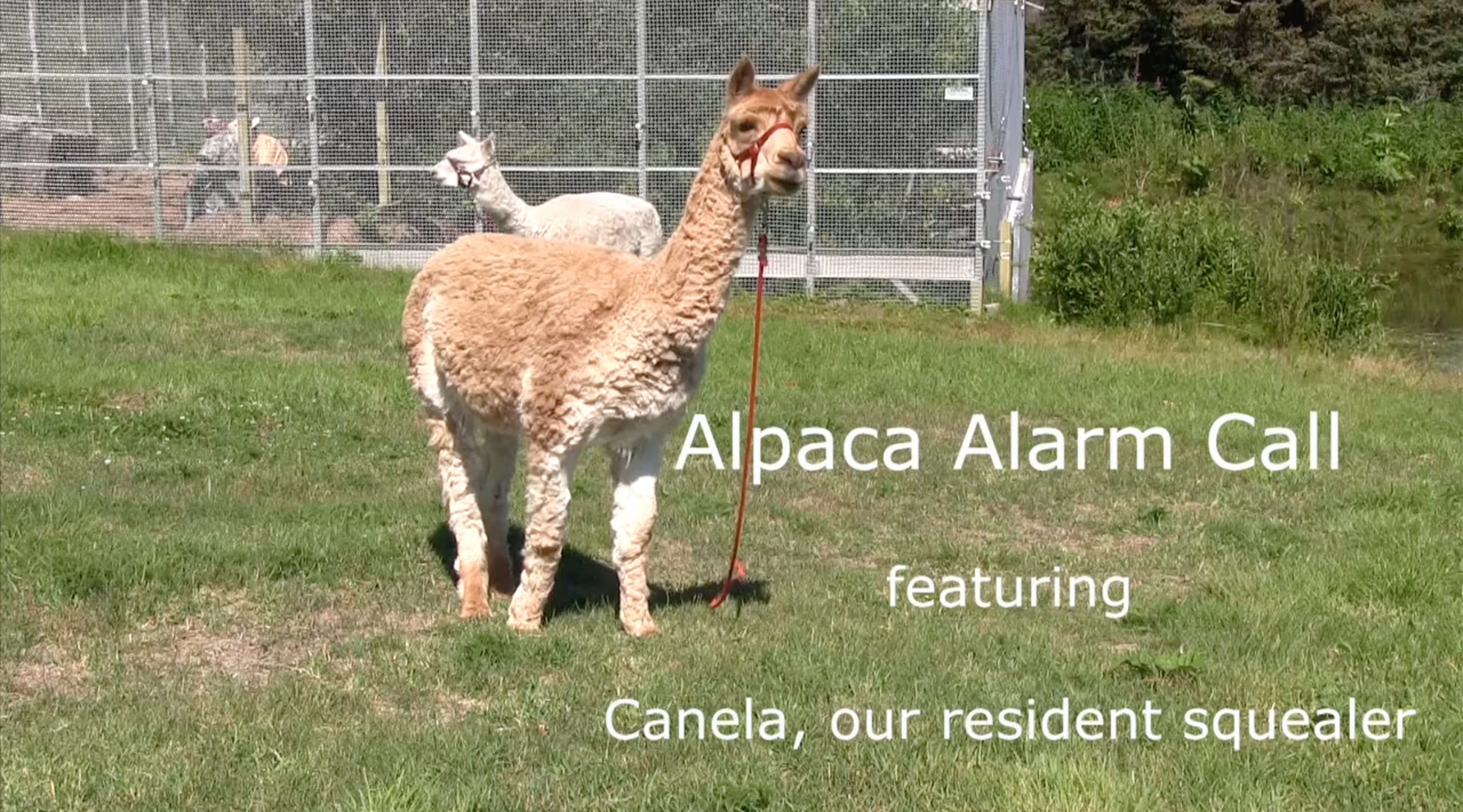
Also sorry another quick detour to satisfy your curiosity on what an alpaca alarm call sounds like, link here. I can promise that it was sufficiently alarming and I literally jumped in my seat even though I knew it was coming.
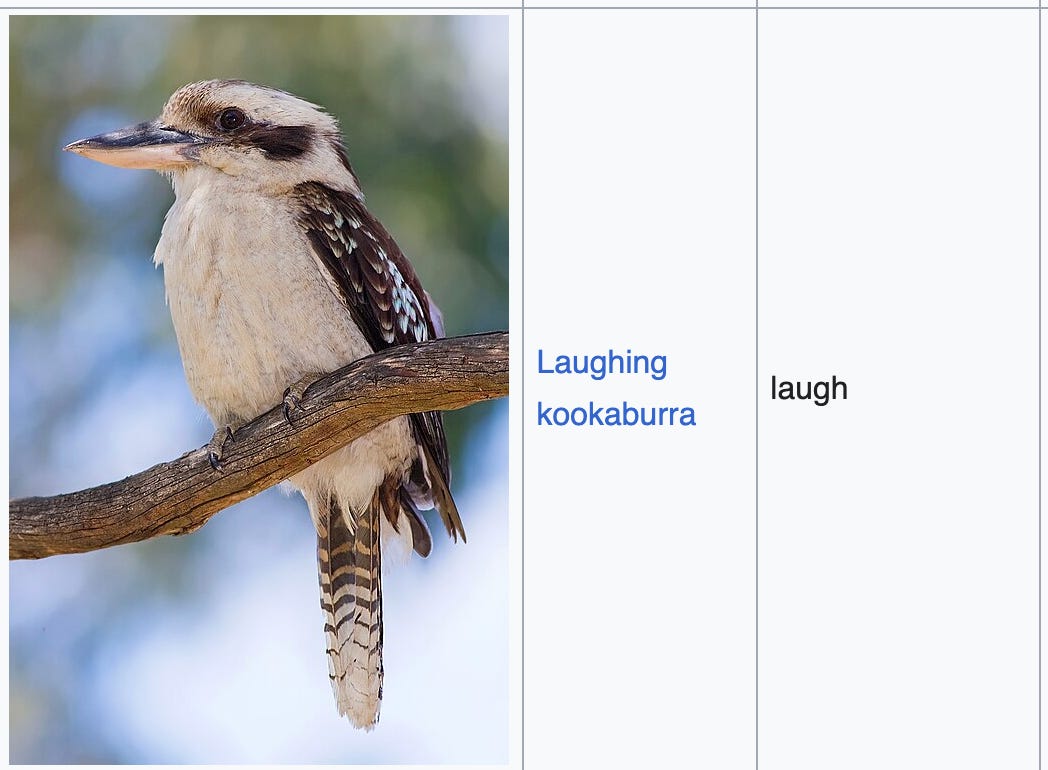
Makes a lot of sense actually
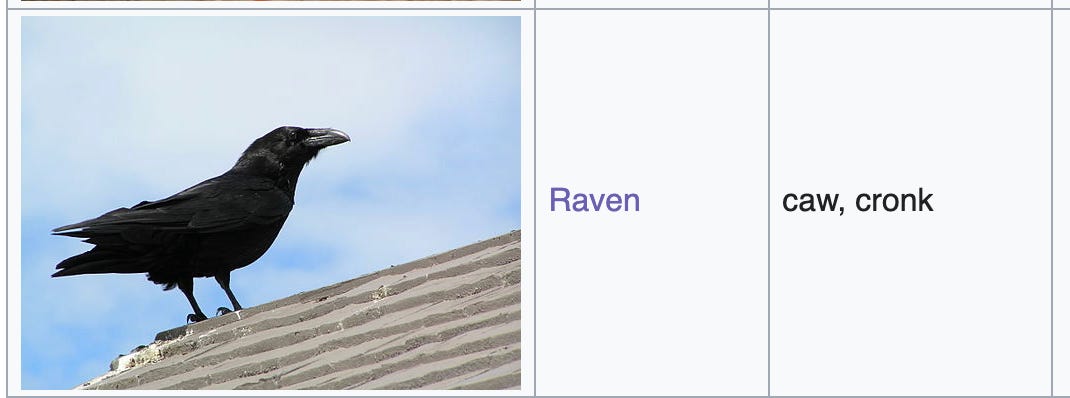
Cronk? Are you for real bro?
As you can see hear, many animal sounds are silly and decidedly unmusical, but some animal sounds are so pleasing to the ear that they’ve inspired the creation of instruments. That’s right, we’re talking about the most pleasant-sounding animal of all: the pig.
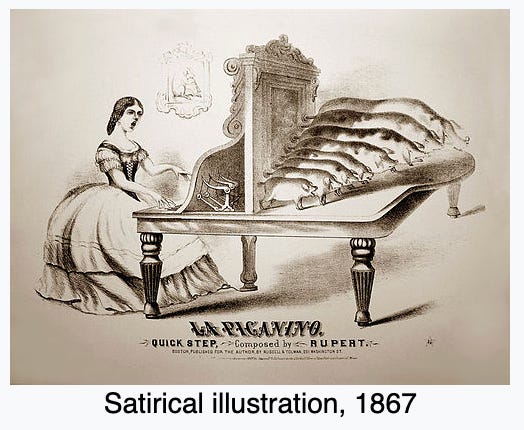
Meet the Piganino. Wikipedia describes this as a “conjectural musical instrument” which is to say it was never actually built but we still have funny drawings of it so we can pretend it did.
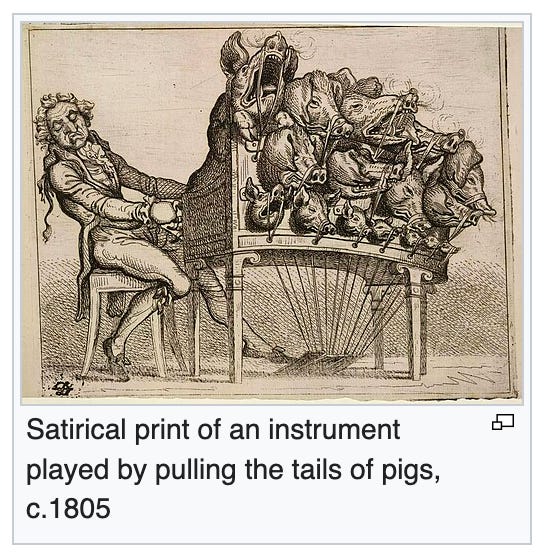
Also known as the “Swineway” or “Porko Forte,” this instrument (would have) worked by poking pigs or pulling their tails to produce pig noises in accordance with the notes of a scale.
It’s rumored that Louis XI challenged a fella called “Abbé de Baigne” to build one of these in the 15th century, and I really tried to find more information on this, but when you Google “Abbé de Baigne” all of the results are just dubiously-sourced blog posts about the Piganino, so I suppose I’m just adding another one to the pile here. Anyway.
Re: Louis XI’s piganino, if it was actually built, one source reports that “The result is said to have been striking, but not very grateful to human ears.” So there you have it. The proud legacy of Louis XI includes the piganino and this dope nickname:
Now, if at this point you find yourself thinking, “Man, I wish there was another imaginary instrument that necessitated animal torture,” you’re gonna love this next part. Introducing the cat organ.
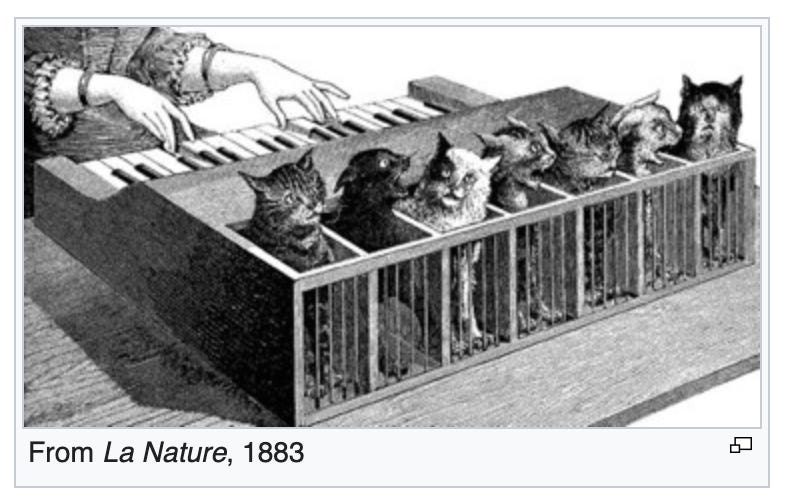
Similar to the piganino, this would have worked by messing with the cats’ tails in accordance with the pressing of a key.
I’m not really sure how they planned on ensuring the cats would only yowl in tune with their designated note. In all my experience with the genus Felis, individual kitties can employ a very wide vocal range, the output of which is largely dependent on whether I am holding a bag of treats or a cat carrier that will transport them to hell the vet. Anyway
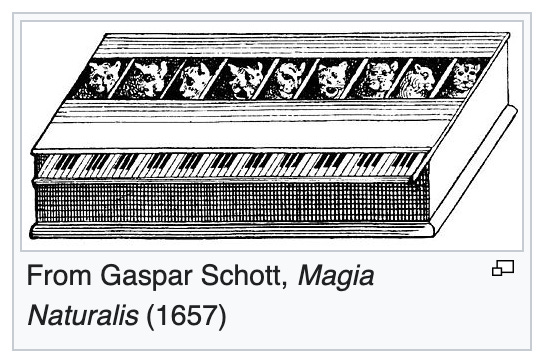
Also like the piganino, there’s no record of a cat organ ever actually being built, but one physician theorized that it could be used to treat patients who had difficulty staying focused. In other words, this would have been an extremely crude early ADHD treatment. Adderall for people in the 18th century, if you will.
Essentially, this thing was so bizarre that it would be impossible for someone not to pay attention to it, so they would be cured. ADHD – poof, gone. That’s how psychiatry works, right? Here’s the good doctor in his own words:
“A fugue played on this instrument--when the ill person is so placed that he cannot miss the expression on their faces and the play of these animals--must bring Lot’s wife herself from her fixed state into conscious awareness.”
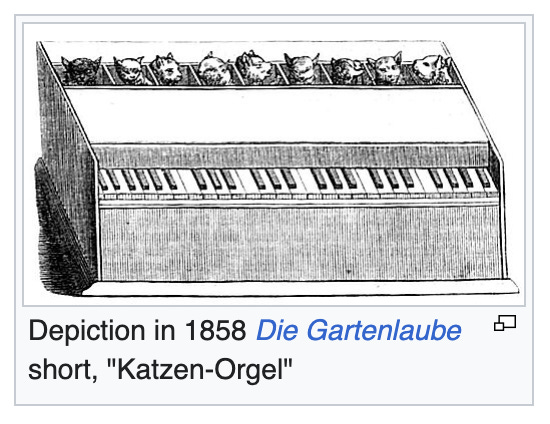
Among the other purported uses of the cat organ was “reducing the melancholy of princes by moving them to laughter,” which has gotta be the most 17th-century medical treatment I’ve ever heard.
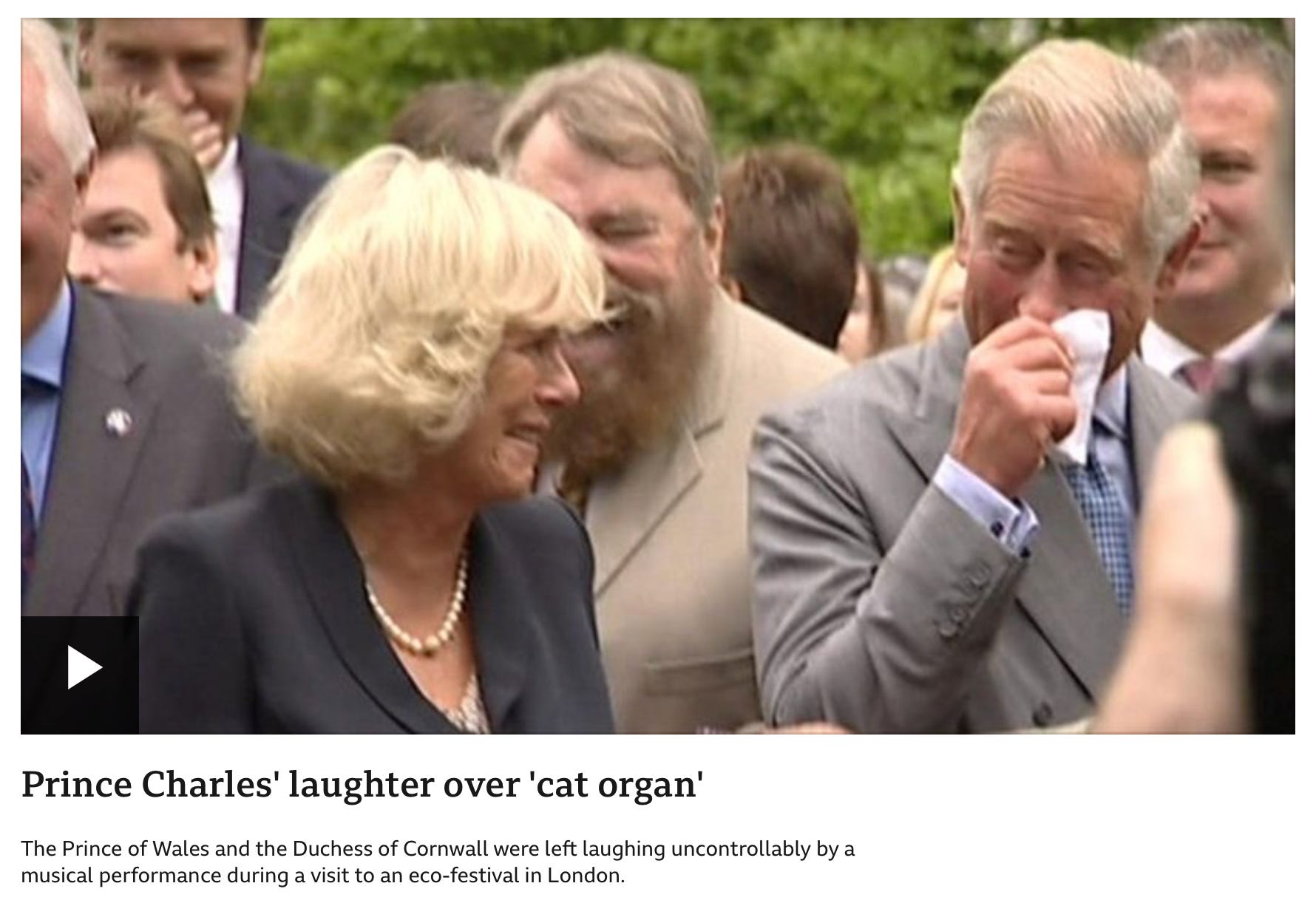
But anyway, this literally happened in 2010 when then-Prince Charles got a huge kick out of a rendition of “Over the Rainbow” played on a cat organ made from squeaky toys. It’s unclear whether Charles had been melancholic prior to the song beginning but he clearly loved this.
Heard Mentality
Occasionally animals are involved in music production in a way that doesn’t necessitate torturing them or vanquishing their dignity. A very novel idea indeed. This is the basic idea behind the Thai Elephant Orchestra.
As NPR puts it, “The Thai Elephant Orchestra is, remarkably, just what it sounds like.”
See for yourself:
The Thai Elephant Orchestra, which “boasts it weighs three times as much as the Berlin Philharmonic,” is made up of a dozen or so elephants playing heavy-duty instruments specially designed for elephant-level strength.
This oddball group was created by Richard Lair, an elephant conservationist, and Dave Soldier, a musician/neurologist. And honestly, when you put two dudes with those job titles in a room together, it was really only going to be a matter of time before they invented an elephant orchestra.
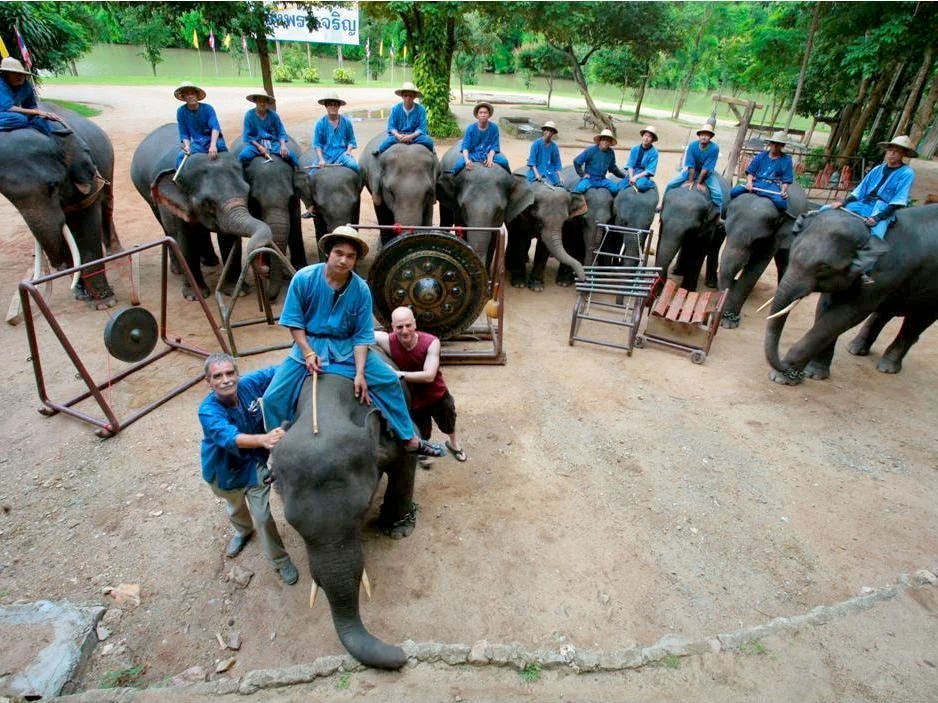
Now, I know what you’re thinking – these elephants are being abused, right? Wouldn’t they rather be doing elephant stuff in the forest? An elephant’s evolutionary imperative is not to play a giant marimba for a crowd of tourists. I don’t know much about elephants but I know that for sure.
But worry not! The elephants are all former working elephants, as in, the orchestra is their escape from a life of working in logging camps and other comparatively awful job assignments. But don’t take it from me, here’s one of the co-founders of the orchestra:
Mr. Lair … is sensitive to any charges of exploitation. Elephants should not be ‘’incarcerated and made to do slave labor,’‘ he writes in the new CD’s liner notes. With habitat vanishing and logging banned in Thailand, however, there’s little alternative to tourist-camp work. At least, he says, making ‘’gorgeous noises of their own volition’‘ is light and pleasurable duty: ‘’What better job than to be in the prison band?’‘
As strange as this idea is, the Thai Elephant Orchestra is actually not the first time humans have made elephants play music.
In the 1850s a circus elephant named Romeo cranked a hand organ while ‘’Juliet’‘ danced, and the Adam Forepaugh and Barnum & Bailey circuses later fielded ‘’elephant bands.’‘ These ‘’probably sounded like a herd of angry Buicks,’‘ said Fred Dahlinger, research director for the Circus World Museum in Baraboo, Wis.
But the ultimate question remains – do the elephants enjoy making music? Do they even know they’re making music? Or are they just hitting objects with other objects because that seems like the natural thing to do when a human puts a mallet in your trunk?
Richard Lair again: “I’d say for about half of the elephants playing in the orchestra is just a job. But several of them genuinely enjoy it.”
Some of them are particularly proficient at their instruments of choice. Here’s Dave Soldier, the other co-founder, elaborating on that:
“Mei Kot likes to smash the hell out of a gong. Chapati is very, very good at the bass. Phong would pick up a stick and we couldn’t get him to stop. Luk Kop could play three drums at the same time. He could even set up rhythms. But he grew to be fairly dangerous, and he’s no longer with the orchestra.”
Wonderfully, the elephants can also play the harmonica. Not a special elephant harmonica, just a normal human harmonica2. Add that to the list of things elephants can do that I cannot.
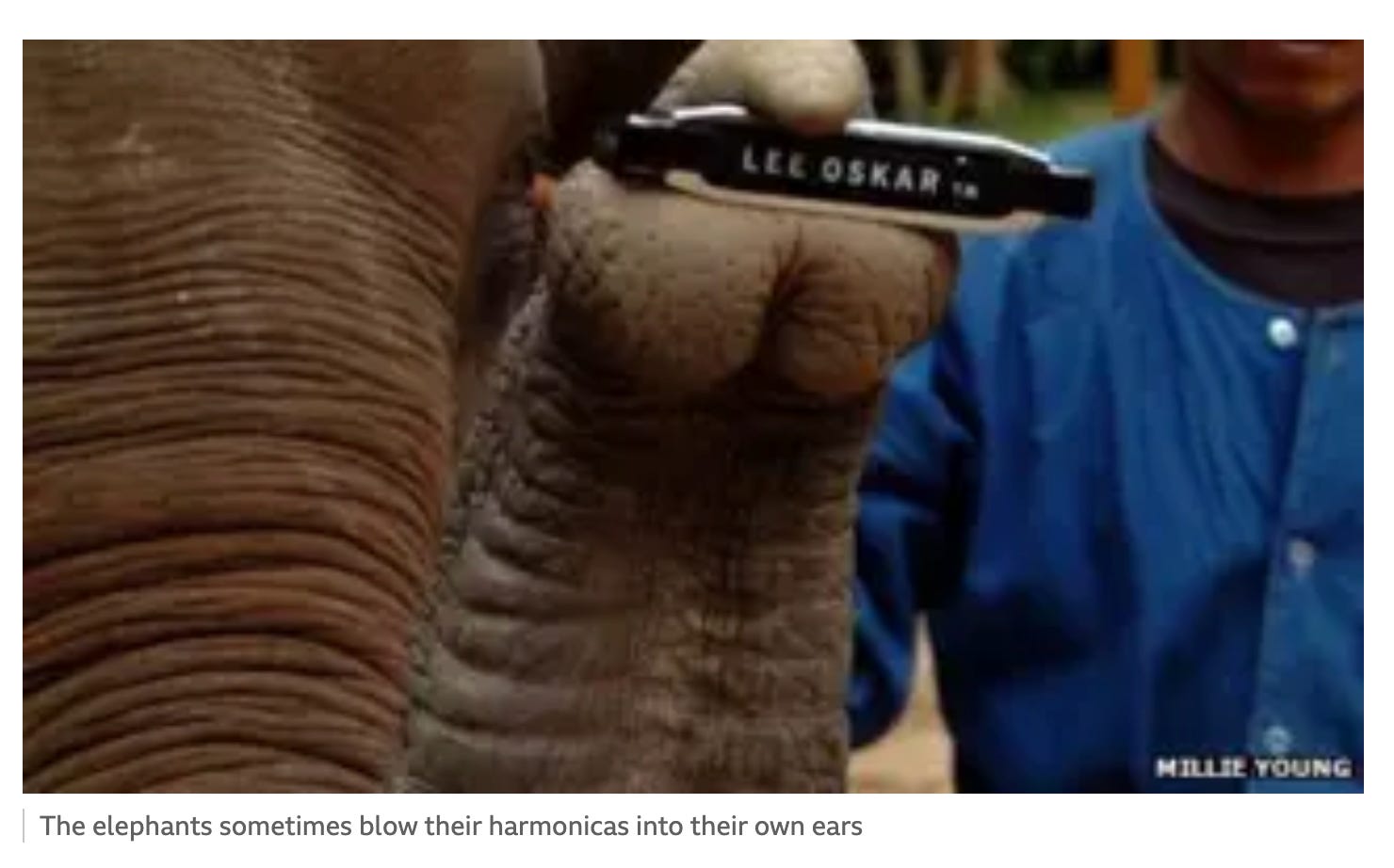
The orchestra’s founders really believe that the elephants have an appreciation for properly tuned instruments and the music they create. Dave Soldier says the elephants “learn where the sweet spot on the instrument is, but no one has taught them how.”
He even ran a sneaky experiment to see whether an elephant could suss out a bad note:
Soldier conducted a test in which he planted a dissonant note on a ranat, a Thai version of the xylophone, and observed how the elephant then avoided it, preferring those that were in tune.
Okay, but surely the orchestra’s founders are biased, right? We’re still lacking empirical evidence that the noises the elephants produce can be fairly classified as music. Unless you count an entire room full of music enjoyers:
Last December Soldier investigated whether the music of the elephants could even be passed off as “genuine” music. A human orchestra in New York performed an arrangement of one of the elephants’ own compositions. The audience was then asked to guess who the composer was. To Soldier’s delight, suggestions included John Cage, Alan Hovhaness, Dvorak, Milica Paranosic, and Charles Ives.
In fairness, I don’t think someone saying “this sounds like John Cage” necessarily settles the debate of “is this genuine music” when John Cage’s best-known composition is just four minutes and thirty-three seconds of pure silence, but anyway.
The validity of the Thai Elephant Orchestra has also been (deceptively) affirmed by a real-life music critic:
“What you do is you play some of the music to your friends, to an audience,” [Soldier] says. “We did this once to a professional music critic from The New York Times, who got pretty upset with me afterwards. And you say, ‘Who’s playing? Is this music?’ And they’ll say, ‘Of course it’s music.’ So far, everyone has. You ask them to guess which group it is; that particular music critic eventually said, ‘I bet it’s a new music group from Asia.’ I said, ‘You got it.’”
Regardless of your feelings on whether the elephant sounds are music or not, Dave Soldier invites us to think a little more philosophically than that:
“I’m saying let’s spark our imagination when we think of our relationships with other animals. This appreciation for art and music seems to go far, far beyond our species.”
At time of writing, the Thai Elephant Orchestra has put out three albums, the proceeds of which “will go to a milk bank for orphaned elephants and a school to improve mahout training -- although Mr. Lair concedes that ‘profits are highly theoretical at this point.’”
The elephants are hovering right around 250 monthly listeners on Spotify as I write these words, and I am determined to be in their top 1% of listeners for the calendar year 2026. I invite you to join me in this endeavor.

Please don’t call it “monkey business” unless you’re prepared to be humbled
Guess what? Animals also make visual art. Monkeys love to paint. Who knew?
The most successful chimpanzee artist of all time was Congo, who lived from 1954 to 1964.

When Congo was two years old, a zoologist gave him a pencil and paper, and by the time Congo was four, he had made 400 drawings and paintings.
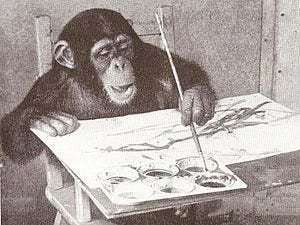
And believe it or not, this monkey had standards! He wasn’t just a simpleton making preschool-quality finger paintings. This chimp was no scrub. He had a process and he stuck to it:
Fascinatingly, if you tried to take a picture away from Congo before he had finished with it, he would scream and throw fits. However, if he considered the picture done, no amount of cajoling would persuade him to continue. The master’s work was complete. That was that.
Congo’s art (described as “lyrical abstract impressionism”) was not universally accepted and/or appreciated, but people were generally cool with it. Picasso was said to be a fan and apparently hung one of Congo’s paintings in his studio.
Here’s a Picasso/Congo anecdote that I’m pretty sure is made up but is still fun anyway:
I read, too, that Picasso was a collector of Congo’s work. This does not surprise me. The notion of a painting monkey would have appealed to the devil in him. What’s more, Congo, as an ape, could not reasonably have mounted any sort of challenge to the ultracompetitive Picasso’s self-esteem. Morris tells an excellent story of a journalist asking Picasso his opinion of Congo’s work. Picasso left the room and returned, his arms swinging like an ape’s and clutching his Congo painting, then jumped on the journalist and bit him. Artists and monkeys are brothers in arms, seemed to be the message.
In 2005, long after Congo had journeyed to monkey heaven, some of his art went up for auction alongside works by Renoir and Warhol. And while the Renoir and Warhol works did not sell, Congo’s art was sold to an “enthusiast of modern and contemporary painting,” fetching a price about 25 times greater than expected.

Just to clarify, the Warhol I’m referring to above is Andy Warhol, the human artist, not Pockets Warhol, the monkey artist.
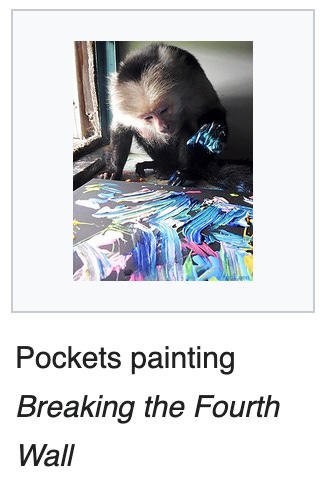
Pockets, who just passed away aged 33 at the beginning of March, was a very successful Canadian monkey artist and his paintings surely would have sold if they were included in this auction.
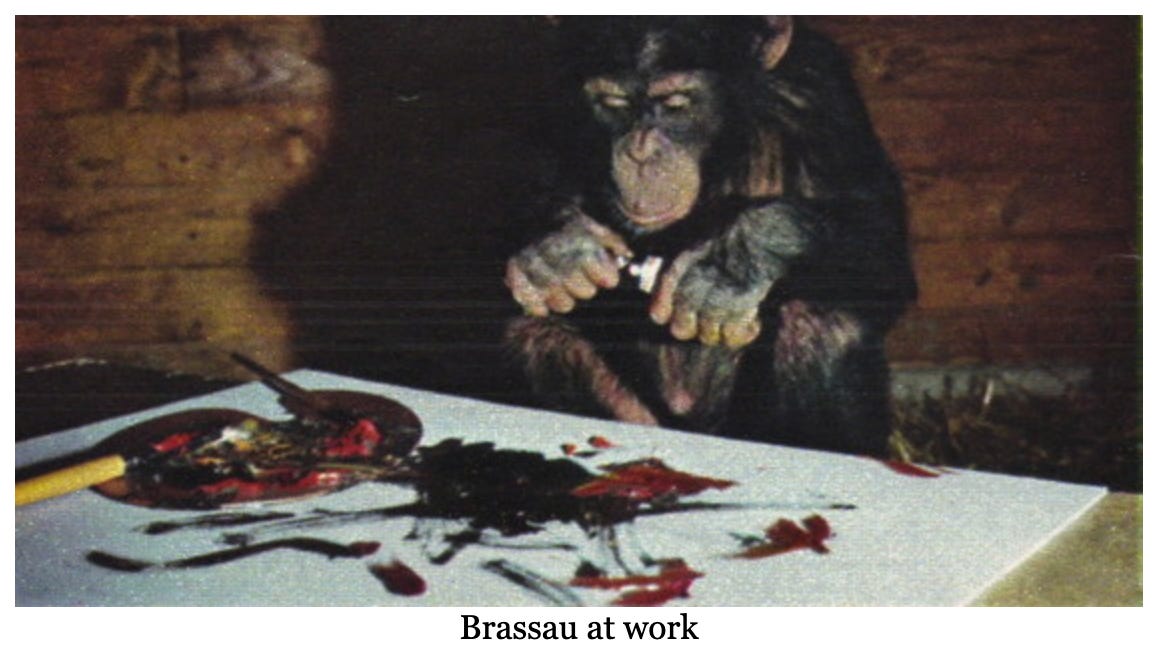
And of course, a discussion of successful monkey artists is not complete without a mention of Peter, or as he preferred to be called, Pierre Brassau.
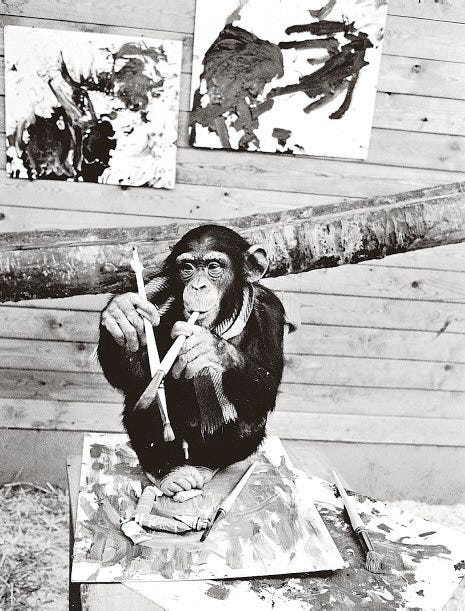
In 1964, a Swedish journalist thought it would be funny to display a bunch of monkey paintings in an art exhibition and try to pass them off as works by an emerging avant-garde French artist called “Pierre Brassau.” And guess what? He was right. This was very funny.
The intention here was to see whether art critics could tell the difference between whatever passed for “modern art” in the 1960s and a painting made by a literal monkey who “ate whole tubes of cobalt blue.”
And while one critic hilariously and correctly noted that “only an ape could have done this,” nobody else suspected they were being duped.
One critic lavished praise upon the monkey, saying, “Pierre Brassau paints with powerful strokes, but also with clear determination. His brush strokes twist with furious fastidiousness. Pierre is an artist who performs with the delicacy of a ballet dancer.”
When the hoax was revealed, this critic was not embarrassed and instead insisted the monkey art was “still the best painting in the exhibition.” Imagine being a (human) artist in this exhibition. Imagine being somehow worse than a monkey at avant-garde art.
_(cropped).jpg)


_b_608.jpg)


Now, an essential question we must pose when it comes to animal-created art is “who owns the art?”
Because, as it turns out, an animal is not considered a “legal person” so far as copyright law is concerned, so the animal cannot own the art they create. But a human also cannot own the rights to something they did not personally create3. So when an animal creates art, who owns the copyright?
Monkey see, monkey do, quite literally
In 2008, British wildlife photographer David Slater was in Indonesia to capture images of the endangered Celebes crested macaque.
The exact details have been hashed out in courtrooms over the years, but somewhere along the way, a monkey got hold of David’s camera and took a selfie.
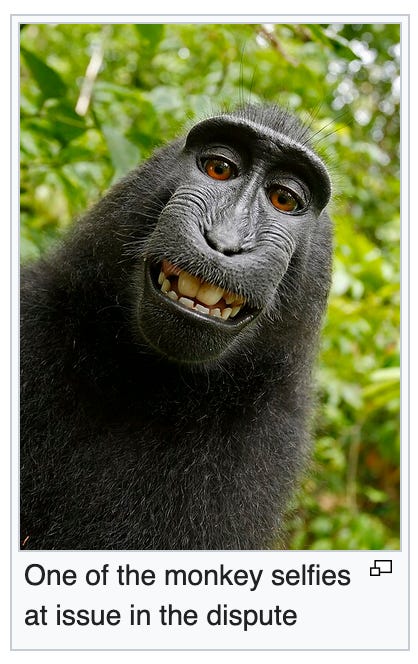

David assumed that because it was his camera that took the picture and because he created the conditions that enabled the monkey to take a selfie in the first place, the photograph belonged to him.
But it’s really a very simple question: who took the picture? Was it you, David? Or was it a monkey? Okay, then. The monkey owns the copyright. Simple as that.
David did not think it was so simple. When various websites, including Wikipedia, posted the image, David got mad and asked them to take it down. Wikipedia said, “Sorry man, you didn’t take the picture. The monkey did.” Thus, they argued, the image was in the public domain.

Copyright law experts are mixed on this. Because, of course, the image wouldn’t exist had David not brought his camera to Indonesia, befriended the monkeys, and let one of them take hold of his camera. But despite all that, it all boils down to one essential question, which is “did he click the shutter button, or did the monkey?” That is really all that matters, and unfortunately for David, the answer to that question hands the ownership of the image to the monkey.
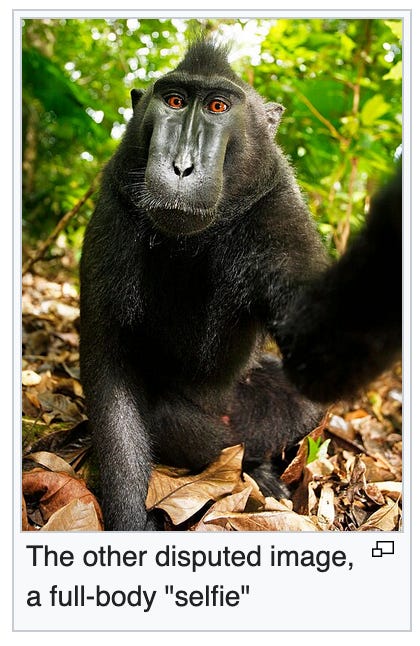

In 2014, the U.S. Copyright Office issued an opinion clarifying that “only works created by a human can be copyrighted under United States law, which excludes photographs and artwork created by animals or by machines without human intervention” and that “[b]ecause copyright law is limited to ‘original intellectual conceptions of the author’, the [copyright] office will refuse to register a claim if it determines that a human being did not create the work. The Office will not register works produced by nature, animals, or plants.”

And the copyright to the image remains in the monkey’s possession to this day! Or, I guess, legally speaking, in no one’s possession, but spiritually it belongs to the monkey and it will always belong to the monkey.
So, in sum, all hail monkey artists, all hail animal artists of other species (I’m including humans in this), and never let anyone tell you something isn’t “art” just because a paint-eating chimp made it. I think that is the primary takeaway I want you to have from this post. Ok
As always, thanks for reading! Until next time :)
If you enjoyed this piece, consider tossing me a few bucks (I will spend it on snacks)
i also get an inordinate amount of joy just imagining a fish making all three of these sounds in quick succession. Imagine scuba diving when the fish in front of your face just goes “brrp click honk!” i would intentionally disconnect my breathing apparatus out of sheer panic
"Asian elephants can hold a harmonica very easily, as the end of their trunk has finger like abilities," explains Soldier. "One morning I got to the jungle at sunrise and all around me was the sound of a dozen elephants playing the harmonica as they converged on the river for their morning bath. That was really an astonishing experience."
i am speaking very generally based on an extremely rudimentary understanding of copyright law here, pls do not @ me
Canela stole the show here
My pet rabbits definitely make art. One of them will like chew around the edges of paper to make little scalloped edges. The other one is more of craftsman, he makes bunny shaped chairs out of cat scratchers. They also do random destruction that I don't think is art but they may disagree.