

Who was the first clown?
this is not a trick question and the answer is not "ur mom"

Pound for pound, one of the smartest decisions I’ve ever made in my life was joining a clown troupe.
“Thought you were already a clown?” was the most common response I got from the people in my life with whom I shared this news, and to that I say, “Yes, but now it’s considered an art form rather than a complicated amalgamation of personality defects. And you are required to clap.”
Despite the fact that I had zero formal clowning experience prior to joining the troupe, this has been perhaps the least surprising personal revelation that I’ve ever shared with the people in my life. Because as it turns out, when you have a lifetime’s worth of experience being a generally clownish person, people kinda assume you were already doing that anyway.
So what have I learned during my time as a clown?
The most fundamental thing I need you to understand about the art of clown is that it is primarily about seeing the world with curiosity and wonder. When you embrace clown, you see the world in a way that you haven’t seen it since you were a kid and you allow yourself the freedom to engage with it on that basis regardless of how others will perceive you.
When my clown troupe begins our rehearsals, we often do breathing exercises together.
“Breathe in clown, breathe out reality.”
We all close our eyes and take a few deep breaths together and literally forget about the fact that the outside world exists. In this magic snippet of time in some rented rehearsal space somewhere, jobs don’t exist, emails don’t exist, traffic doesn’t exist. It’s just clown.
When we breathe out reality, we all just release whatever sound wants to come out at that moment. Collectively, it’s this big exasperated groan as we drop for a moment the responsibilities of the real world and focus on nothing but being silly for the next two hours. This exhale, where I give myself permission to briefly forget about anything and everything happening outside that room, where I allow my worries to pause, is one of the most cathartic things I get to experience on a regular basis.
You open your eyes and you see the world as if for the first time ever. You approach everything with awe. I won’t lie, my first few times doing this it kinda felt like I was just going through the motions and pretending a little bit, but the first time you’re able to really embrace this attitude it is transcendent, like, “Why haven’t I been living my life like this the entire time?”
As one clown says, “When you put on the makeup, you feel free. You can be silly and joyful. You get rid of all your inhibitions. It’s license to play. You have this great freedom to be your true self.”
But guess what? You don’t even need the clown makeup to be silly and joyful! You can just do that literally whenever you want! (Although the makeup certainly helps.)
And when you become a clown, you’ll be in very good company. Recent clowns of note include Heated Rivalry’s Connor Storrie, who credits his clown experience with “teaching him to be unflinching in the face of exposure, both emotional and physical,” and whose SNL “Stripper” sketch was directly inspired by an original clown bit he came up with. Try not to think about Connor Storrie in full clown makeup while you’re watching the sex scenes in Heated Rivalry.
But Mr. Storrie was just the latest in the long and proud tradition of clown, an art form which traces its roots back much further than you would expect.
Clowns are about as old as the literal Pyramids
History’s first clowns came from the Fifth Dynasty of Egypt (c. 2498–2345 BC). This was also about the same time that they started getting super into the Sun god, Ra. Imagine if they’d worshipped clowns instead? Hoping I get reincarnated into that alternate timeline. Anyway.
Clowns appear in many different cultures across the centuries, including ancient Greece and Rome as well as the indigenous cultures of the Americas.
The Heyoka in Lakota and Dakota cultures is described by Wikipedia’s editors as a “sacred clown shaman” and occupies a very important cultural role by holding a mirror to people’s actions and “forcing them to examine their own doubts, fears, hatreds, and weaknesses.”
They help people ponder important questions, ground themselves in reality, and find levity even during times of hardship. Wikipedia again: “For example, if food is scarce, a heyókȟa may sit around and complain about how full he is; during a baking hot heat wave, a heyókȟa might shiver with cold and put on gloves and cover himself with a thick blanket. Similarly, when it is freezing he might wander around naked, complaining that it is too hot.”
Lakota holy man John Fire Lame Deer gives this explanation for why Heyoka are so important to his culture:
For people who are as poor as us, who have lost everything, who had to endure so much death and sadness, laughter is a precious gift. When we were dying like flies from white man’s disease, when we were driven into reservations, when the government rations did not arrive and we were starving, watching the pranks and capers of Heyókȟa were a blessing.
The modern clown as we know it, with white face makeup and all, first came about in the 1800s and was the brainchild of one Joseph Grimaldi.
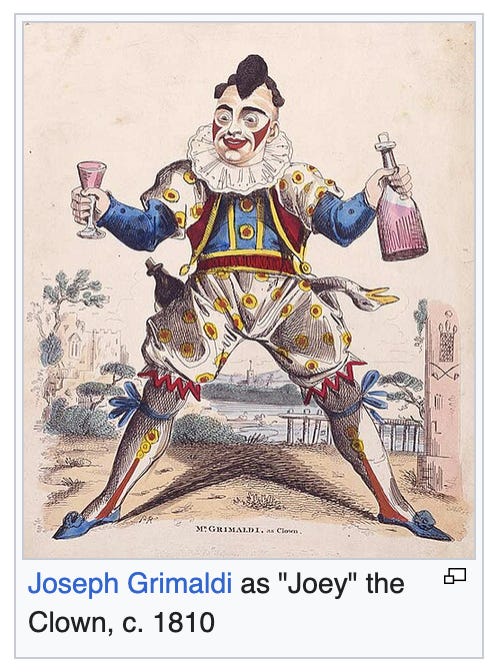
Grimaldi was extremely popular during his lifetime. According to Smithsonian Magazine, “It was claimed that a full eighth of London’s population had seen Grimaldi on stage.”
At the beginning of Grimaldi’s career, the archetypal clown character more closely resembled “a country bumpkin” than anything you’d see at the circus today. But in 1802, the world of clown was forever changed when “Grimaldi started applying distinctive face paint to make him visible from the back of London’s vast theaters.”
In addition to originating the modern clown character, Grimaldi may also be responsible for the popular conception of the clown as a tortured performer who uses their whimsical makeup to mask some deeper pain.
Smithsonian again: “As Grimaldi himself joked, ‘I am GRIM ALL DAY, but I make you laugh at night.’”
This legacy of a dual-life reality for the clown was further cemented after Grimaldi’s death, when a young Charles Dickens was tasked with editing the late clown’s memoirs.
Dickens is credited by one clown researcher “with watering the seeds in popular imagination of the scary clown—he’d even go so far as to say Dickens invented the scary clown—by creating a figure who is literally destroying himself to make his audiences laugh.”
If you’re scared of clowns I do believe you have Charles Dickens to blame:
What Dickens did was to make it difficult to look at a clown without wondering what was going on underneath the make-up: Says Stott, “It becomes impossible to disassociate the character from the actor.” That Dickens’s version of Grimaldi’s memoirs was massively popular meant that this perception, of something dark and troubled masked by humor, would stick.
But Grimaldi’s legacy isn’t all sadness and fear! In recognition of his preeminent role in clown culture, an east London church has held a clown-themed Sunday service in his honor every year since 1959.
From The New York Times:
“We can be faithful to God and also have a laugh,” Laura Luz, the church’s vicar, said in an interview, noting that, during her eight years leading the service, one clown had thrown a custard pie in her face and another had encased her in a giant soap bubble.

While Grimaldi may have been the first modern clown, he was far from the last, and the cultural impact of clowns would only intensify as the years marched on. Enter Bozo.
Bozo is a title of respect, actually
Perhaps the most recognizable clown in American history, maybe apart from Ronald McDonald (more on him later), is Bozo the Clown.
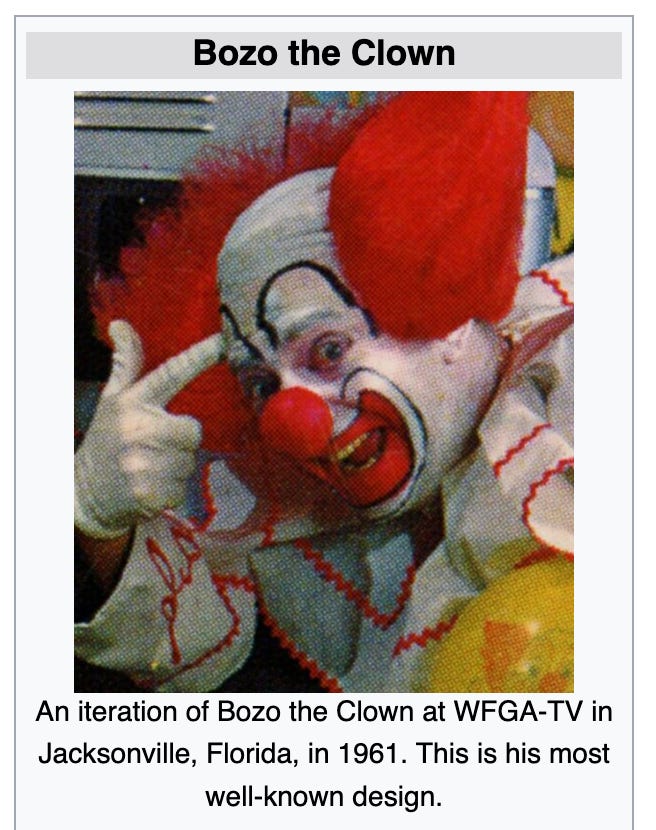
You’ll notice the caption for this image says “an iteration of Bozo” – what’s the deal with that?
Turns out Bozo clown shows were produced under a franchise model rather than syndication, meaning that instead of there being just one Bozo show that local stations paid for the rights to broadcast (i.e. how Jeopardy! or Wheel of Fortune works), each individual station had to produce their own unique version of Bozo to air.
There were hundreds of individual Bozos across the country. In some major metropolitan areas, you might even see one Bozo in one town and a completely different Bozo in just the next town over.
This is really interesting to me because Bozo, as mentioned, is one of the most recognizable and culturally significant clowns in American history, and yet if you grew up with Bozo and have fond memories of watching his show on TV, your memory of him is probably completely different from someone else’s memory of Bozo unless they happened to live in the same media market as you as a child.
Like, I grew up watching SpongeBob so I’m trying to imagine what it would be like if there were hundreds of different versions of SpongeBob across the country. I’d form all these memories of what my SpongeBob did on TV and what that meant to me, and then one days years later I’d make a joke to a friend like “I wumbo, you wumbo,” and they’d be like, “What the hell are you talking about?” because their SpongeBob (or Patrick, I guess) never said that.
To be perfectly clear I did not have a Bozo growing up and literally my only interaction with the Bozo IP in my entire life before writing this post was the “Bozo Dubbed Over” sketch from I Think You Should Leave so maybe I’m not really the person to opine on all things Bozo, but I digress.


.jpg)
Anyway, Bozo was a really big deal during the second half of the 20th century. The first person to play Bozo was Pinto Colvig, who was also the original voice behind Disney’s Goofy and Pluto, and Caroll Spinney, the puppeteer behind Big Bird and Oscar the Grouch, appeared as several different characters on the Boston production of Bozo.
By far the most popular local version of Bozo was WGN-TV Chicago’s Bozo’s Circus. Not only was Chicago Bozo the top Bozo, but it was also one of the most successful locally produced children’s programs in the entire history of television. The waiting list for tickets to the studio audience eventually reached ten years long, so WGN simply stopped taking reservations for an entire decade to let the list clear up.
Evidently this did nothing to quell people’s passion for Bozo. Here’s what happened when they opened the waiting list up again ten years later:
On the day in 1990 when WGN started taking reservations again, it took just five hours to book the show for five more years. The phone company reported more than 27 million phone call attempts had been made.
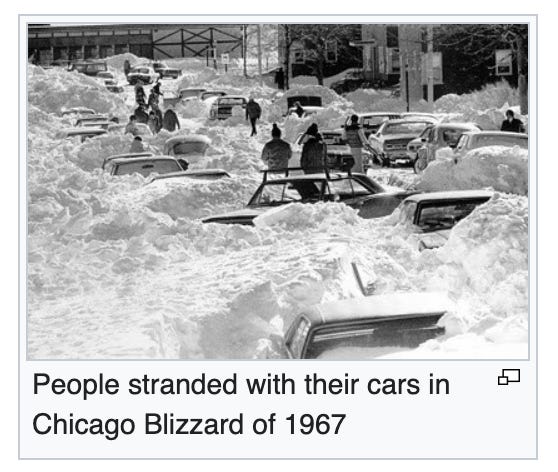
I really cannot understate how intensely dedicated people were to Bozo. In 1967, Chicago got hit by a blizzard so bad that it has its own Wikipedia page, dumping a record-setting 23 inches of snow on the city. To this day Chicago has never received more snowfall in a single storm. Ten-foot drifts covered the runways at Midway Airport. Eighty-six people died throughout the region.
According to a National Weather Service recounting of the blizzard, “20,000 cars and 1,100 CTA buses were stranded in the snow” and the Chicago Tribune reported that “[o]ne woman who worked downtown and lived on the city’s North Side--normally a 35-minute commute--spent four hours making the trip.”

The National Weather Service again:
“Helicopters were used to deliver medical supplies to hospitals, and food and blankets to stranded motorists. Expectant mothers were taken to hospitals by sled, bulldozer and snow plow.”
[...]
“The 1967 snowstorm probably caused the biggest disruption to the commerce and transportation of Chicago of any event since the Great Chicago Fire of 1871. “
And yet, despite all the death, disruption, and disorder that befell Chicago in the wake of this historic storm, seven hours after snow started to fall there were still 193 people standing in line outside Bozo’s studio, waiting to use their tickets. It was one of the only times in the show’s history that a live taping had to be canceled.
Quick tangent, but I think you’ll appreciate this – the quantity of snow that fell on Chicago was simply so immense that figuring out how to dispose of it all became a major logistical issue, forcing people to get creative.
Some railroads started loading snow onto trains that were headed south, the idea being that it would just melt in transit. This worked well, and the idea was so novel that local and national media caught wind of the story and reported on it.
The story made it all the way down to Florida where a 13-year-old girl heard about the snow trains and decided she wanted some snow to be sent to her. So, she sent a letter to the president of the Chicago, Burlington and Quincy Railroad asking him to send snow, and he actually agreed to do it.
From WBEZ Chicago:
“It’s just that 13-year-old Terri Hodson hadn’t realized that all of the other southbound snow was shipped in uninsulated cars — the whole point being to melt. But Quinn, possibly sensing a brilliant PR stunt but possibly out of the goodness of his heart, had the snow shipped to Florida in refrigerator cars.”
Unfortunately for Terri, the snow was absolute garbage quality by the time it got to Florida:
“I had expected it to be soft and powdery. You know, like, dripping snowflakes and it would just come pouring out of the car. Unfortunately after a week’s ride in a refrigerator car it was no longer soft powdery snow. It was quite icy.”
Anyway, it was a crazy storm, but as we can see, it was still not enough to stop people from trudging through the snow to go see Bozo. He was an icon whose legendary status transcended international borders.
Come to Brazil
There were foreign versions of Bozo all across the world, but one of the most popular was in Brazil. I probably sound like a broken record at this point, but the people of Brazil were absolutely obsessed with Bozo.

Bozo had a huge cultural impact and continues to be referenced in art and media to this day. Bozo’s influence has even stretched to the political sphere – opponents of former president and wannabe dictator Jair Bolsonaro have often referred to him as Bozo to make fun of him.
One person who didn’t like this (besides Bolsonaro) was the first guy who played Bozo in Brazil, who said that calling Bolsonaro Bozo was a compliment, actually – “Bozo is a serious character, a good, honest character. They have nothing to say bad about the character.”

Now, Brazilian media reports that this dude is a huge Bolsonaro supporter, so he’s obviously biased in saying this, but to be honest, this viewpoint tracks with my experience in the clown community. Like, ever since I became a clown I have stopped using “clown” as an insult. Clowning is a respectable profession, okay? It is not an insult. Please do not disrespect my culture.
We’re gonna talk about Ronald McDonald in a second, but it would be a dereliction of my duty to you as a reader if I didn’t dig into this tiny mention of Bozo’s broader cultural impact on Brazilian media:

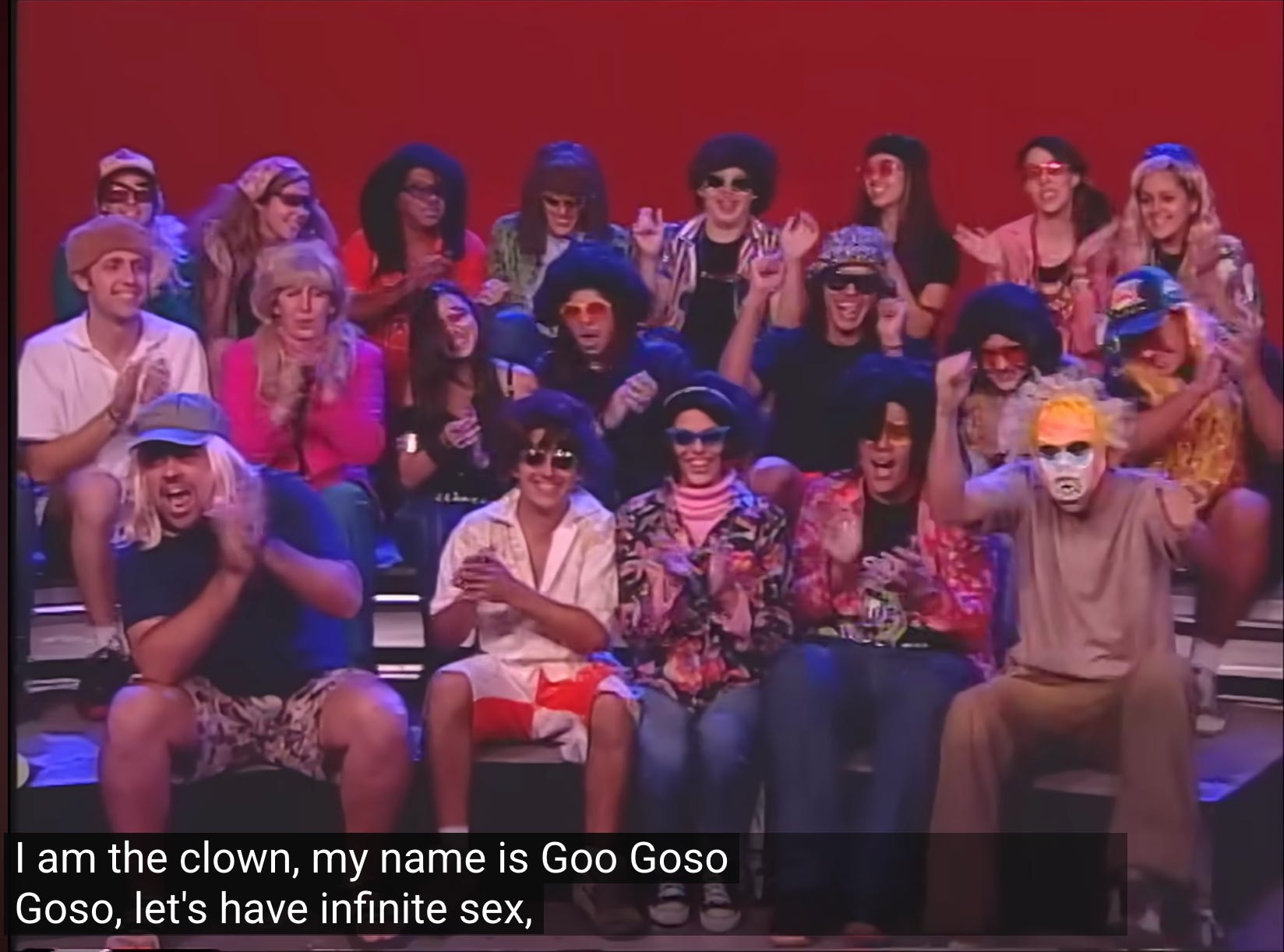
Don’t worry, we’re gonna keep this PG-13. Here’s a quick rundown of what erotic Brazilian Bozo (called Gozo) was all about in three images:
Gozo intro theme song:
Gozo takes calls from his audience:
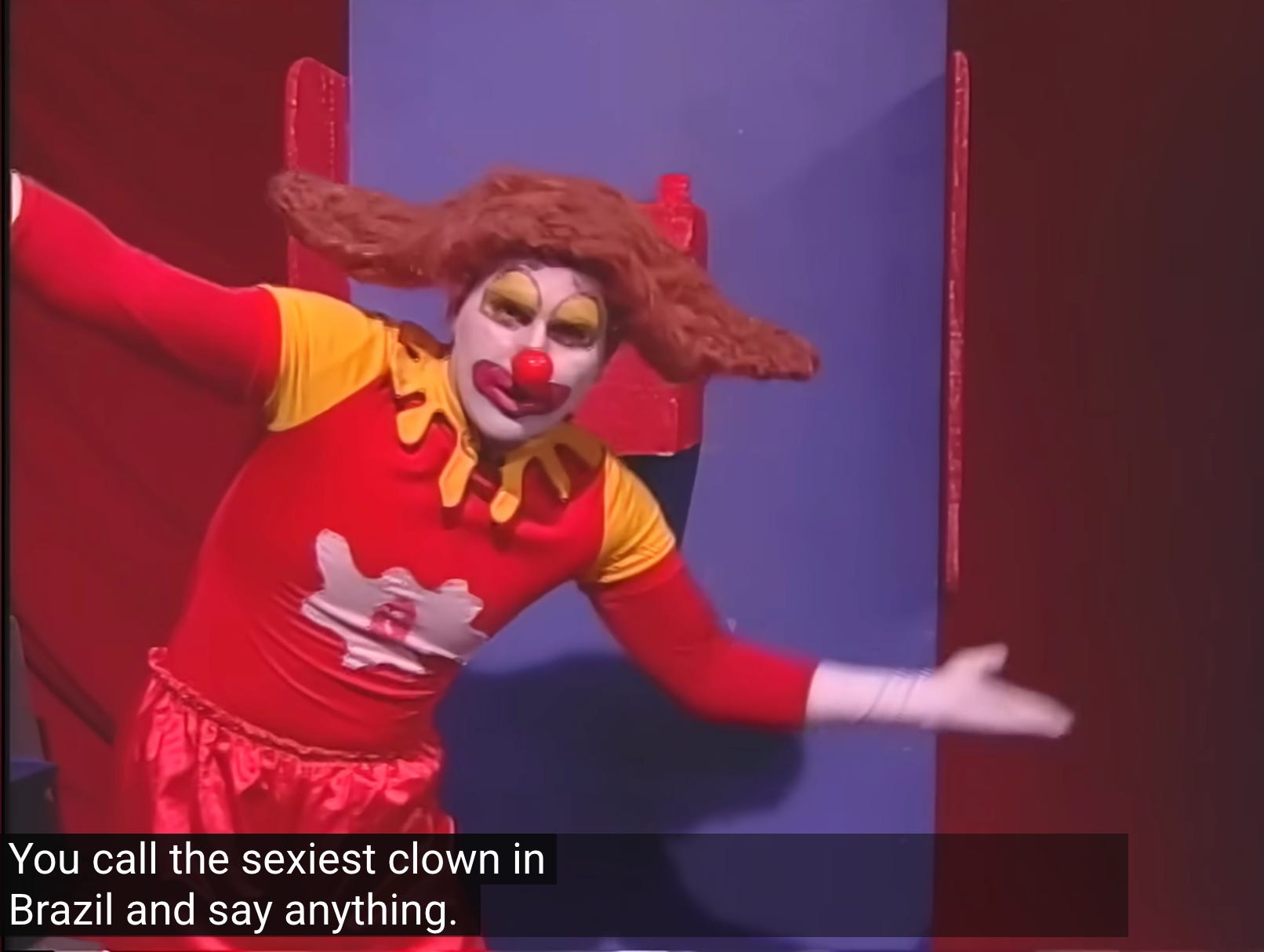
(Right after this Gozo gets a phone call from an actor portraying a “14-year-old with the body of an 18-year-old” and he immediately invites her to his house)
Gozo Gets Threatened
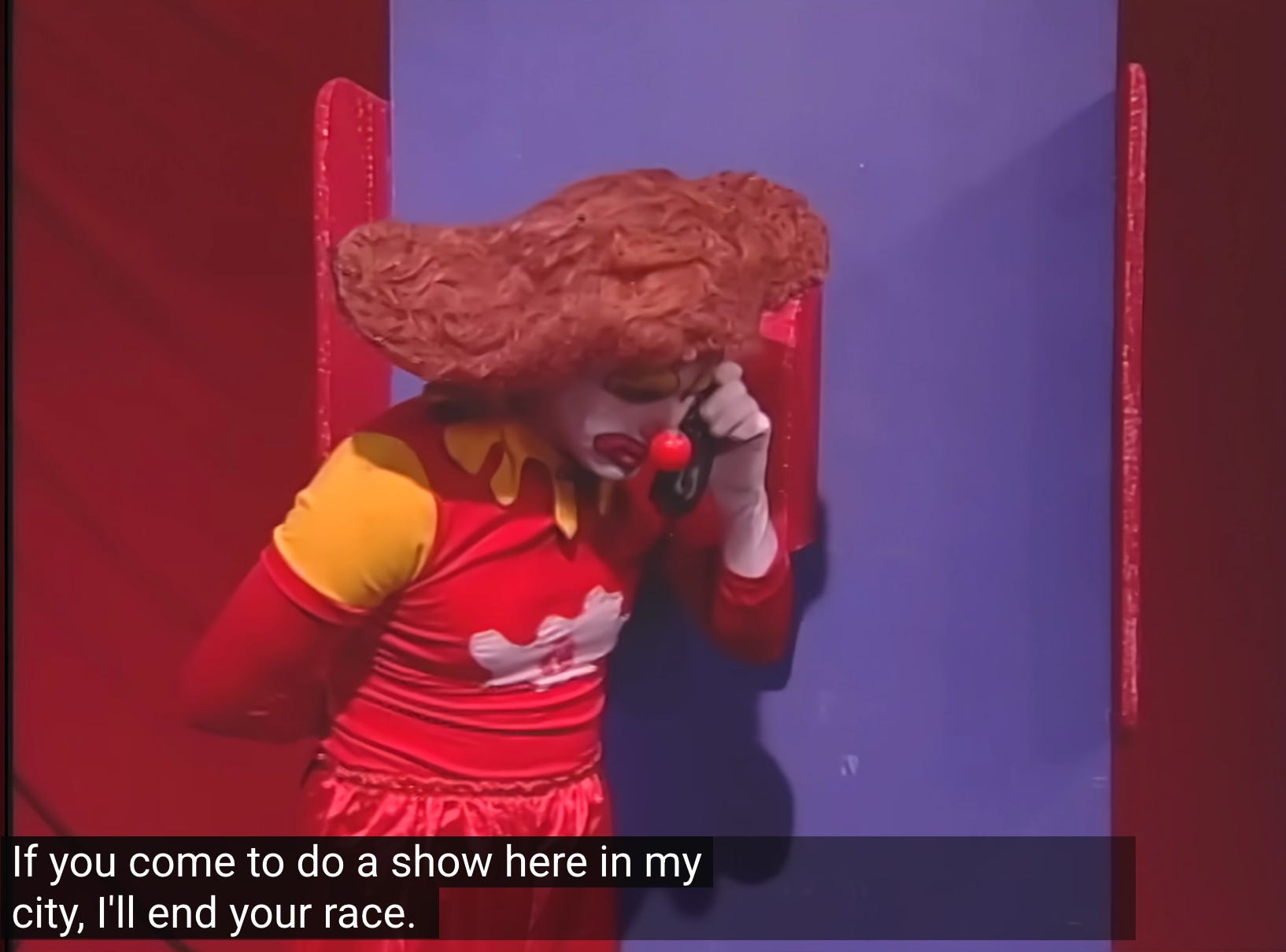
Gozo also shares a reimagining of the Three Little Pigs where, when the wolf blows the first house down, the pigs are discovered to be having a “tremendous orgy.” Really great stuff.
(Full episode here)
Okay, I don’t have much to say about the cheeseburger clown, but you should check out the television debut of Ronald McDonald just to see how different fast food commercials were back in 1963.
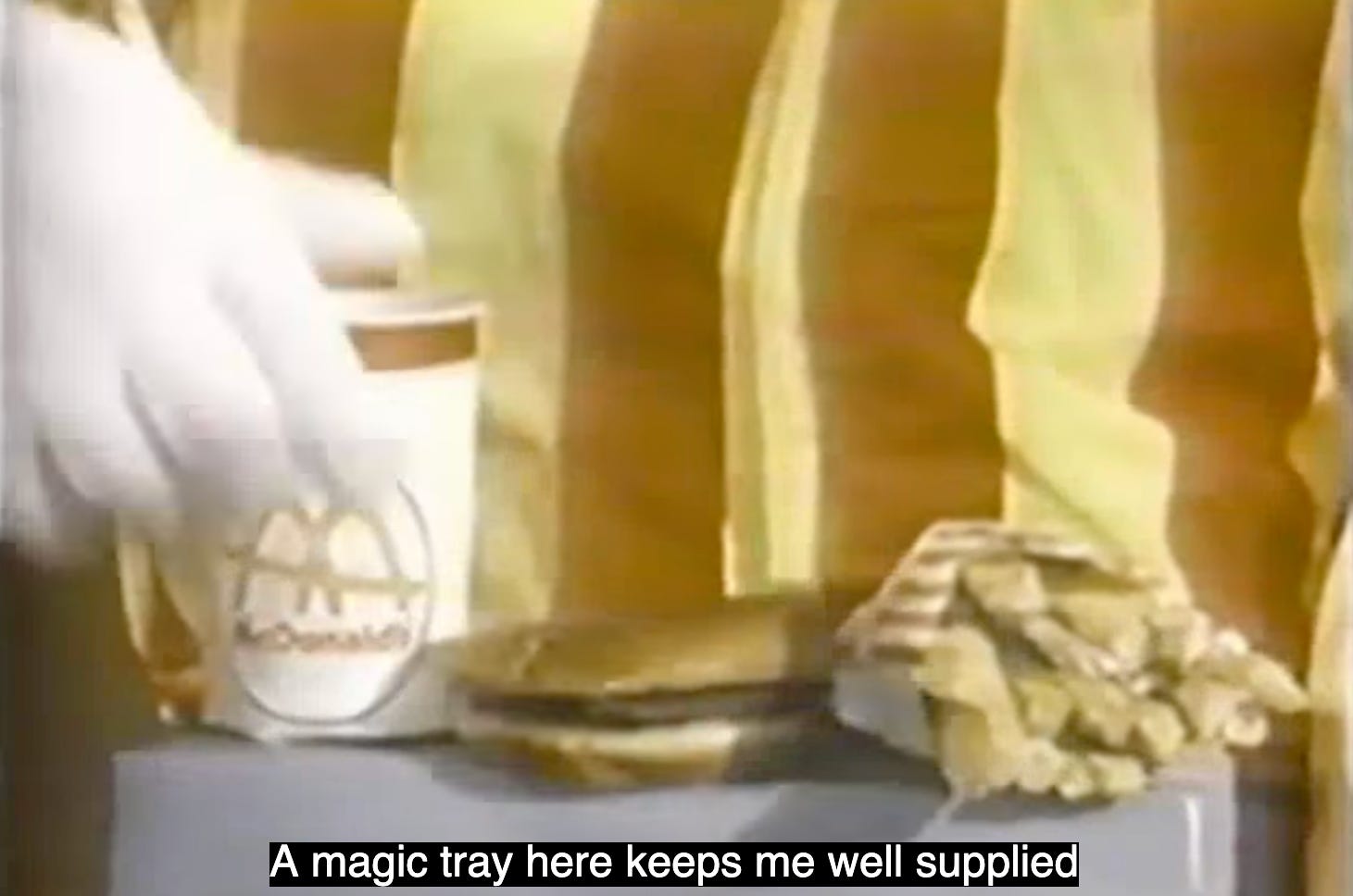
This is so funny to me because these days, restaurants work so hard to make their food look unrealistically pristine in commercials. But here, the burger looks like absolute trash. They’re not even trying to make it look good. They’re showing you what you’ll get, they’re being honest about it. It’s almost refreshing.
I’m here to tell you that Pennywise is a fraud
Okay, it’s finally time to address the elephant in the room – or, I suppose, the evil clown in the room? Sorry, to be clear, there’s not an evil clown in the room with us right now. Didn’t mean to frighten you.
Scary clown media kinda took off in the 1980s and I’m not sure their/our image has recovered since.
Reasons for this sudden influx of anti-clown attitudes include but are not limited to:
The serial killer John Wayne Gacy (aka the “Killer Clown”) who was caught and arrested in 1978;
Stephen King’s It, which came out in 1986 and became the best-selling hardcover fiction book in the U.S. that year;
And perhaps just the general way that people were in the 1980s? (See: Satanic panic, Presidency of Ronald Reagan, Hairstyles in the 1980s)
From a professor of psychology in 2013:
“You don’t really see clowns in those kinds of safe, fun contexts anymore. You see them in movies and they’re scary. Kids are not exposed in that kind of safe fun context as much as they used to be and the images in the media, the negative images, are still there.”
Everyone has their own reasons for being afraid of clowns, but a lot of it usually comes down to being freaked out by the face paint, being unsettled by how difficult it is to read the clown’s emotions through said face paint, and being concerned about what sort of dastardly, consequence-free behavior the clown could engage in while protected by, once again, the identity-concealing barrier of the face paint.
So maybe it’s just the face paint then? The organizers of one circus festival honed in on this theory and ran a workshop to make people less afraid of clowns, centered around getting to see what the clown looks like without the face paint before watching them transform into their clown persona.
This “process of graded exposure” was accompanied by “an explanation about clowns, what they do and where they come from,” all with the intention of demystifying the experience of clown and hopefully making it a bit less unsettling for fearful participants.
Did it work? Not sure! That wasn’t covered in the article, sorry. But I’m willing to bet the experience helped ease the minds of at least a few people, and that’s gotta be worth something.
Before we move on from scary clowns, we obviously have to address the “Great Clown Scare of 2016,” as one reporter calls it. This was very damaging to the broader clown community.
Let me just say here and now, once and for all, that horror movie clowns are not clowns, okay? If the intention is to frighten, then they are bastardizing the art form and I am mad at them.
People in the clown community are actually very serious about this. The scary “clowns” are personae non gratae and we do not own them. Clowning is a joyful art and Pennywise has no place here.
But yeah, the clown scare was a big deal. In the midst of it all, McDonald’s decided that Ronald McDonald would lay low for a little bit, which was probably driven just as much by an urge to protect their brand as it was out of fear for Ronald’s life.
Seriously, do you remember how bad it was? Target pulled clown masks off the shelves. Cities asked people not to dress up as clowns for Halloween. Theme parks told their clown employees to make sure they completely removed their makeup and costumes before leaving the premises to go home lest they get attacked in transit. It was a scary time to be a clown.
The Huffington Post reported that some Floridians decided to arm themselves when they went trick-or-treating as a result of the clown stuff, but I have a feeling that they were gonna bring their guns with them trick-or-treating anyway.
“I’ll be carrying for sure, I’m not leaving to chance,” Kimberly Kersey, who planned to take her children trick-or-treating in Palm Bay, told Florida Today. “I’m terrified of clowns already and if one messes with me or my kids it’ll be to the hospital or morgue they go.”

But mercifully, not everyone hates clowns, and some people see the potential for good in the presence of a goofy person with makeup and a red nose.
And while Kimberly here may want to send clowns to the hospital to receive lifesaving care, others want to send clowns to the hospital to be the caregivers themselves. This is the idea behind Clown Care, and it is so special to me I had to hold back tears the entire time I was researching this part.
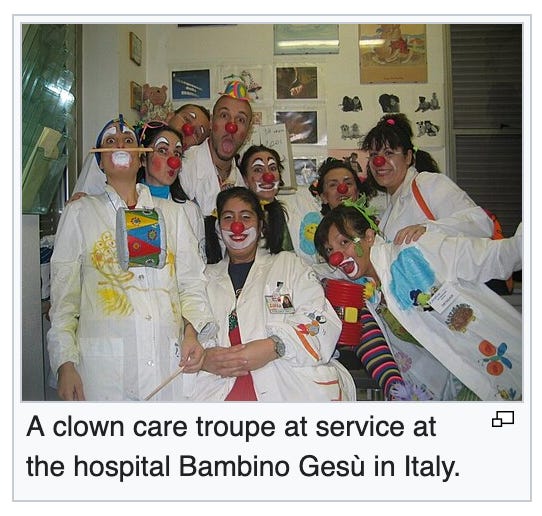

Clown Care was first introduced in the U.S. in the 1980s. Specially trained clowns visit hospitals in full clown regalia to spend time with patients (mostly children, but sometimes adults, too) and allow them a moment of reprieve from the stressful experience of being in a hospital.
Clowns play music, tell stories, perform magic tricks, and engage in all manner of clownery to help alleviate anxiety, fear, boredom, loneliness, pain, or whatever else patients may be experiencing during their time in the hospital.
Clown Care visits have been shown to help lift patients’ moods by injecting hope and humor into the otherwise mundane routine of a stay at the hospital. Hospital staff and families of patients experience a positive effect as well.
From Smithsonian:
The January 2013 issue of the Journal of Health Psychology published an Italian study that found that, in a randomized controlled trial, the presence of a therapy clown reduced pre-operative anxiety in children booked for minor surgery. Another Italian study, carried out in 2008 and published in the December 2011 issue of the Natural Medicine Journal found that children hospitalized for respiratory illnesses got better faster after playing with therapeutic clowns.
What really stands out to me about Clown Care is the psychological impact it has on children who may be enduring the most painful experience of their young lives. And more than that, I’m touched by the responsibility that these clowns feel to be a positive presence for the children and to make a meaningful impact on their lives.
To illustrate this point, I’m going to share a series of quotes from Frank Avruch, the first person to play Bozo on syndicated television. Please spend some time with each of these quotes:
Let’s talk about your public appearances outside of WHDH, which you mentioned earlier. Shopping centers, hospitals, charity events? Which ones were the most rewarding?
Probably visiting the kids in the hospital. [...] I had a little squeaker in my glove and pretend my nose is squeaking. I would tell a child, “You know, you got a squeak too” and touch their nose and press my glove squeaker. They couldn’t get over it.
At one point, Frank broke his hip playing racquetball and had to spend almost two months in the hospital, so he had another clown (Nozo) fill in for him.
The station said, How can we put a little spin on it? So I said, kids are always nervous about going to the hospital. How about a few segments of showing Bozo in the hospital? And Nozo says, “Now let’s see how my brother Bozo is doing.” And then we’d go to the hospital. And I’m in the hospital bed – remember, I can’t get out of bed – so I put on the wig and make-up. And we talked to the kids and tried to explain, “Hey kids, if you have to go to the hospital, it’s the best place. And you don’t have to be afraid.”
Looking back, what memories of being Bozo dominate?
I think what I remember most is the – I don’t want to say adulation, but the feeling I could see in the faces of the kids when they saw me in person. Their eyes would just pop out of their heads and they just wanted to touch me. I loved being able to accomplish and to teach, as I said, to bring a lot of fresh new ideas to the kids. As I say, I loved the role that I was handed and I think I made the most of it. When I meet people today, it’s amazing. It’s 40 years later and they say, “You were part of my childhood.”
How did playing Bozo change you?
I just felt the – I guess the word is love – the love that I received from complete strangers, young and old. Parents to young kids who just stared at me with awe. It just made me realize that I better watch what I do, ‘cause it’s like people who become an idol or an icon. People look up to you and you want them to see you in the best light. And I tried to lead my life that way, so I don’t do anything I would regret, as you have with so many of the celebrities today. They get into trouble too quickly and people just jump on it. What I learned is that I have to guard this [image] and just treat it as a very special thing. It’s a relationship that I have with the public, when I go out, to make sure I put my best foot forward. I think that way it has influenced my life. But maybe I was that way before Bozo, I don’t know. [laugh]
The most important aspect of hospital clowning, in my opinion, is the way it empowers the children at a point in their life when they are feeling more helpless than they have perhaps ever been.
From a Bozo biographer:
“...a cornerstone of Bozo was that he always interacted with children on their own terms. He didn’t talk down to them or try to relate to them in a way that he wanted.”
What’s the most important thing a clown does in the hospital?
The most important thing a clown does in the hospital is to transform the energy in the room. We are probably the only aspect in hospital that the children are in charge of. They are in charge of us. One of the things a clown can do is to be more helpless than the children, because then the children become the authorities and they help us. And we know from experience, that a child who helps us is helping him or herself.
In closing
If there’s only one thing you take away from this post, let it be this: clowns take silly very seriously.
We may play the part of the goofiest of goofballs, we may fall on our butts and get pies in our faces, but at the end of the day, it is a very serious art form.
But serious as it is, one thing clown is NOT is restrictive. Anyone can be a clown. You may already be a clown without realizing it.
We can all learn something from the core principles of clown:
Stop taking yourself so seriously
Embrace and nurture your inner child today and every day
Approach the world with more curiosity, wonder, and silliness
You hear people talk so much these days about “whimsy,” and I can think of few things more whimsical than literal clowns.
So what’s stopping you? Nobody needs a red nose and makeup to be a clown. All you need is openness to the unpredictability of the world, and you can start today.
So go ahead, and I’ll see you in clown town:
“Breathe in clown, breathe out reality.”

If you enjoyed this piece, consider tossing me a few bucks (I will spend it on snacks)
your writing makes me feel so happy and at home, thank you
wow. such a rich, in-depth piece. masterful work, my friend!