
Were you raised by wolves?
no but like literally though

We’re nearing the end of what my very cool and authoritative sources tell me has been “feral girl summer,” so I thought, what better way to commemorate that than by writing about actual feral girls (and boys)?

First, real quick, what is a feral child? Well, I’ll answer that question with another question: have you ever seen The Jungle Book? Yes? Ok, well Mowgli is a feral child.
Personally, I have never seen The Jungle Book and this whole time I thought he was raised by that bear who insisted honey and ants constituted the “bare necessities” of life, so I’m learning a lot today.
Anyway, feral children are exactly what they sound like. They were raised by animals and had little to no human contact growing up. They were never socialized into human society and often have a hard time adjusting.
Some former feral children are able to adapt to human society but unsurprisingly, many of them simply cannot. If you were literally raised by wolves I think you would understand.

As you may expect, a lot of these stories are really upsetting. We are mostly going to avoid those stories because this is a certified Fun Blog.
Of course, the idea of a child being raised by animals is kinda inherently upsetting but some of them are a lot less upsetting than others, and anyway I think you will forget all about how traumatic this must have been for the kids when I tell you about such examples as “the Hessian wolf children.”
These were three separate children all raised by wolves in Germany during the 1300s. Weird that it happened three separate times all so close to each other and then seemingly never again. What was going on in Germany during the 1300s that was so conducive to children being raised by wolves? Anyway
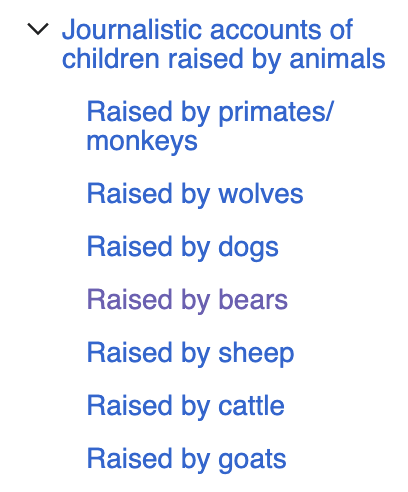
The first wolf child was raised by wolves from ages 3 to 7. And you know what? The wolves took great care of him. It’s said that they “surround[ed] him in cold weather, and fed him the best meat from the hunt.”
Later on, after he was “saved” from the wolves, he was able to acclimate to being a human, but even though he was sent to a literal royal court and probably had an awesome life, “he said that he preferred living with the wolves.”
The second wolf child really didn’t wanna stop being a wolf child so he bit and scratched the people who tried to capture him. He ran away on all fours, hid under a bench, and refused all the food they tried to give him, which is probably closely related to the fact that he then died shortly afterwards.
The third wolf child actually seems like he did pretty okay, and I only say that because some sources say he lived to age 80 after he stopped being a wolf child, so I have to assume things turned out alright for him.
However, other sources say he died immediatley after he was discovered, so who really knows? Life as a 14th-century Hessian wolf child was pretty tough no matter how you spin it.

There was another boy in Germany about 200 years later who was raised by cattle. Like Wolf Child #1, the cattle boy was also sent to a royal court, where it is said that he “continued his wild behavior” and did wild things like chasing and fighting dogs on all fours.
Eventually, though, cattle boy stopped being wild and even got married (to a human woman). And, um… I’m sorry… but can you imagine being this guy’s wife? Oh my god
In 1619, a 15-year-old Danish boy was found who “lived in the woods with bears” and was reported to be “distinguish[able] from [the bears] but by his shape." Eventually he learned how to speak human languages but claimed not to remember anything about living with the bears, which I think is total horseshit.
Like, I’m sorry, but we’re gonna go to all the trouble of rescuing the hairy Danish bear boy and he’s not gonna tell us any cool stories about his time with the bears? Send him back to the bears, I say. They can have him.
In the 1990s there was a little Russian boy named Ivan who lived with a roving pack of wild dogs for two years. Ivan gave the dogs scraps of food and in return, the dogs “made him their pack leader.”
This alpha male dog child was eventually captured by police after previously evading capture three times (“defended by the pack”).
The cops lured Ivan’s pack of dogs away from him by leaving bait in a restaurant kitchen, and once undefended, the alpha male could finally be neutered. (No I’m not gonna apologize for that weird sentence, complain to the FCC if you don’t like it)
Ivan eventually reentered society and joined the Russian Army. Wikipedia puts Ivan’s current age at 33, so it’s honestly very likely that Ivan is either currently fighting in Russia’s invasion of Ukraine or has already been killed doing so.
Daniel the Andes Goat Boy was discovered in (you guessed it) the Andes, living with goats, in the 1990s. It’s said that he “drank goat's milk and ate berries and roots” to survive, which is interesting because my Instagram feed this summer has been filled with picnics that look just like that.
One of the most interesting feral children was Victor of Aveyron. Victor’s origin is unclear, but he seems to have been a wild child basically his whole life until he was first found at age 9. After this, he escaped back to the woods “approximately eight times” before joining civilization for good at age 12.
Victor was scooped out of the woods around the same time that all the European intellectuals were trying to figure out what separated man from beast, which was honestly really unlucky timing for Victor because it meant the intellectuals all wanted to study him.
And by “study him” I mean… well… just read this:
“...an amazing number of miraculous feats were described about him, such as his being able to put his whole arm into boiling vats of water to remove apples without being burned. After all, no one had ever taught him that doing such a thing would cause him harm.”
Another intellectual guy took off all of Victor’s clothes and brought him outside into the snow (as one does). But instead of shivering and chattering his teeth and saying “brr” like a normal human child, Victor “began to frolic about in the nude,” which was probably an important scientific finding, I guess?
Victor sort of learned language but didn’t get far beyond a basic level:
“...his ear was not an organ for the appreciation of sounds, their articulations and their combinations; it was nothing but a simple means of self-preservation which warned of the approach of a dangerous animal or the fall of wild fruit.”
In all his human life, Victor managed to learn how to spell two entire phrases – lait ('milk') and Oh, Dieu ('Oh, God'), which is really all you need if you ask me.
My favorite feral child, and also one of the most extensively documented feral children I could find, is Marina Chapman.
At age 4, Marina was kidnapped and abandoned in the jungle, where she would live for the next five years with a colony of capuchin monkeys.
Marina became one with the monkeys – with them, she found food and companionship. She says she began to feel accepted by the monkeys “when they started to wee on my leg.” The monkeys groomed her hair and even saved her life on one occasion:
“I became very ill one day by eating the wrong plant – I think it was the tamarind. Then a monkey approached me. I wonder if I was annoying him with all my yelling and complaining. Then he started to push me. And he kept pushing. There was a little pond of water. And he pushed me there. He wasn’t angry with me. He pushed my head to the water and I must have drunk a lot. I vomited and I felt much better.”
Eventually, Marina would be discovered by hunters and brought back to human society, but life was not much easier for her there. She was initially sold to a brothel, but “they expelled her as she was too feral.” Marina spent some time living on the streets and was eventually enslaved by a family with mafia connections.
Thankfully, she soon escaped these horrid conditions and was taken in by a family in Bogotá, who in turn sent her to England along with their children to be a nanny.
Marina eventually met a man at church, and although they did not speak the same language and she did not tell him about the monkeys, they got married six months to the day after meeting each other.

Marina and her husband John had two children, and Marina made sure they grew up with monkey culture as a very important part of their life.
Marina groomed her children just like the monkeys groomed her. How did her kids feel about this? Well, one of her daughters simply recalled, "Oh yes, I loved to be groomed,” while the other gave more detail:
"A typical Saturday afternoon, if I'm just chilling on the sofa, she'll bring a cushion and tell me to put my head on it, and just groom me. I'll lay my head on her lap on the cushion and we'll watch a film and she'll just scratch.”
Speaking of scratching:
"John [husband] likes his back scratched," Marina says with a girly giggle. "And sometimes I'll pull the hair off his legs." Blimey, I say. Is there anything else I need to know about the family habits? Silence.
"She does bite," Joanna says. "She bites Dad."
Marina screeches with laughter. "I used to bite."
"I'm not going into details," John says with an embarrassed smile. "Let's just say she's never bitten me in anger. Neither is it in love! We're not masochists – it's just affection."
Marina also showed her kids how to climb trees and catch animals with their bare hands, which they would then keep as pets – “we had a couple of wild rabbits that eventually escaped and a seagull.”
When Marina’s story gained more media attention and she penned a book about her ordeal, people began to question whether she was telling the truth. Thankfully, though, she has some hard evidence: “They found Mum has strange jungle diseases lying dormant in her blood that she couldn’t possibly have if her story wasn’t true.”
There’s also this next thing, which is less concrete than a test for strange jungle diseases, but it’s honestly just as convincing to me as proof that this woman was raised by monkeys:
Vanessa Forero was just seven when she realised her mum was very different to anyone else’s.
Whenever the final bell rang at her primary school, the children would dash out to find their parents gossiping at the gates. But not Vanessa’s mum. She would usually be blowing a whistle and waving from the branches of a tree she had just climbed. “I knew other mums didn’t do that,” Vanessa recalls. “But that was just mum. My playful mum.”
Finally, I’ll wrap up today’s post by sharing that, for some reason, Kate McKinnon did an impression of Marina on SNL’s Weekend Update in 2013:
Honestly the sketch wasn’t very funny and thankfully the YouTube commenters agreed with me

Anyway, that’s everything you never wanted to know about feral children. Happy? Me neither. Thanks for reading!
If you enjoyed this piece, consider tossing me a few bucks (I will spend it on snacks)
Interesting point about the guy who forgot all about his time with the bears: apparently this was used to found a theory that language and memory are joined at the hip. So by learning language, the way the guy retained and recalled memories was formed by language, and thus any non-language memories rendered inaccessible. No idea if thats true but its a theory as to why no one really remembers their childhood.
I like some of the nerdy big-brain articles that adorn this platform. But it's nice to have a break from that every once in a while, and stop thinking about philosophy and politics, and come here.