
Do snowmen belong in museums?

Picture this: Wellington, New Zealand, 1978. In the middle of downtown sits an empty lot, formerly the site of a prominent hotel and a 24-hour cinema.
This lot has sat empty for two years, turning a once-bustling corner into an “eyesore” that “mars [the] city centre,” according to local media. In the absence of urgency from developers, only stagnation lives here.
If you’ve ever lived in a city plagued by empty lots like this, you surely know the feeling: the lot drags down everything around it. Potential could grow from this tract of Earth, but instead it hosts only litter and scrubby overgrowth. The vacancy is not just contained to the lot.
If the lot owner won’t do anything with the site, eventually, someone else is sure to come along who will.
What would you do with it?
Where emptiness lives, so too does opportunity. Barry Thomas realized this. So, he planted cabbages.
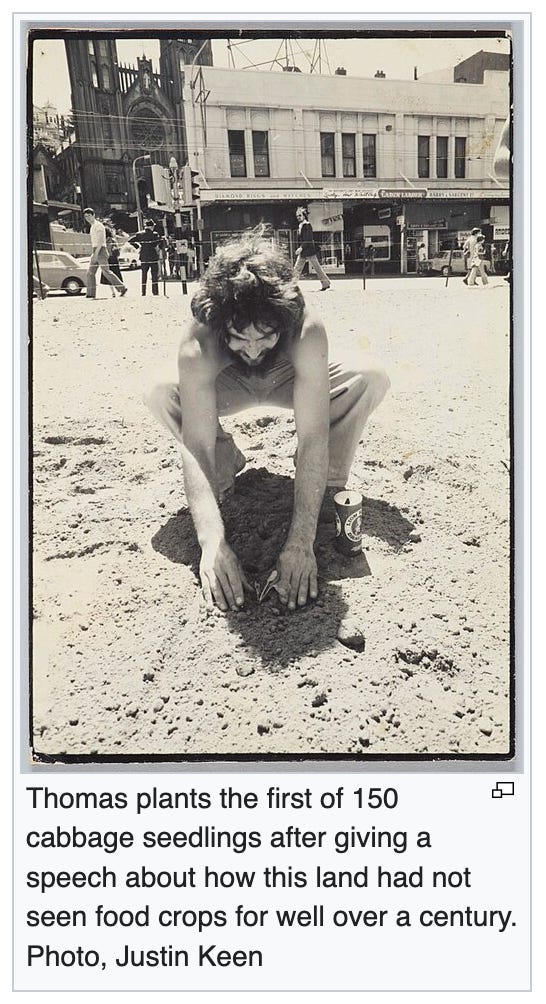
On January 4th, 1978, Barry and a group of New Zealand artists showed up with a truckload of topsoil, cut the fence around the site, and dumped the soil onto the ground.
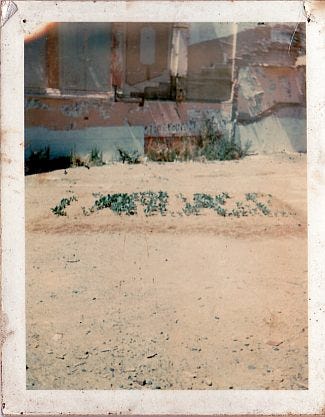
Together, they raked the soil into a square and planted 150 cabbage seedlings, spelling out the word “CABBAGE.” A fish shop next door let them borrow a hose to water the plants.
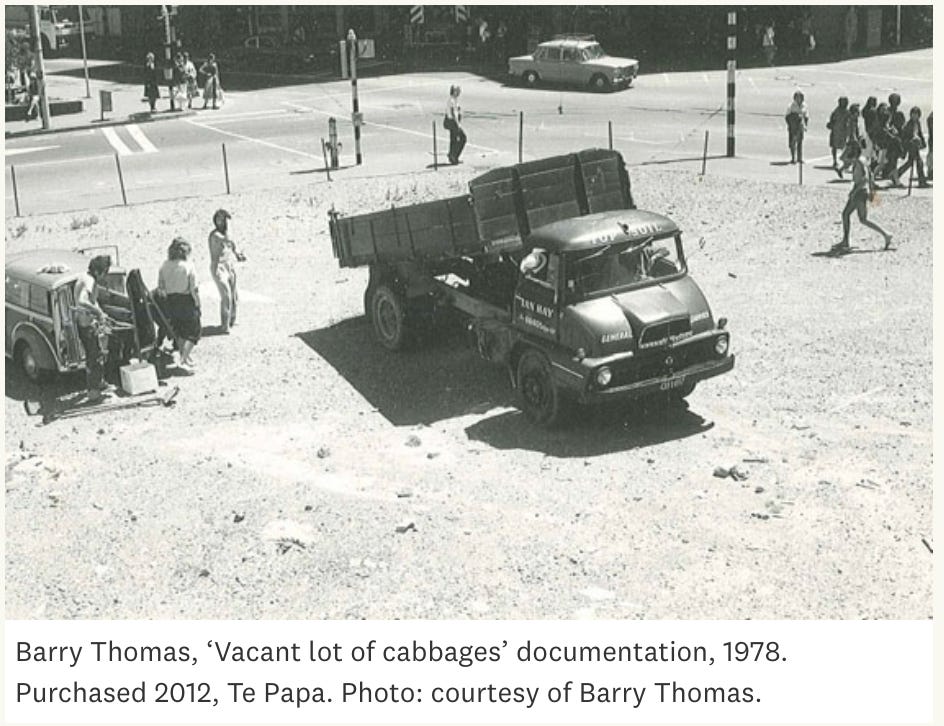
Then, Barry left. For three weeks, he enjoyed a holiday and let the cabbage patch take on a life of its own. It would be up to the Wellington community to decide what would come of the cabbage and the site as a whole.
Barry challenged the public, saying, “Whether they just leave them, or steal them, or run over them with motorbikes is part of the art because it is a reflection of our culture... It’s a unification of nature with the culture of our society.”
Wellington accepted this challenge. Artists, environmentalists, and community members flocked to the site, tending to the cabbage and bringing art of their own. The site quickly became a “soap box art corner,” attracting larger crowds than New Zealand’s national museum. Even the owner of the vacant lot expressed support for the project and said he hoped they had a bountiful harvest.

The cabbages ultimately remained for six months, culminating in a week-long festival to celebrate the harvest and the community that had made it happen.
The festival was alternately called “A Festival for Trees,” “the Last Roxy Show,” and “the Free Coleslaw Party,” and indeed featured free coleslaw made from fifty cabbages and seven bags of carrots. Leftover cabbage was sacrificially burned.
Today, the Vacant Lot of Cabbages is no longer vacant. Cabbage has not grown here for decades. But the legacy of the site lives on. It is cited as an influence on the Occupy movement and an important moment in the history of artists being embraced as social leaders. In 2012, New Zealand’s national museum purchased Barry’s archives of the Vacant Lot and described it as “an important moment in New Zealand’s art and social history.”
Why was the Vacant Lot of Cabbages such a success?
I’m going to let you in on a little secret, which is that people love stuff like this because it gives them permission to be expressive, to be silly, to use their imaginations in ways they usually don’t get to.
In Wellington’s case, this urge to act out always lived inside the community – Barry and his friends simply gave people a place where that behavior was not only tolerated, not only accepted, but celebrated, expected, rewarded. They tapped into the potential of creativity as a unifying force to great success.
Barry and co. took the initiative by being the ones to actually cut the fence and plant the cabbages, but beyond that, the project was totally outside of their control. I mean, Barry literally left – he said, It’s not up to me, this belongs to my neighbors. All they did was provide a canvas on which the community was invited to paint.
The saying “You can just do things” wasn’t popularized until decades after the Vacant Lot of Cabbages disappeared, but the Vacant Lot embodies this ethos perfectly. This project obviously never would have happened if they’d asked for permission first, but because they simply exercised their free will in a way that felt right to them, they shaped the culture in ways we still benefit from today.
Marcel Duchamp walked so I could also walk
In emphasizing the importance of the observer as part of the art, the Vacant Lot of Cabbages touched on ideas that Marcel Duchamp helped bring into the mainstream years earlier. But before we talk about that, we need to talk about my time in eighth-grade art class.
Once upon a time, all of the students in my class were given a block of light green foam about the size of a small toaster. Our teacher, Mr. Conway (not his real name), told us to do whatever we wanted with the foam. He said there were no wrong answers. Evidently, Mr. Conway had arrived at this conclusion before seeing what I had in mind.
Because what I had in mind was “Art Juice.” Instead of carving the block into pretty geometric shapes like the rest of my class, I decided to simply grind the foam block into a fine dust and deposit the remains into a clear plastic two-liter bottle.
To keep the foam from getting lonely, I also shoved various found miscellany into the bottle. A small wooden cube here, a disfigured LEGO man there. It was a genuine terrarium of adolescent apathy.
Now, did I dream up “Art Juice” because I was too lazy and uninspired to think of a serious idea that would have involved carving the block into recognizable shapes? Yes. But was I mad as hell when Mr. Conway called my bluff on this and gave me a very bad grade? Also yes.
Reader, this dastardly man gave me and my Art Juice a D. D!!! Can you believe that? Probably you can, yes. I absolutely phoned it in for this one. Worse than that, actually – I texted it in, if we’re being honest with ourselves. But a D? Come on Mr. Conway, be real.
I knew that in creating Art Juice I was making a mockery of Mr. Conway and his assignment, but I also knew that “art” is a very ambiguously defined thing and it didn’t really feel like his place as a middle school art teacher to tell me that he knew how to define it any better than I did. Like, bro, I was a literal child. We all know that children can tap into an innate sense of wonder and creativity that becomes fundamentally inaccessible once you turn 18. I was the authority on this matter. Anyway
Beyond a D grade, my experience from Art Juice also earned me a lifelong resentment of my middle school art teacher (genuinely go to hell, Mr. Conway) and a recalibrated understanding of what makes art, art. And I didn’t know it then, but by intentionally submitting for consideration a piece of art that I knew in my heart of hearts was absolute trash, I was notching my place in the long, proud history of Dadaism in the United States of America.
Years before Art Juice was birthed into this wild world by my scrawny child hands, Marcel Duchamp submitted a porcelain urinal to be included in an art exhibition.
The exhibition was being held by the Society of Independent Artists, a group of which Duchamp was a founding member. The Society was formed to promote avant-garde artists with minimal barriers to entry. As Wikipedia’s editors explain, “Exhibitions were to be open to anyone who wanted to display their work, and shows were without juries or prizes. In order to enter, one had to pay a six-dollar membership and entry fee.”
And that was it! You very much did not have to be an Important Artist to be included in their shows, and your work did not have to meet a certain standard. The message was simple: anyone can be an artist.
Except, it wasn’t so simple, as Duchamp learned. Signing the urinal with a pseudonym (“R. Mutt”), he submitted it to the exhibition and gave it the title Fountain. And despite the Society’s proclaimed open-mindedness to any art that came their way, they certainly did not expect anyone to submit a urinal.
Abiding by their stated policy, the Society could not reject Fountain, but they were absolutely not about to put it on prominent display, either. Here’s Duchamp to explain what happened:
No, not rejected. A work can’t be rejected by the Independents. It was simply suppressed. I was on the jury, but I wasn’t consulted, because the officials didn’t know that it was I who had sent it in … The Fountain was simply placed behind a partition and, for the duration of the exhibition, I didn’t know where it was. I couldn’t say that I had sent the thing, but I think the organizers knew it through gossip. No one dared mention it. I had a falling out with them, and retired from the organization.
Fountain and its fallout ignited immediate controversy. In a New York-based Dada journal, one artist argued, “Whether Mr Mutt with his own hands made the fountain or not has no importance. He CHOSE it. He took an ordinary article of life, placed it so that its useful significance disappeared under the new title and point of view – created a new thought for that object.”
The artist continued, plainly stating, “The only works of art America has given are her plumbing and her bridges.”
For his part, Duchamp defended the artistic merit behind pieces like Fountain by stating they are “everyday objects raised to the dignity of a work of art by the artist’s act of choice.”
Duchamp championed “cerebral art” over “retinal art,” advocating art that engaged the mind and challenged the viewer rather than catering to the eye by focusing purely on easy aesthetic values.
Apparently, Fountain may have been a tad too challenging – it was lost after the exhibition, likely thrown out by someone who thought it was garbage. Oops!
So, was Fountain art? Did it have meaning? Opinions vary here.
Of course, the organizers of the exhibition very much did not consider Fountain to be art. Many in today’s world would surely agree with them, likely including some of you reading this now. But others defend the piece, to varying degrees.
Philosopher Stephen Hicks:
The artist is not a great creator—Duchamp went shopping at a plumbing store. The artwork is not a special object—it was mass-produced in a factory. The experience of art is not exciting and ennobling—at best it is puzzling and mostly leaves one with a sense of distaste. But over and above that, Duchamp did not select just any ready-made object to display. In selecting the urinal, his message was clear: Art is something you piss on.
Duchamp biographer Calvin Tomkins shares a quote from one of the artist’s friends:
Arensberg had referred to a ‘lovely form’ and it does not take much stretching of the imagination to see in the upside-down urinal’s gently flowing curves the veiled head of a classic Renaissance Madonna or a seated Buddha or, perhaps more to the point, one of Brâncuși’s polished erotic forms.
And, listen… I don’t wanna be too mean to Arensberg here… but I really think he managed to miss the point about as much as you possibly could. He’s ascribing artistic value to a urinal that I believe was specifically chosen by Duchamp for its almost complete lack thereof. Like, no, dude – it does not evoke a classic Renaissance Madonna. It is a urinal.

Personally, I think Fountain is very similar to the Vacant Lot of Cabbages in that the artistic value does not come from the physical work itself, but from the collective public reaction to it.
The urinal, like the cabbages, was simply a catalyst for the true art to manifest itself in the public space. Both were canvases for the receivers of the art to create the art.
In the same vein, Art Juice had the effect of exposing Mr. Conway as a phony and a fraud and a likely Duchamp hater. I will be bitter until the day I die.
Anyway, over 100 years later, Fountain is remembered as one of the most important pieces of art created in the 20th century. The Independent said that with Fountain, “Duchamp invented conceptual art and severed for ever the traditional link between the artist’s labour and the merit of the work.”
In 2004, Fountain was voted the most influential artwork of the 20th century by 500 art world professionals, which is rather ironic considering the whole reason it rose to prominence in the first place was precisely because it was rejected by a group of art world professionals.
Sixteen replicas of Fountain were commissioned from Duchamp and live in museums around the world today. These replicas have the unfortunate problem of being targeted by “performance artists” who think they’re doing important art themselves by urinating into the Fountain replicas.
These criminal pissers defend their acts by stating that Duchamp himself would have approved of their subversiveness. And, like… I see their point… I don’t necessarily disagree… but they really need to stop pissing in the middle of museum galleries. That is disgusting. Please stop. If you are reading this post and you have ever urinated on/in an artwork in a gallery you were most likely in the wrong. Okay. Moving on.
Frosty the Snowman is canonically Italian
Is a snowman art? Please consider your answer to this question before continuing on to the next sentence.
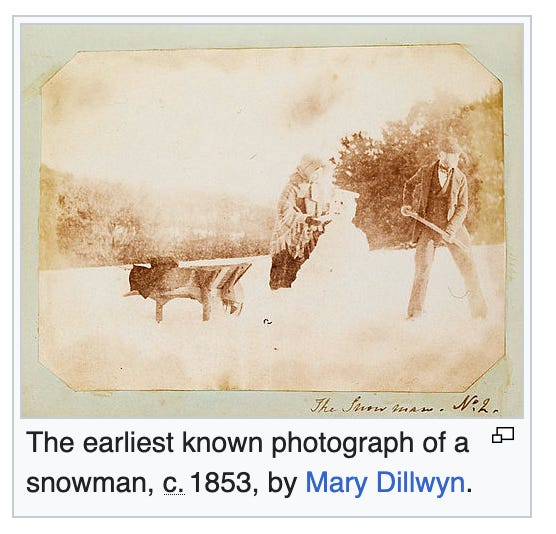
Okay, got your answer? Great. Now, is a snowman art if it was built by Michelangelo?
It’s not just a silly hypothetical – the Renaissance master Michelangelo, better known for the David and the immaculate ceiling of the Sistine Chapel, was once commissioned to build a snowman by the Lord of Florence.
In the winter of 1494, a bunch of snow fell on Florence, and Piero de’ Medici said, “You know what would be awesome? A snowman. And I know just the man for the job.”
A Renaissance art historian noted that this “statue of snow … was very beautiful,” but as The Guardian reports, “Nothing else is known about the snowman. All that is known for certain is that it happened; it was very beautiful; and it melted.”
Do we think Michelangelo included the snowman in his professional portfolio? Was Pope Clement VII thinking about the snowman when he commissioned ol’ Mikey to paint The Last Judgment?
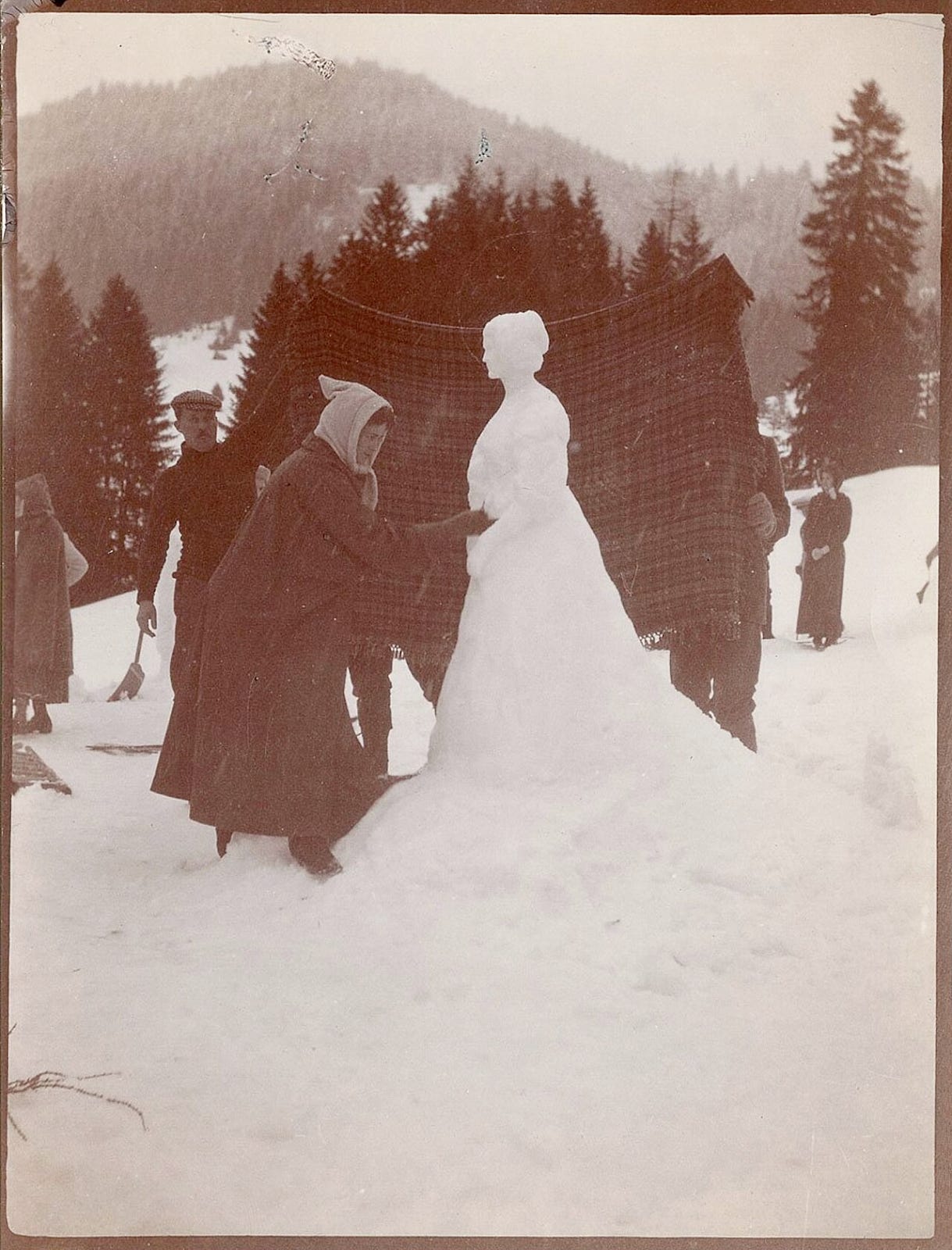
Snowmen have been part of human culture for hundreds of years. The earliest known documentation of a snowman is an antisemitic illustration found in the margins of a 1380 Christian prayer book in the Dutch national library.
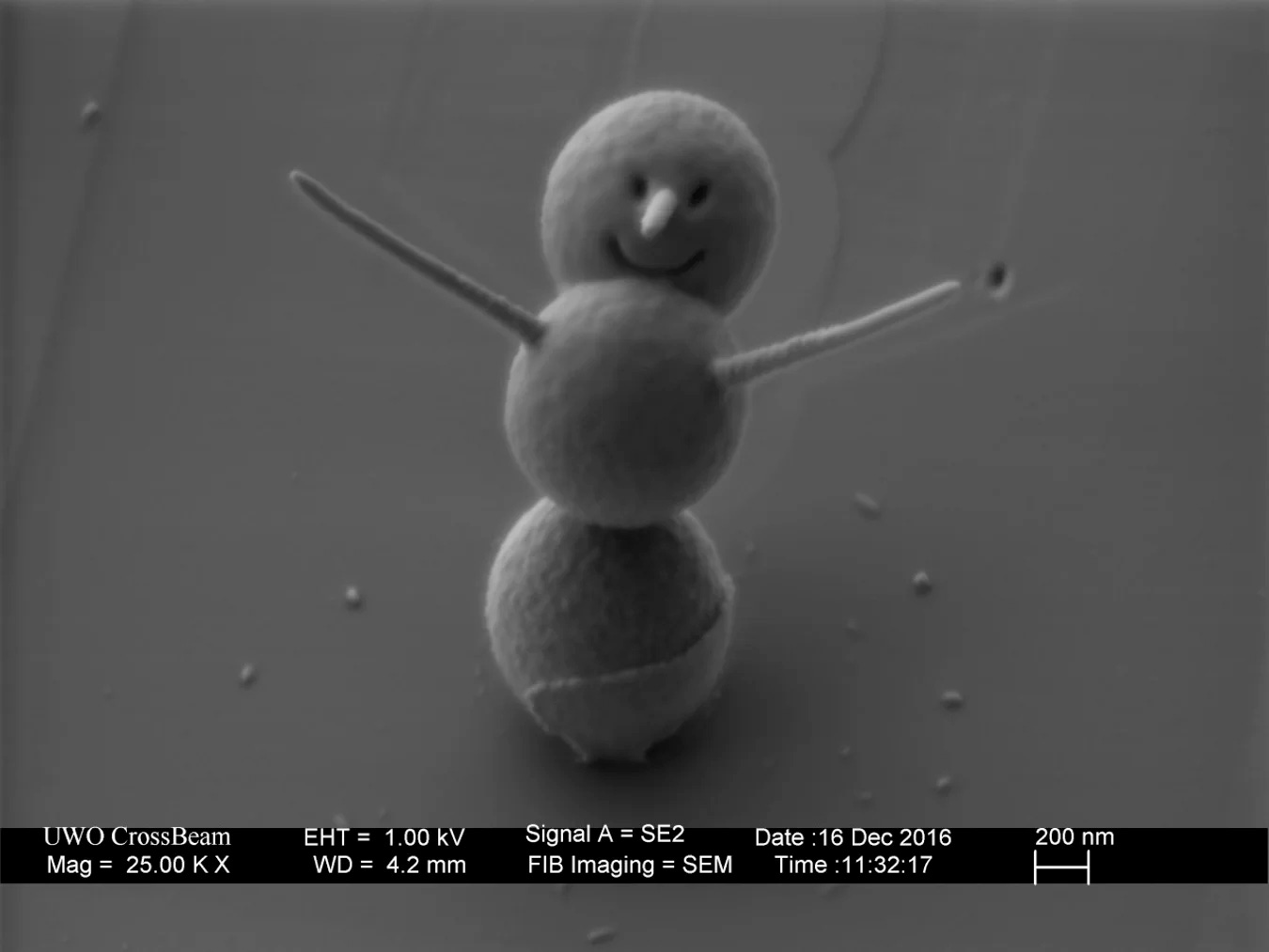
Since then, snowman technology has advanced to such an extent that it is honestly unnecessary. Have you ever considered building a snowman with a focused ion beam? No? Please don’t tell Elsa this is an option.


.jpg)

Todd Simpson and his colleagues at Ontario’s Western University took it upon themselves to build the world’s smallest snowman using a technology that is more typically utilized in semiconductor manufacturing or microscopy sample preparation.
The snowman’s body is made from “three .9-micron silica spheres placed one on top of another.”
And if you, like me, have absolutely zero reference for how small that is, here are the science boys to break it down for us:
So how small is it? It is about three microns tall. By comparison, one strand of human hair is 75 microns thick and the snowman is about half the size of a red blood cell. It is estimated the smallest grains of sand are about 60 microns.
But we’ll return to the traditional method of snowman construction for today’s final tale, the greatest snowman story in human history.
It was the winter of 1511 and it was COLD. We’re talking six straight weeks of freezing weather. We’re talking “Little Ice Age” levels of chilly. And in Brussels, Belgium, the common people were not doing well. They were poor, hungry, and cold, and they wanted the government to do something about it.
The government recognized these sky-high levels of suck and said, “Yeah, you know what? We’ll help you guys out.”
Did they give them food? No. Firewood? No. Literally anything that had a material impact on their general welfare? Haha, no. They gave them a snowman festival.
The benevolent government of Brussels said, “You know what would help distract you guys from the fact that you are so, so cold and very, very hungry? Going outside in the freezing weather and burning precious calories by building funny little snow guys.”
And they did! But just not in the way that the government intended.
In what is now known as the Miracle of 1511, the good people of Brussels banded together to populate the city with more than 100 “pornographic snow sculptures, as well as graphic caricatures of prominent citizens.”
Some of the snow scenes were fairly PG, such as a snow dentist and a snow mermaid, but “[a]ll told, … more than half the scenes were sexual or scatological in nature.”
Some favorite snow citizens included:
a snownun seducing a snowman
snow prostitutes enticing people into the city’s red light district
a snowman and a snowwoman having sex in front of the town fountain
a naked snowboy urinating into the mouth of a drunken snowman.
And although this early example of political protest may well have annoyed the government, I’d argue it likely had the exact effect they intended upon the citizenry, albeit in a rather perverse way. Though it didn’t warm their bellies or their homes, the creation of a common enemy to unite against likely warmed their spirits and helped them endure the harsh winter.
I must give the disclaimer that this is pure speculation on my part – I don’t snow for sure the impact that it had – but we love a common enemy, don’t we?
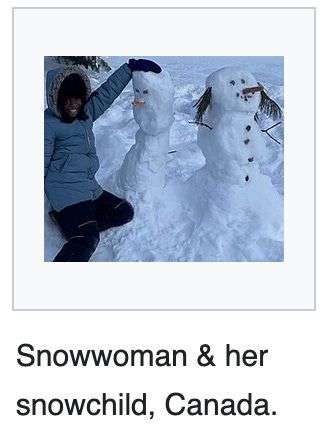
It’s a story as old as time and as human as I can imagine – in the absence of support from the powers that be, we find warmth in community. And I don’t know about you, but I can hardly think of anything more artistic than that.
That’s all for this week! Go out and make some art today, whatever that means to you. Until next time, friends :)

If you enjoyed this piece, consider tossing me a few bucks (I will spend it on snacks)
I've got some cabbage seedlings left over from work, just gotta find me a plot now i suppose
Loved the article, I actually downloaded it onto me off-brand e-reader because I felt like it, but came back here to comment hehe
I have a funny snowman related story to tell you. But I'll have to send it via DM LOL