

Do bubblers prevent alcoholism?
if only it were so simple

One of the world’s oldest water fountains is located in Nepal and has been in continuous use since 570 CE.
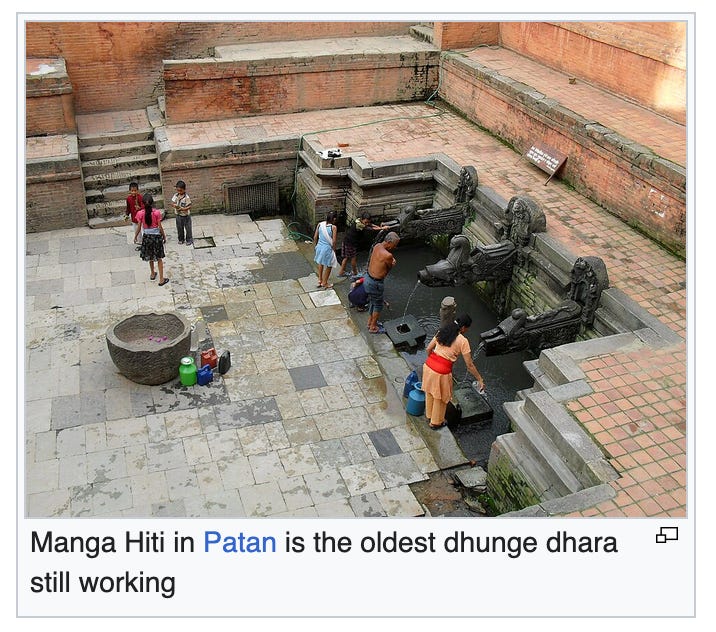
This is a dhunge dhara, literally “stone faucet,” and it supplies water from underground sources to any thirsty people who arrive at its spout. Contrary to what I assumed when I first saw these things, you are not required to answer a riddle to receive water, but you can forgive me for thinking so. I mean, just look at this thing:
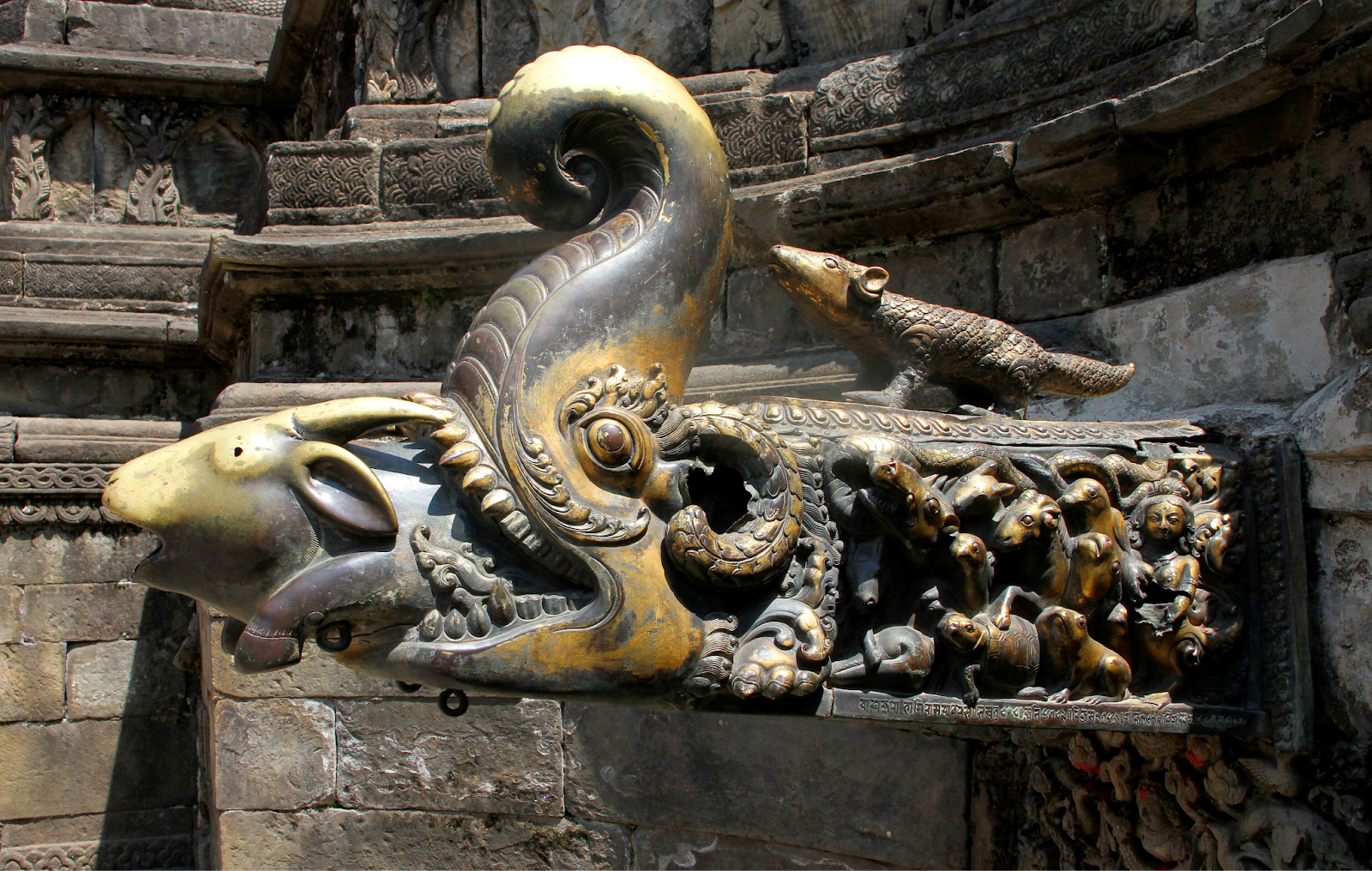
Hundreds of these fountains are still in use today and serve a significant portion of Nepal’s population. The dhunge dharas in Kathmandu, Nepal’s capital, produced 382,399 liters per day (about 100,000 gallons) in 2019.
After the devastating 2015 earthquake in Nepal, regular water service was unavailable for many Nepalese people and dhunge dharas became the sole source of water until infrastructure could be repaired.
More than just being a reliable source of clean drinking water, dhunge dharas occupy an important place in Nepalese culture as community hubs, sites of religious importance, and living testaments to their shared heritage.
And this quality is not unique to Nepal – as we look across the world, we see again and again water fountains as sources of not just water, but cultural value as well.
In Armenia, people love their pulpulaks. This very cute name comes from the combination of “pul-pul,” an onomatopoeic descriptor for the sound of murmuring water, and “ak,” meaning “water source.”
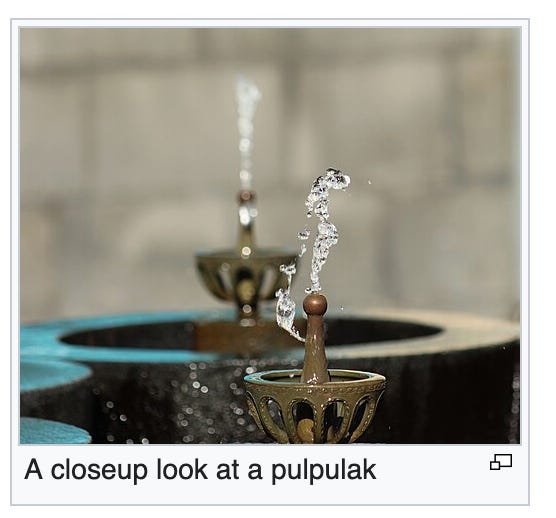
Pulpulaks are sometimes built as memorials to dead relatives, and drinking from one imparts a blessing unto the person in whose memory the pulpulak was constructed.
Pulpulaks can be social hubs, too. People will tell friends or romantic interests to meet them at the pulpulak, which I think qualifies the pulpulak as a third place? Someone should write a Substack essay about that.
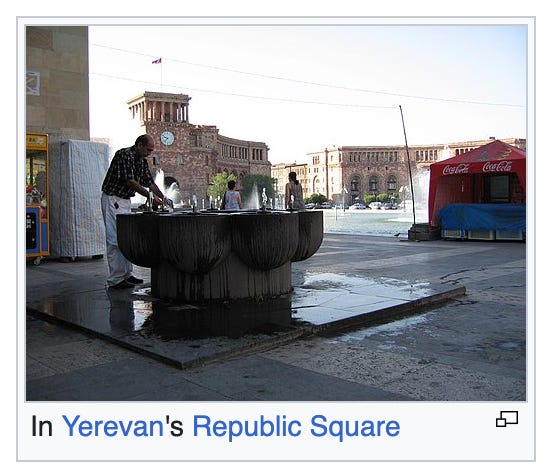
Water fountains have historically been popular meeting places for people in numerous cultures, because, as it turns out, we all need water. Who knew?
Unfortunately, this also makes populations susceptible to devastation when something bad happens to that water source. Ever heard of cholera? Spoiler alert: it’s not good!
You may well already know the story, but in 1854, a London water pump was contaminated by a nearby cesspool filled with cholera bacteria. A huge cholera outbreak occurred and 616 people died.
The death count was especially high because at the time, London was very overcrowded and had insufficient water resources to serve its ballooning population. But after the tragedy of the 1854 cholera outbreak, steps were gradually taken by the government to improve this situation.
Such measures included:
Mandating water filtration (smart)
Requiring that intakes for drinking water on the Thames be moved upstream from sewage pipes (very smart)
Beyond government action, though, philanthropy was also essential to improving the water situation in London. And this is where we meet the first main character of today’s post, the Metropolitan Free Drinking Fountain Association.
Led by Samuel Gurney and Edward Thomas Wakefield, the Association was committed to doing exactly what you would expect given its name – providing free drinking fountains to the people of London.
They built their first fountain in 1859 and it was an immediate hit, being utilized by 7,000 people a day.
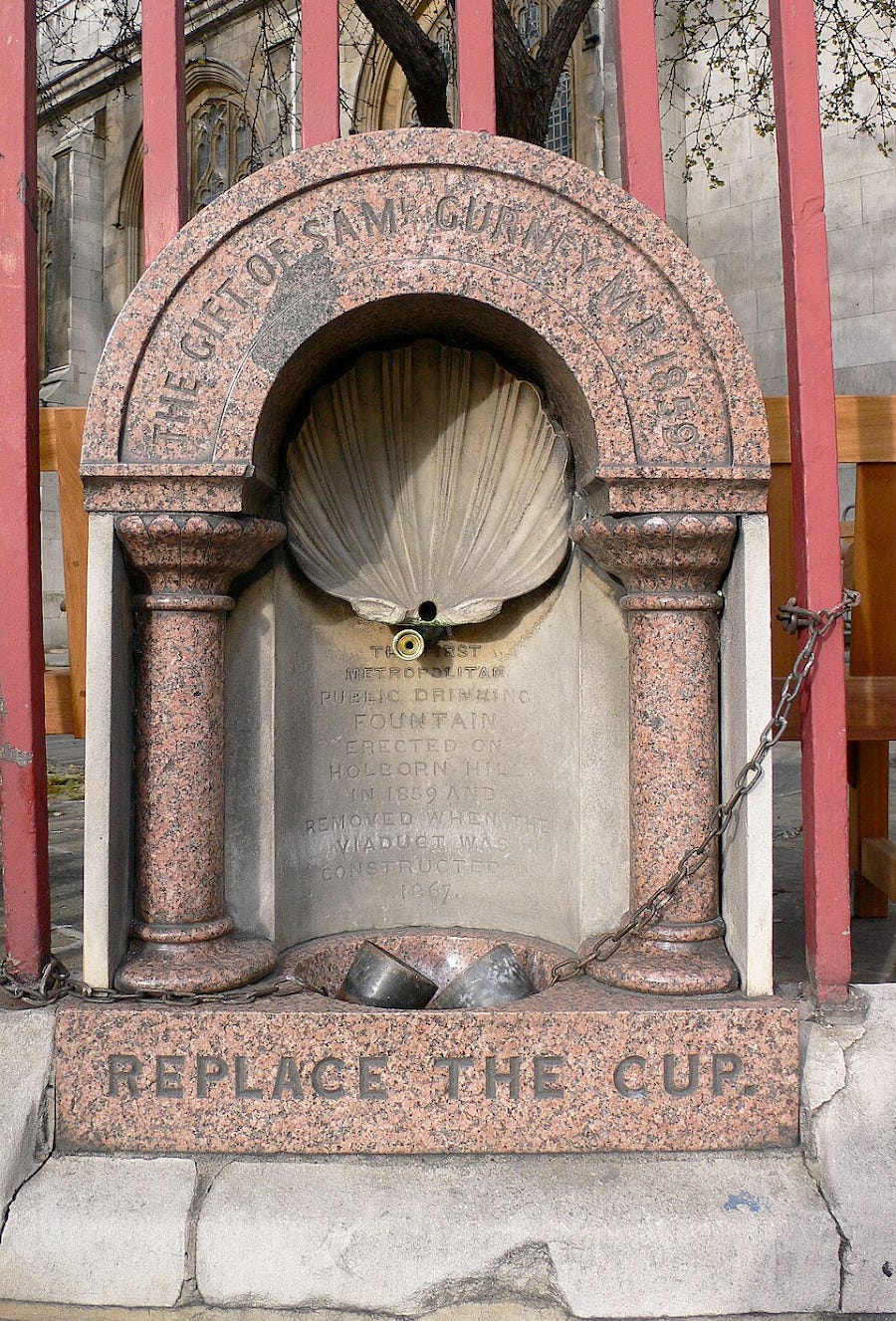
As you can see, this fountain was unlike the fountains we are used to today, namely in that it had a “common cup” that everyone drank from. And before you ask, yes, this was exactly as gross and unhygienic as you would think.
Mercifully, at some point between 1859 and present day, “people finally realized that common cups were completely disgusting and insane,” and we are blessed today with the freestanding streams that we are challenged to slurp out of midair. A marginally better arrangement if you ask me.
Anyway, the Association grew and grew over the years, thanks in part to its connection to the temperance movement. At this point in history, beer was generally safer to drink than water, so much so that choosing beer over water could genuinely be framed as a health-conscious decision.
Non-alcoholic alternatives like coffee and tea were simply too expensive to be viable options on the regular for most people, so the free water fountains came in clutch vis-à-vis reducing widespread societal alcoholism.
By 1879, twenty years after the first free water fountain was built in London, it was estimated by Charles Dickens, Jr. that the city had almost 800 water fountains and troughs serving 300,000 people daily, along with 1,800 horses.
Oh, right, I forgot to tell you about the horses. In 1867, the Metropolitan Free Drinking Fountain Association changed its name to the Metropolitan Drinking Fountain and Cattle Trough Association on account of they wanted to give the horses water too.
The reason for this was more than just the philanthropists of London being secret horse girls. Of course, before the automobile came along, horses were extremely important to the general functioning of society, so it was important to keep them well fed and hydrated. The free horse troughs have been described as Victorian-era gas stations, but it has gone unreported whether they also sold lottery tickets and Gardettos.
Now, London was not alone in wanting to feed its residents water rather than letting them all get wasted in the streets every single day. For another example of an ambitious water-based commitment to teetotalism, we must travel to the grand metropolis of Portland, Oregon.
One day, wealthy Portland businessman Simon Benson woke up and said to himself, “You know what? I’d really like it if my employees stopped boozing it up in the middle of the workday,” so he gave the city of Portland $10,000 to build twenty of these dope bronze fountains, today known as “Benson Bubblers.”
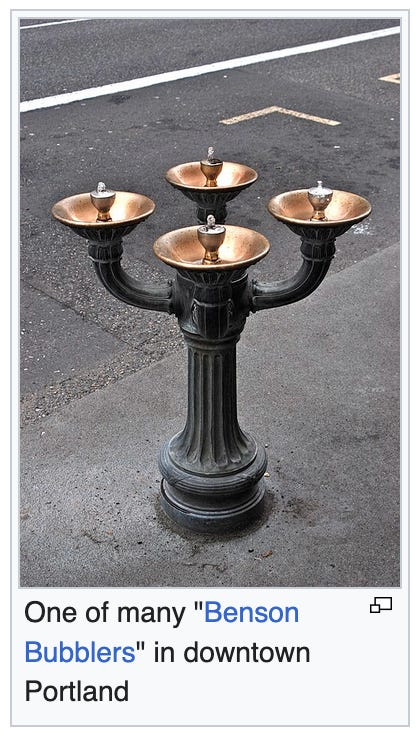
Were the Benson Bubblers successful in stopping people from getting drunk on their lunch break? Well, I asked one of my Portland-based subscribers for their thoughts on the fountains and they said, “i have heard that back in the day they were for men to rinse their beer breath before returning to work,” so uhhhh that’s gonna be a maybe.
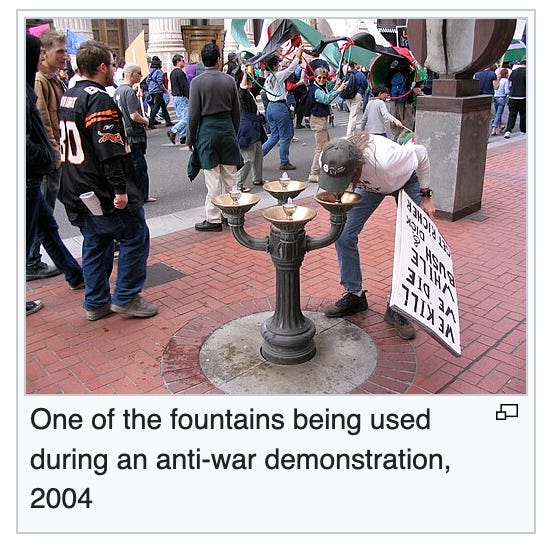
The Benson Bubblers are still around today, and the city of Portland estimates that they dispense nearly 100,000 gallons of water daily.
Do you love beer? How about a statue instead?
If there were a Mount Rushmore of dudes who built water fountains to stop people from drinking alcohol so much, there is one man who would deserve more than anyone else to occupy a place of honor there, and that man is Henry Cogswell.
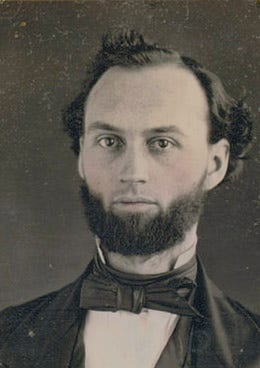
Our friend Cogswell was one of San Francisco’s first millionaires, and he made his fortune in the teeth business (dentist). Cogswell was described by one author as “not really a bad sort […] His chief fault seems to be hubris in believing that his statuary would inspire men to drink more water.” More on that later.
I’m sure I sound like a broken record at this point, but Cogswell had this incredible idea that if people had easier access to water, they wouldn’t drink alcohol so much. Cogswell wanted to build one water fountain for every 100 saloons in the United States, and while he definitely failed at this overly-ambitious assignment, he sure tried his best!
Something I should mention that has kinda gone unspoken until this point in the story is that all these donations, philanthropic as they were, could never really be described as selfless. These dudes always had an agenda to push or a message to impart. Oftentimes with the temperance fountains, the message was simply, “Drink less alcohol and pay more attention to God,” but Henry Cogswell took it one step further. His message was, “Drink less alcohol and pay more attention to God, and also to Henry Cogswell.”
You see, many of Henry Cogswell’s fountains were topped with the likeness of none other than Henry Cogswell himself.
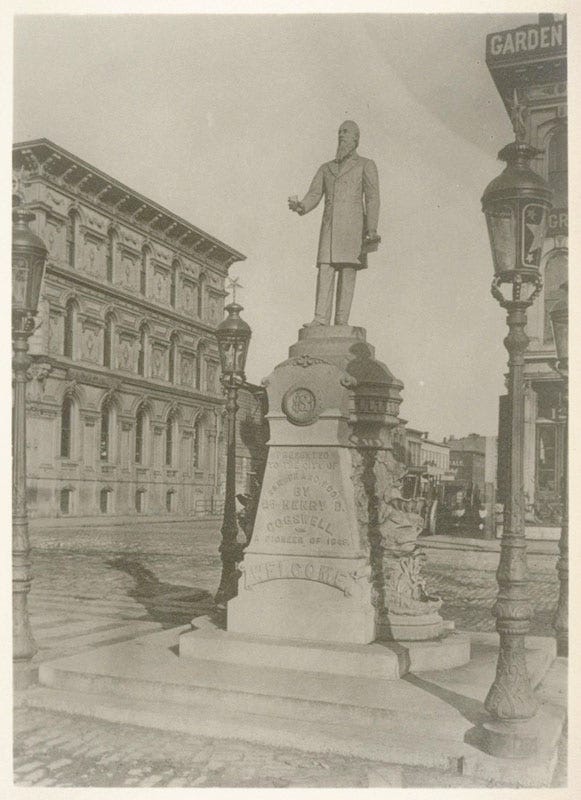
Unsurprisingly, people did not exactly love this blatant display of vanity. It’s time for a Cogswell fountain roll call!
Rockville, Connecticut? Thrown into a lake.
Dubuque, Iowa? Toppled by an angry mob and entombed beneath a sidewalk.
San Francisco, California? Also toppled by an angry mob, called “a lynch party of self-professed art lovers.”
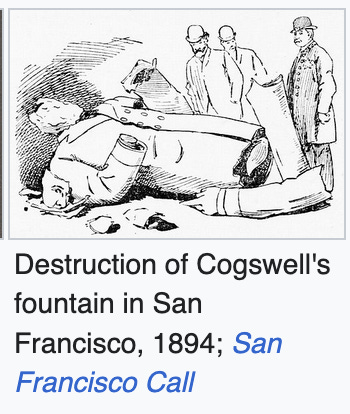
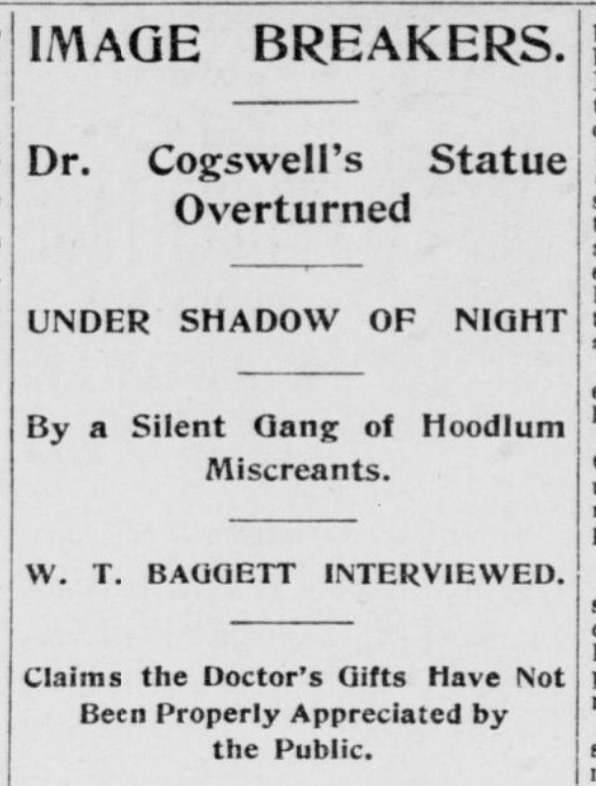
The good people of San Francisco haaaaated this statue. In an 1893 edition of the city’s Morning Call, it was said, “In a moment of delirium the [Board of Supervisors] allowed one of the fountains to be placed at Market and California streets, where it has suffered from contact with the world.”
I really cannot emphasize enough how much people despised these statues. In Washington, D.C., the Cogswell fountain “was considered so ugly that it led to the formation of fine arts commissions in other parts of the country to keep municipalities from having to deal with such gifts.”
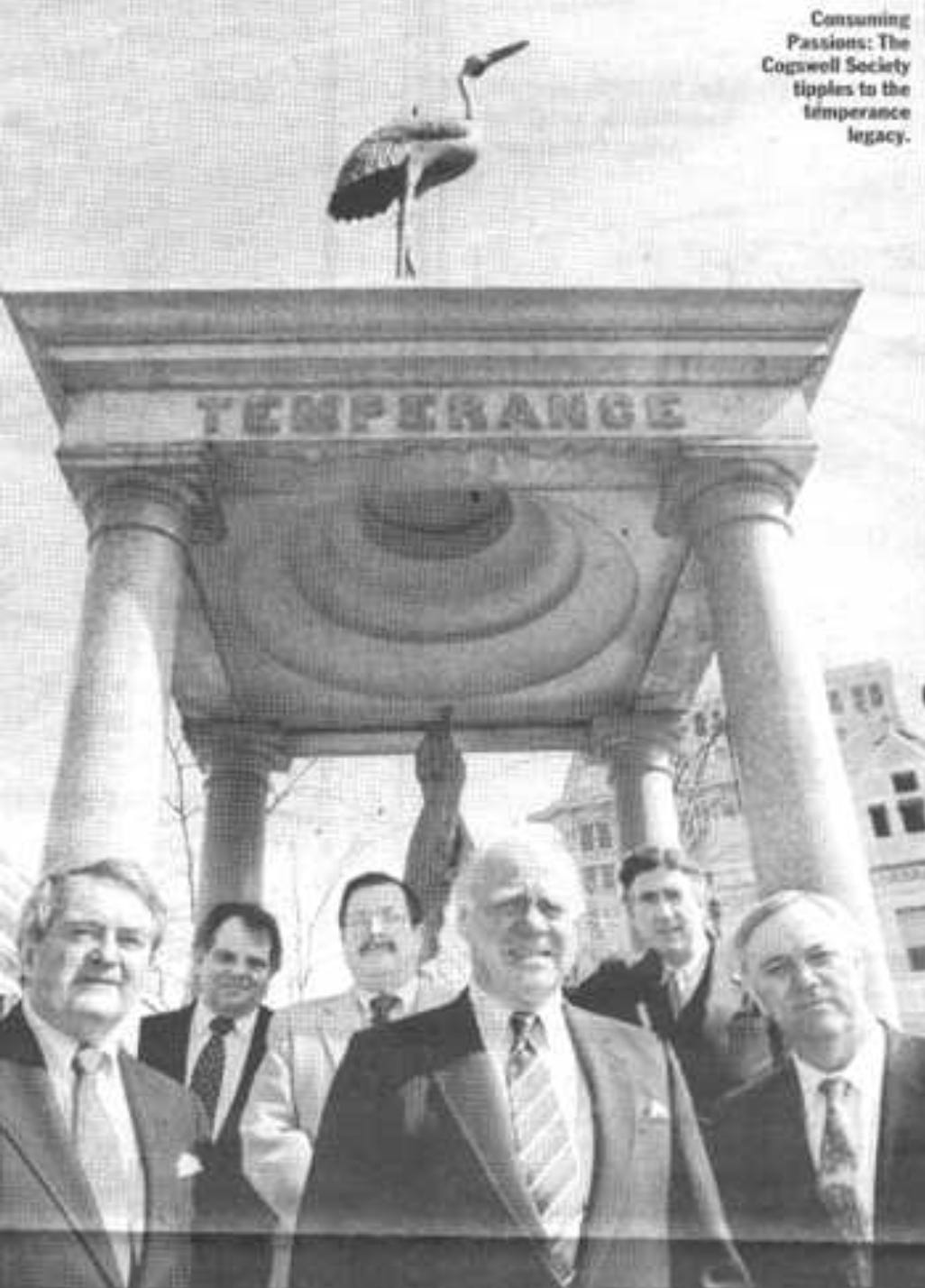
The statue in question:
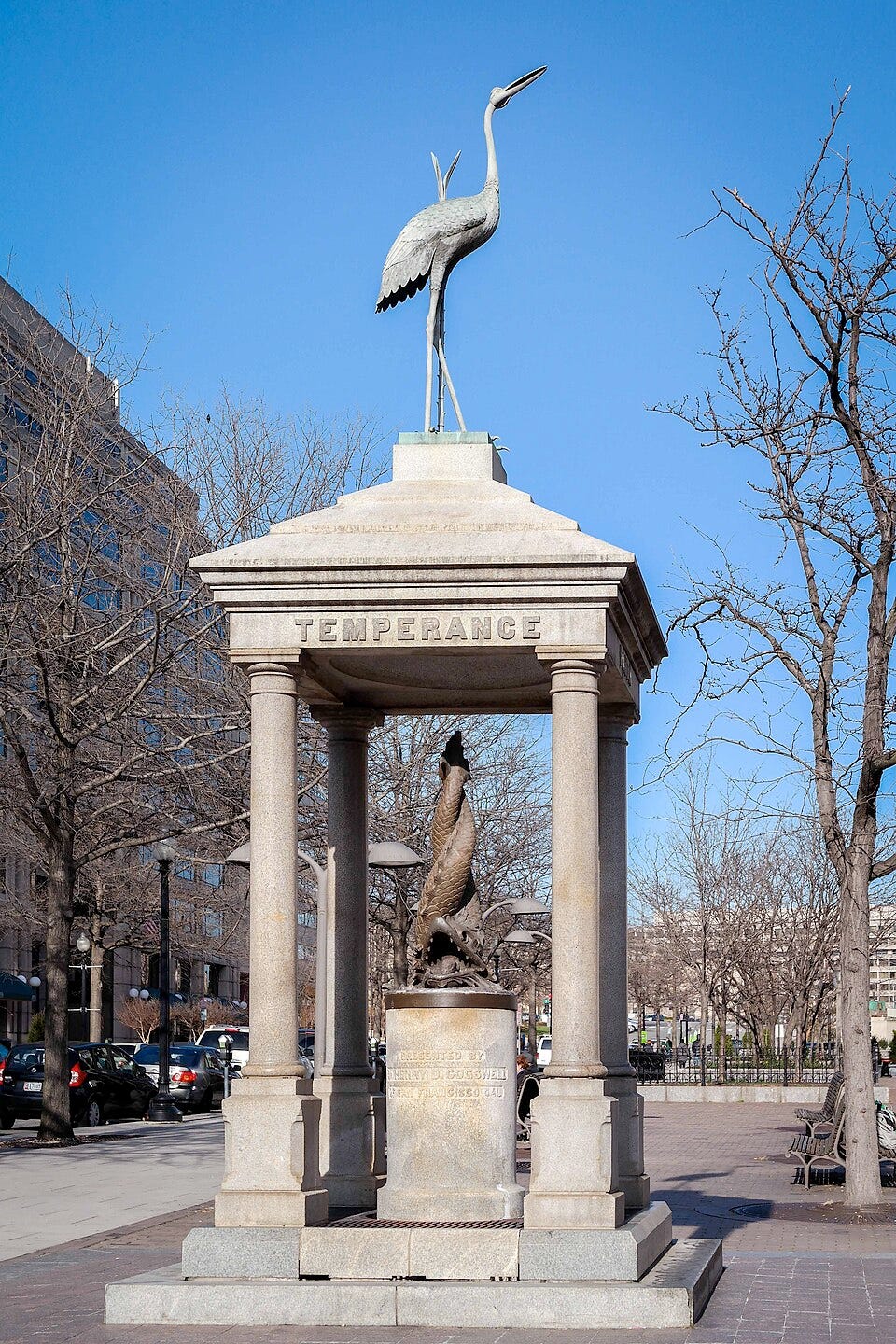
What do you think, does this statue deserve all the hate it has received? I will say for my own part, I don’t find it to be astoundingly ugly, just extremely forgettable. Or, as Wikipedia’s editors put it, “thousands of tourists and workers walk past daily without noticing it.”
Now, if you do find this statue very ugly but also oddly charming, you are not alone. Meet the Cogswell Society.
This eccentric group of FTC employees, founded in 1972, “found the sculpture so uniquely ugly that they assigned themselves the mission of guarding it from vandals, graffiti artists, and unappreciative bureaucrats.”
Their reason for loving the statue is as simple as “it was next door to their office building” but they’ve formed a beautiful community around their shared admiration of it.
From The New York Times:
[The Cogswell Society is] …ostensibly dedicated to “the study of man’s excesses and the lack of temperance in past and present cultures.” When last heard from, society members held monthly meetings, rarely involving water, at which they stood on one leg like the fountain’s heron, raised their glasses and pledged: “To temperance, I’ll drink to that.”
Want to join the Cogswell Society? Well, there are two problems with that. One, I don’t know whether the group even exists anymore. Two, membership is incredibly exclusive.
From a 1992 Washington City Paper article:
Infiltrating their ranks is no easy task. At any given time, there are exactly 12 active members, selected by unanimous vote of their peers. A 13th seat is kept open in the never-ending hunt for the perfect Cogswellian.
At one point, the society’s members learned of an enticing candidate who worked in the Treasury Department – the great-nephew of none other than Henry Cogswell himself – so they invited him to a meeting.
“He was so insulted that he left during the soup.”
Now, again, I have no idea whether the Cogswell Society still exists today. Many of its original members are likely dead today. Of course, it was a very small group with a barely perceptible footprint so it makes sense that if they’re still going, they would be flying extremely under the radar. But I hope they’re still around. I hope they’re still looking for their 13th member.
Because we need groups like this! Like, it’s funny that they have such strong feelings about this stupid ugly statue, but of course, it’s not really about that. It’s about friendship! It’s about community. It’s about the boys getting together for a drink after work and talking about this dumb bird statue for five seconds but then moving on to talk about much more important things. How’s your day going? How’s your family? What’s on your mind?
There have been a million Substack essays written about how we need more of this exact kind of thing and they are all right. Communities are fueled by the connections that exist within them. We sustain each other through the bonds we form. Let this serve as your call to action to go find a butt-ugly statue in your community and create a club centered around appreciation/defense of said statue.
I love you all, be kind to your neighbors, thanks for reading. Until next time :)

.jpg)


.jpg)


.jpg)
If you enjoyed this piece, consider tossing me a few bucks (I will spend it on snacks)
😂 i am so glad to have contributed
deep dive on gardettos next??
Well that was fun!!